 |
|
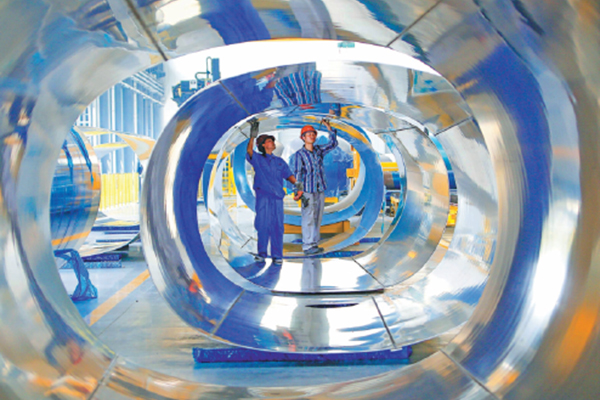
Workers check the steel tanks used to produce a special type of tanker in Tianming Special Vehicle Manufacturing Company, which mainly exports to the Middle East, South America and Africa, in Tuowang Port Industry Zone in Lianyungang, east China's Jiangsu province in June. The competitive manufacturing industry remains a pillar of the Chinese economy. [Photo/China Daily] |
Despite adjusting its structure, it is still a driver for the world
China's economic growth has slowed in recent years, but its contribution to the world economy remains significantly more than that of other countries', which signifies the vital role it has played in maintaining global economic vitality, say analysts.
China's GDP growth was 6.9 percent in 2015, the slowest in 25 years. In the first half of 2016, it registered an even lower GDP growth of 6.7 percent, and the International Monetary Fund forecast in July that China's GDP growth this year could be 6.6 percent, triggering concerns that the country might be caught in the low-rate growth trap for some time.
Relative to other countries, especially the developed ones, however, China's growth is quite impressive and it has continued to make a significant contribution to global growth. In the 1980s and early 1990s, emerging market economies started playing a larger role in global growth, contributing about 25 percent to world economic growth. From the late 1990s until now, emerging-market economies have contributed about 70 percent to global economic growth, with China's contribution estimated at about 30 percent, says Wang Guangqian, president of the Central University of Finance and Economics.
Although estimates vary, researchers generally agree China's contribution to global economic growth in recent years ranges from 25 percent to 40 percent. From 2011 to 2015, China's average GDP growth was 7.3 percent while the global average was only 2.4 percent, with the United States, Japan and Germany registering 2.4 percent, minus 0.1 percent and 1.6 percent growth, says Wan Xiangyu, a researcher at the Institute of Quantitative and Technical Economics of the Chinese Academy of Social Sciences. During that period, he says, China contributed 25 percent to global GDP growth.
In 2014 alone, China contributed 27.8 percent to global growth, making it the top contributor that year, says Ding Yifan, a researcher at the Development Research Center of the State Council, China's Cabinet. In 2015, China contributed about 33 percent to global growth, the IMF said in a report in August.
Although China's economic growth rate has slowed, given its fast expansion of overall scale, the Chinese economy's contribution to global growth has become even more significant.
China has achieved such a growth against the backdrop of the fragile global economic recovery and domestic economic restructuring.
The low global growth has affected the demand for China's exports, one of the traditional growth engines for the Chinese economy, analysts say. It has also affected the flow of capital into the country.
On the domestic front, China has been unswervingly pushing forward economic restructuring to rebalance its economy and make its growth more sustainable. Such a drive is set to affect its growth, say analysts.
Moreover, China's growth used to benefit enormously from the so-called dividends of globalization, economic reform, demographics and industrialization, but those factors no longer facilitate its growth, says Liu Yuanchun, researcher of the Renmin University of China.
China's demographic structure, for example, has changed, with the number of young working-age people starting to decline. "China's trade surplus will also decrease gradually," Liu says.
Despite these adversities, China has continued to provide solid support for global growth. For example, it invested $118 billion overseas in non-financial fields in 2015, up by 14.7 percent year-on-year, benefiting the economies of destination countries. "China's outbound investment has created some miracles," says Ding.
For instance, in the 1990s, when China did not make any large-scale investment in Africa, the continent was a forgotten land and didn't attract much overseas investments. Entering the 21st century, China started investing in the continent and now it has become a powerful global powerhouse, Ding says. "All this has much to do with China's large-scale investment in the continent."


Copyright 1995 - . All rights reserved. The content (including but not limited to text, photo, multimedia information, etc) published in this site belongs to China Daily Information Co (CDIC). Without written authorization from CDIC, such content shall not be republished or used in any form. Note: Browsers with 1024*768 or higher resolution are suggested for this site.
License for publishing multimedia online 0108263 Registration Number: 130349