 |
|
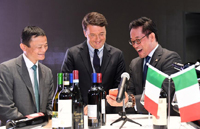
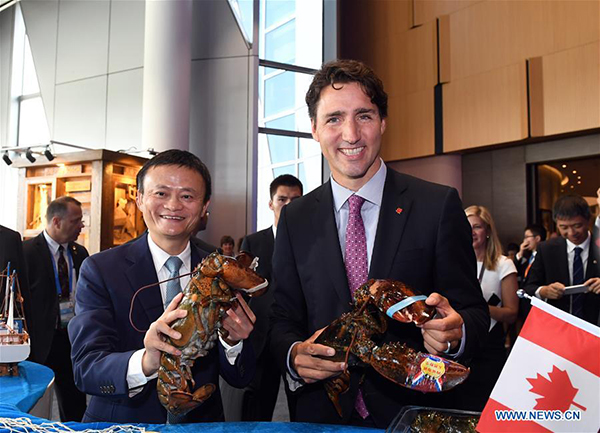
Canadian Prime Minister Justin Trudeau and Alibaba's chairman Jack Ma show lobsters from Canada at the headquarters of Alibaba Group in Hangzhou, capital of East China's Zhejiang province, September 3, 2016. [Photo/Xinhua] |
It has been 740 years since Hangzhou last reigned as the world's most important city. It was then the capital of the world's wealthiest and most developed nation, China, during the Southern Song Dynasty (1127-1279). This week Hangzhou has again been the center of the world's attention thanks to the G20 Summit.
The world's spotlight falls on Hangzhou's most famous historical landmark, the West Lake, as well as its most famous local company, Alibaba, the world's largest e-commerce company. Alibaba's founder and chairman Jack Ma, is a Hangzhou native. He has boasted "Hangzhou has become the driving force of China's new economy," and suggested G20 visitors rise at 5 am to walk around the West Lake, to appreciate Hangzhou's scenery, ancient and modern.
Alibaba has changed Hangzhou and changed China. But, to grasp the full extent of that change, world leaders should venture out from Hangzhou and visit some of China's smallest, poorest and most remote rural villages. Here Alibaba's impact is perhaps the most transformational. Alibaba has made a special effort to bring the benefits and convenience of online shopping to China's rural families, the 45 percent of China's population that still live on the land.
Since Alibaba listed its shares on the New York Stock Exchange in 2014, the company has announced plans to spend 10 billion yuan ($1.49 billion) to make it possible for people in over 100,000 Chinese villages for the first time to buy and sell on Alibaba's Taobao marketplace.
It is impossible to overstate the importance of this effort. E-commerce now offers the fastest and most durable way to improve living standards in China's countryside. By getting online, farmers can shop more widely and buy more cheaply a vast range of products never before available in rural China. In addition, they can sell directly their farm products, both fresh and packaged, to tens of millions of customers living in cities across China.
I'm one of those urban dwellers in China who does some of the food shopping from tiny rural family businesses on Taobao. Last week I bought dried chili peppers from Sichuan province, apple vinegar from Shanxi, goji berries from Qinghai and dried sweet potato chips from Shandong. Everything I buy from rural producers is great. But, the real enjoyment comes from knowing that, thanks to Alibaba, my money can go directly to the people working hard to build a better life for themselves and their families in rural China. This, in turn, helps narrow the income gap between rural and urban.
Unlike the two big US e-commerce companies, Amazon and eBay, Alibaba takes no commission on purchases made on Taobao. This is what economists call "frictionless trade", where buyers and sellers can transact without any middlemen taking a cut. It is a dream of farmers worldwide, to sell products directly to customers and so earn more for their hard work.
Online shopping in rural China is now growing much faster than in cities. Most exciting, we are still in the early days. In the future, farmers should be able to save significant amounts of money and improve harvests buying seeds, fertilizer and tools on Taobao and other websites. Haier and JD.com are also quickly expanding their rural e-commerce.
Alibaba is paying for tens of thousands of "Village Taobao" centers across China. Here, farmers can get free help to buy and sell online. Nowhere else on the planet is e-commerce being as successfully introduced into the lives of small village farmers. The world should take note, and China should take pride.
This year marks the first time China has hosted a G20 summit. The world leaders held detailed discussions on trade, fostering innovation and eradicating poverty. We should all wish them well. Meantime, Alibaba is busy actually putting such talk into action. Its efforts to spread e-commerce in China's countryside provide concrete proof of how tech innovation can be both inclusive and helpful to all of society.
The author is chairman and CEO of China First Capital.


Copyright 1995 - . All rights reserved. The content (including but not limited to text, photo, multimedia information, etc) published in this site belongs to China Daily Information Co (CDIC). Without written authorization from CDIC, such content shall not be republished or used in any form. Note: Browsers with 1024*768 or higher resolution are suggested for this site.
License for publishing multimedia online 0108263 Registration Number: 130349