China issues five-year reform plan on cultural industry


 |
|
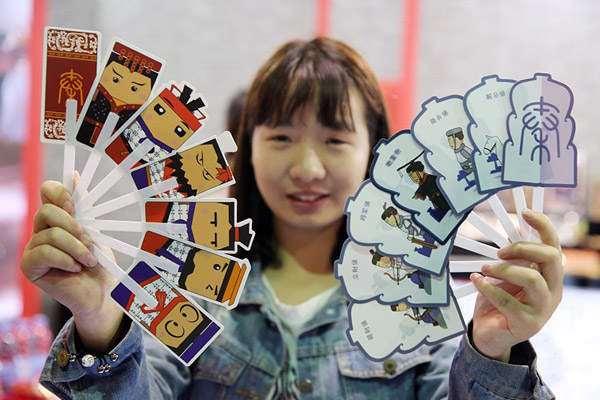
An exhibitor holds up two folded fans featuring Qin Dynasty (221 to 206 BC) characters at the 12th China Cultural Products Trade Fair in Yiwu, Zhejiang province, April 27, 2017. [Photo/VCG] |
BEIJING - China is planning to develop its cultural industry into a pillar of the national economy by 2020 by upgrading its industrial structure, fostering major brands and boosting consumption, according to a government blueprint made public Sunday.
Issued by the general offices of the Communist Party of China (CPC) Central Committee and the State Council, the outline for the 13th five-year program (2016-2020) period on cultural development and reform specifies the guiding principles, major goals, key projects, as well as policy supports for future cultural reforms.
This period is decisive for China's goal of building a moderately prosperous society in an all-round way by 2020, and also key for promoting the country's cultural development, the outline said.
"Building a discourse system" was listed as one of the major innovative projects in the philosophy of the social sciences under the plan. The outline said that research should focus on the CPC Central Committee's new governance concepts, ideas and strategies.
The outline also called for support for specialized high-level think tanks, saying their role should be given full play.
Pillar industry
Vowing to develop its cultural industry into a pillar of the national economy by 2020, the country will help create cultural enterprise groups with core competitiveness and high market share, the outline said.
"Several of them should strive to be among the top in the industry globally by 2020," it said.
The government will promote both mergers among State-owned cultural enterprises and cross-ownership mergers and acquisitions.
Newspapers and magazine resources should also be merged or reorganized and news and publishing organizations with long-term financial and operational difficulties should be shut down or revamped, according to the outline.
State-owned cultural enterprises are encouraged to use the capital market to grow stronger if conditions allow, it said, adding that asset securitization will be promoted in the industry.
In addition, efforts will be made to run major cultural assets and equity exchange platforms well, and encourage State-owned cultural assets to conduct transactions and test exchanges of TV dramas on these platforms, said the outline.
Online media
China will gradually set up a modern communication system by 2020, the outline said.
It will boost the development of online media by encouraging eligible websites to go public and create new mainstream media institutions and groups during the 2016-2020 period.
Authorities will give support to mainstream media institutions in developing their websites and new media. It will step up efforts to guide and standardize investment in the Internet cultural sector with both state and private funds.
Meanwhile, existing laws and regulations on news and publishing will be extended to cover the management of online media, according to the document.
"The licensing mechanism on sources of online news should be improved, while management over news gathering and reproduction qualifications should also be strengthened," it said.
The outline also vowed to set up a sound system for online copyright.
Aiming to ensure a good order for communication, the government will intensify management over search engines, instant messaging tools and news apps, and clarify operators' responsibilities for content disseminated via microblog or WeChat, it said.
Expanded service
A modern public service network should be put into place by 2020 with more standardized and equitable services offered, the outline said.
Apart from major public cultural projects, including museums, galleries, libraries and cultural centers, members of minority groups, disabled people, migrant workers and other special groups will also receive more cultural services.
The government at all levels will be encouraged to purchase public cultural services, and social organizations and companies will be pushed to operate or supply public cultural facilities.
Promising major progress in remote and poor regions, China also plans to build more public cultural facilities, increase access to radio and TV programs, and offer subsidies for grassroots cultural workers, according to the outline.