Piggyback transportation puts China's logistics system on fast track


GUIYANG - Piggyback transportation, where for example, a truck is transported on a train, is becoming a new way to address China's logistics woes in the era of big data.
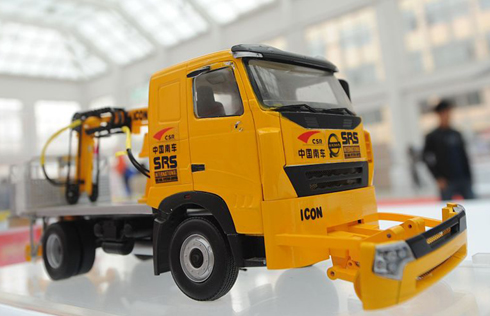
At the ongoing 2017 International Big Data Expo in Guiyang, Huochebang, China's biggest platform for truck drivers to find goods to transport, inked a deal with China Shenhua Rail and Trucks Company (CSRTC) to cooperate in piggyback transportation.
The system allows road and rail transportation to be combined into one. Trucks can be loaded onto a train. When the train reaches its destination, the trucks are then unloaded and continue carrying goods to places beyond the trains' reach. This mode of transportation saves costs, improves efficiency and eases congestion on highways.
"You not only put trucks on the back of trains, but also containers and semi-trailers," said Kang Fengwei, CSRTC general manager. "Piggyback transportation will use Shenhua's railway routes while utilizing the data of Huochebang, to transport goods more efficiently."
Kang said that this mode of transportation will "restructure the logistics industry" and "shape a new model" in the industry.
The first piggyback transportation route under the deal will link a logistics park in Erdos, in North China's Inner Mongolia autonomous region, with a port in Huanghua, Hebei Province, about 1,000 km away. Operation is expected to begin by year end.
Huochebang, which means "truck groups" in Chinese, has 630,000 registered truck drivers in its system. It is known as China's Uber of the truck industry, providing information on around 5 million pieces of freight daily.
Shenhua, which belongs to China's biggest coal-based energy company Shenhua Group, owns railway routes spanning more than 2,000 km.
Multimodal transportation
Piggyback transportation is a form of multimodal transportation, which combines at least two of the following logistics means: road, rail, sea and air, within one freight contract for the shipper. It is particularly suited for mid- and long-distance transportation.
In the United States, truck-rail, truck-sea and rail-sea transportation links are the major transportation means for routes over 800 kilometers, while in Europe, these forms of transportation accounted for about 25 percent of all transportation means in 2015, according to Kang.
But such transportation links are rare in China, partly due to tight control over the rail network, which is considered one of the most effective means of mid- and long-distance transportation in such a large country.
The railway system has long been viewed merely as a "transport vehicle" rather than a part of the logistics industry, Kang said. In addition, China has many railway bureaus, each handling its own business without much coordination.
Trucks, on the other hand, have taken over about 78 percent of mid- and long-distance freight transport in the country. They not only consume large amounts of energy, but also cause congestion and emit pollutants.
Traditionally, the rail, road and water transportation systems in China are operated by different departments without a unified system, making coordination very difficult.
As these logistics methods went their own ways, resources were wasted, costs were high and the environment was polluted. But that situation is set to change in an industry with an annual revenue of more than 3 trillion yuan ($438 billion).
With the advancement of supply-side reform, the Belt and Road Initiative and the improvement of information technology, multimodal transportation is experiencing a period of great development potential, said Luo Peng, president of Huochebang.
Chinese authorities have encouraged the development of multimodal transportation, with the State Council last year requesting the creation of more such routes.
According to the State Council, China's cabinet, it is necessary to promote the development of multimodal transportation for an international logistics "corridor" with improved transportation quality and efficiency.
"Multimodal transportation can improve efficiency, slash costs, protect the environment, and is quite safe," said Wang Ming, an official with the National Development and Reform Commission.
"All related departments should deepen reforms in the rail network and freight prices to create a fair and orderly market environment, so as to push an upgrade in the logistics industry."
Yu Chunxiao, deputy head of the National Railway Administration (NRA), described the deal between Shenhua and Huochebang as a "positive" and "beneficial" step.
"The NRA will improve regulations and actively engage in multimodal transportation," Yu said. "We will also try to create a good environment for companies to promote the healthy development of the logistics industry."