China's economy likely to slow while avoiding steep fall


BEIJING - As China continues its moves to contain leverage and financial risks, its growth may slow, but a steep decline is unlikely due to a buttressing effect from reforms and burgeoning new growth drivers.
Fresh data showed that despite an overall picture of stabilizing growth, signs of weakening momentum have emerged in the Chinese economy, stoking concerns that the rebound has lost steam and may slip into a hard landing.
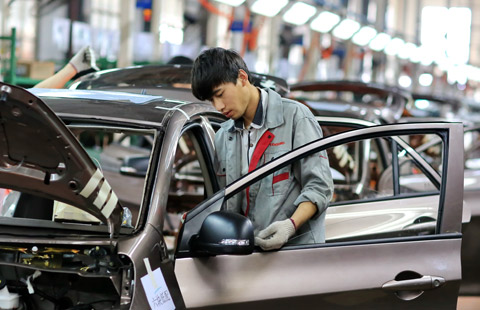
The official purchasing managers' index (PMI) for the manufacturing sector, released Wednesday by the National Bureau of Statistics, was 51.2 in May, flat with the reading in April, which was the lowest since October. The index has remained above the 50-point mark, which separates expansion from contraction, for the 10th straight month.
The official service PMI continued fast growth, rising to 54.5 in May from 54 in April -- evidence of a better economic structure. China has been striving to shift its economy toward a growth model that draws strength from consumption, the service sector and innovation. The service sector accounted for more than half of the Chinese economy last year.
A private survey of smaller manufacturers, however, showed Thursday that the sector had fallen below the boom-bust line of 50 last month for the first time in 11 months. The Caixin manufacturing PMI came in at 49.6 in May, down from 50.3 in April.
China's manufacturing sector had "come under greater pressure" in May, said Zhong Zhengsheng, director of macroeconomic analysis at CEBM Group, a subsidiary of Caixin Insight Group. Zhong believes the economy is on a downward trajectory.
UBS economist Wang Tao expected other May data to show marginally slower industrial production growth, slightly cooler export growth, consumer inflation picking up and factory-gate inflation growth sliding further.
Slower credit growth due to China's ongoing supervisory tightening could lead to weaker fixed-asset investment and activities later in the year, while softening property sales amid policy tightening may also weigh on construction by the end of the year, said Wang, who expected China's GDP growth to slow to 6.5 percent in the fourth quarter this year.
The forecast was in line with that made by the Chinese Academy of Social Sciences (CASS), a government think tank. CASS expected the economy to grow 6.7 percent and 6.6 percent in the second and third quarter, respectively.
The GDP expanded 6.9 percent in the first quarter of the year, up from the 6.8-percent growth in the previous quarter and 6.7 percent for 2016. The government has targeted annual growth of around 6.5 percent for 2017.
Since the end of 2016, Chinese authorities have tightened financial regulation and credit control and have been using an expanded monetary policy toolkit to deleverage without destabilizing growth.
This came as surging housing prices in major Chinese cities and investment booms in financial markets -- ranging from stocks and bonds to farm produce futures -- made policy makers wary of debt piling up in corporations, local governments and households. The government pledged to make a priority of preventing financial risks in 2017.
Measures have been unveiled to step up risk scrutiny in banking, securities and insurance in recent months, targeting non-performing assets, shadow banking, regulatory arbitrage and other malpractice.
"We should not underestimate the senior leadership's desire to contain financial leverage and risks, efforts on which have only just begun, even if they may lead to slower credit and economic growth," Wang Tao said.
However, Wang noted the government will try to strike a delicate balance between deleveraging and stabilizing growth by constantly adjusting the pace and magnitude of supervisory tightening according to economic development.
Expecting China's GDP growth to slow to 6.6 percent in 2017, Elena Duggar, an Associate Managing Director at Moody's, said the policies target limiting the growth of leverage, rather than bringing about rapid deleveraging that could be destabilizing. "The risk of disorderly deceleration of growth in China is limited."
China has been pressing ahead with economic restructuring and supply-side structural reform, which analysts said have yielded outcomes and will ensure sustainable growth in the economy.
Consumption contributed 77.2 percent of the economic growth in the first quarter, up from 64.6 percent in 2016. High-tech industries and the service sector posted strong growth, while employment remained stable.
Ren Zeping, chief economist at Founder Securities, said besides deleveraging and curbing asset bubbles, the country needs to continue tax cuts, promote reforms to loosen restrictions to access and reboot growth in private investment.
- Divergent manufacturing data point to economic stabilization amid contraction pressure
- Inspired by China's success story, Ethiopia modernizes its economy
- Experts say China's financial position robust
- Full of passion for a free global economy
- China gains new economic traction on path of restructuring