Industrial park turns crystal capital into green county


 |
|
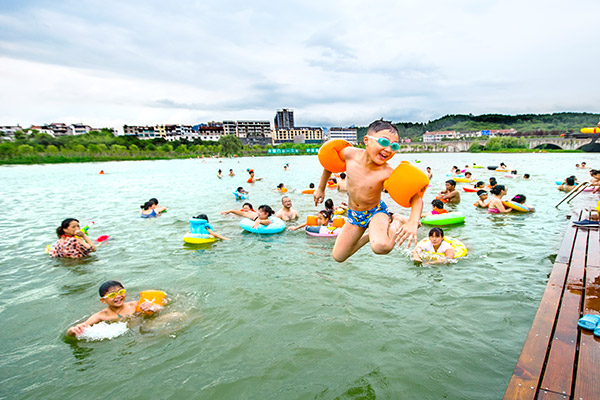
Local children swim and play in Cuihu Lake in Pujiang county, the target of Zhejiang province's "Water Movement" launched in June 2013. [Photo/China Daily] |
Crackdown on pollution puts sparkle back into Pujiang's local economy
Zhou Chengle, 62, relaxes outside his whitewashed three-story home in Jinhua, East China's Zhejiang province, and watches the local children paddling in the shallows of a sun-drenched Cuihu Lake.
Just four years ago, if he had seen someone swimming in the lake, the local landlord probably would have called for an ambulance.
"Before 2013, Cuihu Lake had all kinds of waste floating on the surface. Bad smells used to come up from the lake," he recalled.
The lake then was a sickly shade of milky-white, poisoned by tons of untreated waste dumped into it by 1,400 crystal glass workshops huddled around its banks.
Cuihu's transformation from cesspit to picturesque bathing spot was the result of a huge anti-pollution campaign launched by Zhejiang province in 2013, an initiative that has had far-reaching effects on not only the region's waterways but its economy and society.
Black crystal
Cuihu and its surrounding area, Pujiang county, was the first place targeted by Zhejiang's "Water Movement" launched in June 2013.
In Pujiang, 22,000 local companies churned out 85 percent of the world's hot fix crystal glassware.
The crystal industry had brought huge wealth to the county, with Pujiang's urban residents' per capita annual disposable income trebling from 9,542 yuan ($1,392) in 2003 to 30,711 yuan a decade later. Zhou had benefitted from the industry himself, renting out his downstairs flat to be used as a crystal workshop.
But cutthroat competition and lax regulation in the industry had also unleashed devastating pollution. By 2013, Pujiang was the most polluted county in China, according to China Global Television Network. More than 500 of its water sources were milk-white like Cuihu, while another 25 had turned black.
The county government had attempted to crack down on polluters in 2006 and 2011, but quickly aborted both campaigns for fear of damaging the industry, which then accounted for over 11 percent of the county's GDP and provided employment to more than 200,000 people.
With fear spreading that Pujiang's toxic waterways could create a public health emergency in the county and downstream Hangzhou, home to 9 million people, Zhejiang decided to take radical action to clean up China's "crystal capital".
Cleaning up
Policymakers in Zhejiang faced a seemingly intractable dilemma as the Water Movement got underway: How could they fix Pujiang's environmental problems without triggering an economic slump in the county?
It was eventually decided that they could only square this circle by dramatically consolidating the entire crystal industry, shutting down Pujiang's thousands of outdated, difficult-to-regulate workshops and promoting modern, large-scale production.
"The transformation and upgrading of the industrial structure is essential to solving the water problem," said Huang Hai, deputy director of Pujiang's environmental protection bureau.
The government launched a huge campaign to shut down workshops operating without a business license, enlisting every government department and the public to root out any violators. Often, they inspected workshops at midnight to catch clandestine polluters red-handed.
But, crucially, the government also invested 5.5 billion yuan to build the Pujiang Crystal Business Park, which opened in August 2015.
The region's remaining crystal companies were given the choice of moving to the new park or investing in their own sewage treatment systems, according to Huang.
More than 21,000 of Pujiang's crystal companies shut down as a result of these measures. Of the 614 producers that survived the crackdown, 526 are now based in the park.
Benefits abound
The Crystal Park has helped Pujiang's crystal industry remain competitive. Its centralized waste treatment system allows companies to share the costs, while the generous subsidies it provides help boost tenants' profits further.
Automating production also plays a key role in cost-cutting. "I used to employ 100 workers before moving to the Crystal Park, but now I only need ten," says Luo Yintian, owner of Luoxiao Crystal.
Pujiang's crystal industry has not only survived the anti-pollution campaign but grown significantly. Its output value in 2016 was more than 9 billion yuan, up from 6 billion yuan in 2013.
This wealth is also trickling down to the wider economy. Per capita disposable income rose another 20 percent in Pujiang between 2013 and 2016, according to Zhejiang Online.
Workers who lost their jobs have either moved back to their home provinces or been paid compensation, according to the county government, with many using the money to set up agribusinesses growing grapes and Chinese toon.
Pujiang's cleaner environment is also helping new businesses sprout up. Xinguang village, which once choked on the fumes of 300 crystal workshops, is now a tourist spot housing trendy bars, cafes and boutiques.
In Cuihu, Zhou has also prospered from the water campaign. His new tenants have converted the old workshop into a restaurant, and pay him 5,000 yuan more a year in rent. He's now retired and spends his evenings strolling around the lake with his granddaughter.
"There are many people walking beside the lake in the evenings these days," he said with a smile.
Qin Jirong and Feng Chonglin contributed to the story.
Related story: Initiative that transformed Zhejiang
Zhejiang initiated the Water Movement campaign at the end of 2013.
It aims to tackle five issues: water pollution, flood control, drainage in waterlogged areas, water supply and water conservation.
Zhejiang has invested nearly $41 billion in projects related to the water campaign over the past three years: $12.3 billion in 2014, $16 billion in 2015, and $12.5 billion in 2016.
The province has appointed 60,000 "river chiefs", usually local government officials, who are responsible for the water quality in their local area.
By 2015, Zhejiang had cleaned up 6,500 kilometers of "garbage" rivers and 5,100 kilometers of "black and smelly" waterways.
And $5.5 billion has been invested in 177 major flood control projects over the last three years.
It strictly controls water usage, with the goal being that annual water consumption would not rise above 24.5 billion cubic meters in 2020.
By 2020, all water problems in Zhejiang are expected to be solved.