Tax breaks stimulate corporate China


 |
|
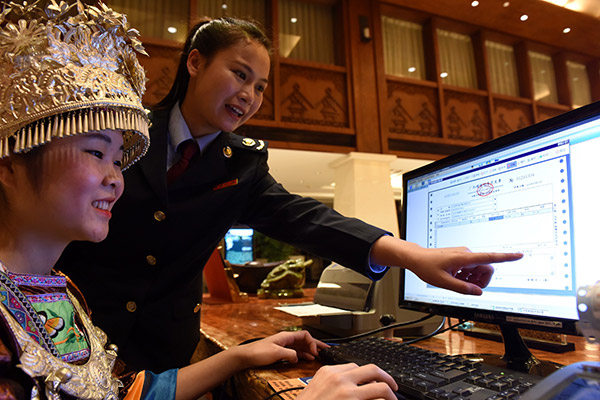
A local taxation bureau employee coaches a waitress in a guesthouse in a county of the Guangxi Zhuang autonomous region on how to make out a VAT invoice by using the new taxation system on May 1, 2016. [Photo/Xinhua] |
Cost reduction will help raise the vitality of the business sector and cut companies' financial burden by as much as 1 trillion yuan this year
Xu Shugen is head of a major manufacturing company in East China's Zhejiang province which helped to build the country's first large passenger aircraft.
The chairman of Zhejiang Dingli Machinery Co revealed that his group rolled out the electric aluminum work platforms used in the construction of the famed C919 commercial jet.
But none of that would have been possible for one of the leading companies in China without favorable tax breaks.
"It was a great honor to help in the process of building the C919," Xu told the Economic Daily. "Yet it would not have happened without the country's support policies, especially tax cuts."
Dingli Machinery Co makes electric lifts, platforms, aerial pickers and stackers, and has recorded rapid growth in the past 10 years, which has been partly fueled by pro-business tax breaks launched in 2006.
This has allowed the company to invest in upgrading and expanding its operations.
"The Zhejiang authority cut nearly 20 million yuan ($2.9 million) in taxes for the company in 2006, which was the equivalent of about half of our research and development budget that year," Xu said. "This year reduced taxes could amount to 50 million yuan."
 |
|
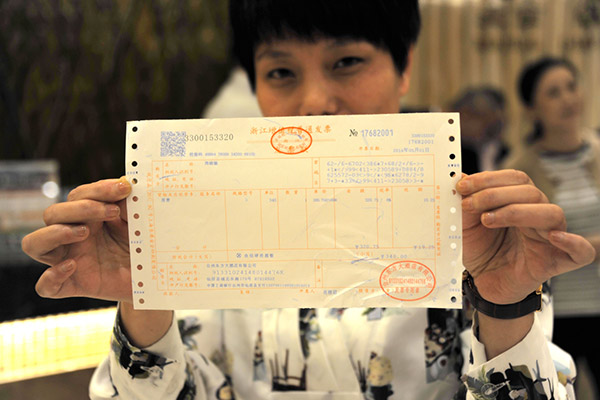
Taxpayer Zheng Xiaomin holds the first VAT invoice in Xianju County, Zhejiang province, issued by a local company on May 1, 2016. [Photo/China Daily] |
A new round of tax breaks was announced last year in a move to stimulate growth in the corporate sector. Valued Added Tax, or VAT, was brought in to replace business tax, releasing a 500 billion yuan windfall for companies.
But the process has produced mixed results for businesses here.
Many small companies have complained about the increased taxation burdens and hidden financial fees at central and local government agency level.
In a bid to address those concerns, the State Council, or China's cabinet, decided at an executive meeting earlier this month to reduce fees and continue its tax-cutting policy.
This will help reduce the financial burden on companies by as much as 1 trillion yuan in 2017.
"Cost reduction measures are an important part of the country's supply-side structural reform and will help effectively raise the vitality of the corporate sector," Pan Jiancheng, an official of the National Bureau of Statistics, told Xinhua.
The State Council confirmed that central and local government agency fees worth more than 600 billion yuan, or 60 percent of the 1 trillion yuan target, would be reduced by the end of the year to ease the financial load on corporate China.
Analysts expect this move to benefit companies across the country.
"The policy decision, especially in the field of fee reduction, is unprecedented," said Hu Yijian, an economist at the Shanghai University of Finance and Economics.
Still, tax levels have generated a heated debate among business leaders during the past few years.
Entrepreneurs Zong Qinghou, chairman of major food and beverage producer Hangzhou Wahaha Group Co Ltd, and Cao Dewang, chairman of leading glass manufacturer Fuyao Group, have complained about the high levels of taxation.
An investigation later proved that while taxation levels for both companies were normal, local government agency fees appeared excessive.
"Fee collection must be governed by law and further regulated," said Liu Shangxi, head of the Chinese Academy of Fiscal Sciences.
"Certain fees must be eliminated and for those that are retained, it should be clearly explained why they are being collected," he added.
To streamline the process, Beijing announced new regulations in March 2016 to protect small companies.
These regulations are "aimed at strengthening the management of non-tax government revenues and protecting the legitimate interests of citizens, legal persons and other organizations", according to a document issued by the Ministry of Finance.
It also clearly defined what types of government agency can collect fees.
Since 2013, the central government has eliminated 496 agency fees while local governments across China have scrapped more than 600 business fees.
But analysts have warned that tough checks need to be carried out to safeguard the policy.
"Measures should be taken to ensure the practice of fee collection does not come back in disguise," said Liu of the Chinese Academy of Fiscal Sciences.