Analysts: Wait and see on RMB


 |
|
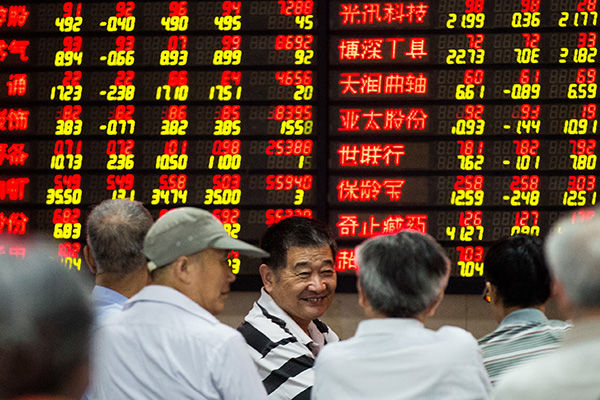
Investors examine stock prices at a security brokerage in Nanjing, capital of Jiangsu province. [Photo/China Daily] |
The offshore yuan gained around 0.1 percent against the dollar five minutes after the index provider announced its decision to include China's A-share market into its Emerging Markets Index on Wednesday.
The inclusion will help stabilize the yuan's exchange rate, because inclusion will bring more capital inflows, according to David Leung, head of wealth management of Standard Chartered Bank.
But to what extent it will help boost demand for the yuan and how long the positive effect will persist remains quite uncertain, according to Gai Xinzhe, an economist with the Bank of China.
"It looks like a marginal support for yuan. We need to wait till next year, after the stocks were included," he said.
The mainland stocks will be included via a two-phase process in May and August next year, according to the index provider.
Zhao Qingming, chief economist at China Financial Futures Exchange, said an obvious boost for the currency is unlikely to be seen, because the scale of initial capital inflows brought by the inclusion, which is estimated to be around $17 billion next year according to MSCI executives, is too small to bring a major impact to the forex market.
Foreign exchange trading volumes in the inter-bank market are more than $100 billion each day, according to Zhao.
He said the yuan did not face much depreciation pressure, noting a narrowed decline of the central bank's foreign exchange purchases.
Purchases totaled 21.55 trillion yuan ($3.16 trillion) in May, the sixth month in a row of month-on-month declines.
"An improved, more market-oriented pricing model can support the yuan in the long-run," said Xie Yaxuan, chief economist at China Merchants Securities, adding that a likely weakening dollar in the second half might ease pressure on the yuan.
In late May, the central bank adjusted the pricing model by adding a "countercyclical factor", correcting market expectations that often fail to reflect the economic fundamentals.
The move has helped discourage bearish bets after the central bank sent signals to the market about its intention to guide the currency moving toward a more stable trend.
With Beijing's efforts to improve the pricing model and regulate capital outflows starting from this year, the yuan subsequently gained around 2 percent against the dollar, compared with an almost 7 percent fall last year.
"Although a 2 percent is not a big gain, a turning point for continued downward pressure has already come," Zhao said.
Timeline
In June 2013, global share index compiler MSCI Inc announced that it would consider the inclusion of China A-shares in its MSCI Emerging Market Index.
In March 2014, MSCI said it started to consider the weighting of A shares in the MSCI Emerging Market Index.
In June 2014, MSCI announced it would not include A-shares, but they would be put on its review list.
In June 2015, MSCI rejected the inclusion of A-shares because of issues including the Qualified Foreign Institutional Investors quota allocation process, capital mobility restrictions and beneficial ownership of investments.
In November 2015, MSCI included US-listed Chinese companies in its emerging market index.
In February 2016, the State Administration of Foreign Exchange relaxed investment quotas for single institutions under QFII programs and allowed for a more convenient capital flow.
In May 2016, "nominee" and "beneficial ownership of securities" were recognized by China Securities Regulatory Commission.
In May 2016, the Shanghai Stock Exchange and the Shenzhen Stock Exchange set the upper-time limit for listed firms' trading suspension. Similar time limits were also rolled out for continuous plans for asset reorganization, non-public offerings and major asset purchase.
In June 2016, MSCI said it would delay including A shares in its emerging markets index.
In December 2016, the Shenzhen-Hong Kong Stock Connect officially started. The new scheme is aimed at giving global investors access to stocks in the tech-heavy Shenzhen market via the Hong Kong bourse.
In February 2017, Fang Xinghai, vice-chairman of the China Securities Regulatory Commission, said China would gradually raise the upper limit of overseas investors' stock proportions in domestic securities and futures companies.
In February 2017, China's securities regulator relaxed the trading rules for stock index futures, signaling a gradual exit by the regulator from the harsh restrictions imposed during the market rout in 2015.