Helping SMEs with office space


 |
|
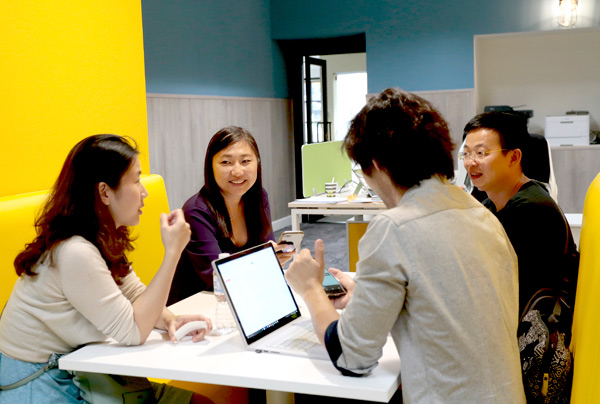
Executives of a firm that operates out of Urwork's new co-working space in Los Angeles formulate business strategy in a team meeting. [Photo provided to China Daily] |
Urwork, a Chinese co-working space provider, opened its second overseas office in late September in Los Angeles.
The two overseas offices seek to better link Urwork's customers at home and abroad.
"The overseas office aims to help Chinese companies to go global and foreign companies to enter China," said Mao Daqing, founder and CEO of Urwork.
After completing a pre-C round of funding for $178 million in August, the two-year-old startup now boasts a valuation of up to $1.3 billion, making it the first unicorn in the co-working space business in China.
Its 100 offices in 30 cities, including the two in Singapore and Los Angeles, serve about 50,000 office-goers working with 4,000 companies.
Since the company's first overseas office opened in Singapore in June, Urwork's goal has been to enter major cities in developed countries that have frequent trade contacts with China and where the concept of office-sharing is widely accepted.
After Los Angeles, the company will target cities in Europe such as London, Paris and Berlin in 2018.
Mao said Urwork has no intention to grab market share from foreign competitors such as Wework in other countries.
"We've different targeted clients-startups or SMEs (small and medium enterprises) that have interest in bilateral business," he said.
Urwork's shared office facilities overseas can provide low rentals, investment resources and related services that can help newcomers to settle down quickly, including facilitation of business licenses, legal consultancy and recruitment, he said.
Besides, tenants can have a broader channel to link potential business partners around the world by joining the company's membership community, he said.
The newly established office in Singapore now rents out about half of the desks, with an average rental of S $500($371.4) per person per month.
Kerr Sun, board director of Master Real Estate Pte Ltd, a Singaporean real estate company, also a tenant of Urwork, said he wants to explore the Chinese market by using the network and commercial services provided by the company.
"We hope to meet other Chinese companies and investors in the online and offline communities to establish further cooperation," he said.
Mao said Urwork will treat Singapore as a hub to expand into Southeast Asian cities like Bangkok, Jakarta and Kuala Lumpur.
Shared offices or co-working spaces, where employees of different companies share offices, meeting rooms and entertainment facilities, such as gym, coffee bar and reading corners, have sprung up in China in recent years.
According to the 2017 Flexible Working Space whitepaper released by real estate consultancy Colliers International in March, co-working spaces will make up 30 percent of the office market in China by 2030 with an annual growth rate of 30 percent.
Since the post-1985s generation, or millennials, have begun to dominate the labor market, more than 100 million people will choose the new form of offices in the future, Mao said.
"Co-working is an emerging industry with much space to explore and innovate in, and the market is far from saturation," he said.
The company expects to set up 160 offices in 32 cities worldwide in three years, providing 100,000 desks for innovative enterprises by 2020.
However, it will still focus on the domestic business, he said.
"Why do you turn to other countries when China is already the biggest market?"
He said 60 percent of single offices have achieved profitability, but the whole company is expected to break even in 2019 on the back of stronger and stable demand.
Shared working spaces will find it hard to make money if they rely solely on government tax cuts or desk rental to cover operational costs, he said.
Facility-wise, most of the income may come from rentals. But for the whole company, profit sources remain membership and related services, he said.
Non-rental income contributed 15 to 20 percent of the whole, he said.
"It's not rental that we put emphasis on, but services, derivative products, investment and community construction that matter really," he said.
He further said overall revenue was about 300 million yuan ($46.2 million) by August, which was expected to grow to $100 million the next year.
The company plans to adopt new models like joint-management or franchised outlets, he said.