Trade tensions, dollar danger cloud optimism


 |
|
Police patrol at the entrance of the venue of the annual meeting of the World Economic Forum in Davos, Switzerland, on Monday. [Photo/Getty Images] |
Potential trade disputes between the United States and China and a strengthening dollar are among the biggest threats to a brightening global economic outlook, according to leading economists at the World Economic Forum in Davos.
As political leaders, businessmen and bankers meet in the resort in the Swiss Alps this week, they can draw hope from a more benign economic picture and a rally in global stock markets on expectations of major stimulus under a new US administration led by Donald Trump.
The backdrop is brighter than it was a year ago, when concerns about an economic slowdown in China led to what Credit Suisse CEO Tidjane Thiam described at the time as "the worst start to any year on record in financial markets ever".
Axel Weber, the chairman of Swiss bank UBS and a former president of the German Bundesbank, said: "I am more optimistic than last year. If no major political or geopolitical uncertainties materialize and derail the world economy, it might even surprise to the upside in 2017."
Still, there are big storm clouds on the horizon.
"It is too early to give the all-clear," Weber said. "This cyclical upswing hides but does not solve the world's underlying structural problems, which are excessive debt, over-reliance on monetary policy and adverse demographic developments."
Among the biggest concerns for this year cited by the half dozen economists interviewed by Reuters was the threat of US-China trade disputes, and broader economic tensions, triggered by what they fear could be a more confrontational Trump administration.
Trump is threatening to brand China a currency manipulator and impose heavy tariffs on imports of Chinese goods. Last month, he named leading China critic Peter Navarro, author of the book Death by China, as a top trade adviser.
"This is the key uncertainty because you don't know how much the rhetoric is a ploy to get better deals," said Raghuram Rajan, an economist at the University of Chicago who stepped down as governor of India's central bank in September.
"I'm worried about the people he is surrounding himself with. If they have a more protectionist world view and believe the reason the US is not doing well is because others are cheating that creates a certain kind of rhetoric that could end up very badly for the world."
Currency risks
 |
|
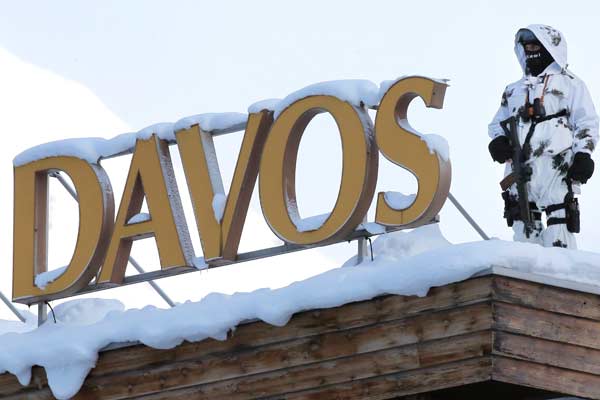
An armed Swiss police officer stands on a roof during the forum in Davos on Tuesday, as business and world leaders attend the annual meeting. [Photo/Agencies] |
Last month, the US Federal Reserve hiked interest rates for just the second time in a decade, a sign that the lengthy period of ultra-loose monetary policy that followed the global financial crisis may be coming to an end.
The World Bank said last week that it expects global growth to accelerate to 2.7 percent this year, up from a post-crisis low of 2.3 percent last year, on the back of a pickup in US growth and a recovery in emerging markets fueled by a rise in commodity prices.
A year ago in Davos, both Rajan and Weber warned about the limits of loose monetary policy. But now that the Fed is in tightening mode, a new set of risks has emerged.
One is a further strengthening of the dollar, which is already hovering near 14-year highs against the euro.
A further appreciation could widen the US trade deficit, increasing pressure on Trump to resort to protectionist policies. It could also expose weaknesses in the balance sheets of borrowers outside the United States who have borrowed in dollars but hold domestic currency assets.
In Europe, by contrast, a stronger dollar could add fuel to a solid if unspectacular economic recovery, allowing the European Central Bank to plot an end to its own easy money policies including the bond-buying, or quantitative easing, program it recently extended through to the end of this year.
While welcome, this would also come with risks, particularly for the peripheral eurozone countries that have come to depend on QE to keep a lid on their borrowing costs.
"Just when you think the eurozone is stable it might turn out not to be," said Kenneth Rogoff of Harvard University, a former chief economist at the International Monetary Fund.
"If US interest rates continue to rise and the dollar appreciates against the euro it's going to start getting very hard for (ECB President) Mario Draghi to tell the story that he's doing QE to prop up inflation. If he ever slows down on QE, the vulnerabilities of the periphery countries are huge."
Reuters