Schneider Electric targets Shanghai firms in AI push


 |
|
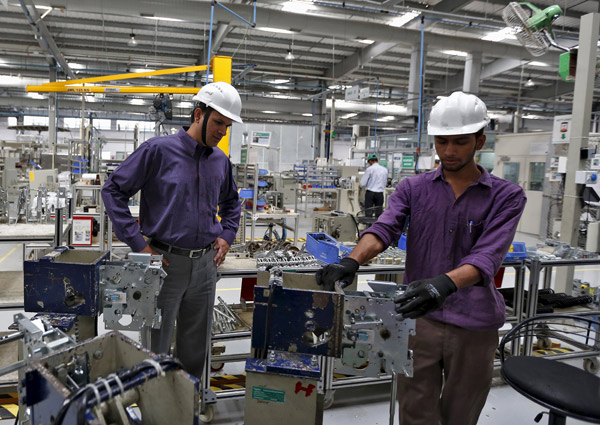
Vivek Sarwate (left), director of MV/LV equipment and transformer tendering and sales support, watches an employee assembling medium voltage switchgear inside the plant of Schneider Electric Infrastructure Ltd. on the outskirts of Vadodara in Gujarat, India. The company believes the IoT can be used in different industries as part of digitalization of manufacturing. [Photo/Agencies] |
Move aimed to help firm to compete with ABB, GE, Siemens in new field
The China arm of Schneider Electric, the Rueil-Malmaison, France-headquartered company, is seeking to collaborate with various businesses in Shanghai to integrate the internet of things, or IoT, into traditional industries.
John Tuccillo, senior vice-president, industry and government affairs at Schneider Electric, believes the IoT can be used in different industries as part of digitalization of manufacturing.
The IoT can be described as a network of devices, vehicles, buildings and other objects that contain software or sensors that allow them to connect and exchange data.
"The application of the IoT will push not only the manufacturing industry ahead but other related fields, such as sewage disposal, healthcare, transportation and energy," said Tuccillo.
"Making different systems function together is what makes the IoT different to the internet of consumption. The IoT not only makes manufacturing more automatic but connects different systems."
Eager to compete with other established rivals such as Swiss company ABB Group, the US-based General Electric and Germany's Siemens AG in the same field, the company promoted EcoStruxure, its open, interoperable, IoT-enabled system architecture in Shanghai last month.
EcoStruxure has been already adopted by China Baosteel Group, one of China's largest steel producers by output. It helps Baosteel to increase safety of operators and non-operators in the workshop and improve productivity. Daily output will likely increase 15 to 30 percent to reach up to 10,500 tons.
Schneider Electric now earns 45 percent of its revenue through the IoT.
The platform combines operational technology and information technology into one management interface. Users can easily access the system to practise various complex operations.
The whole procedure is as simple as tapping smartphone apps. "It's like an industrialized Android system," said Ma Yue, senior vice-president, industry business, Schneider Electric China, the company's local arm.
The system also creates a centralized multi-user collaboration platform, which allows itself to maintain configuration, administration and deployment locally or remotely.
Combined with its sustainable design, the system can make a company a consumer of its own byproducts.
The company currently has more than 700 researchers in China. The average time they take to bring a new product to market is 18 to 24 months.
The company's China operation employs 26,000 staff across 26 factories, eight logistics centers, three research and development offices, five branches and 40 regional offices.
China is also the second-largest market for Schneider Electric and the largest market of industrial automation, ahead of the US.
"We've set a long-term goal to sell one-fourth of our products in the Chinese market and the rest to global markets. China's Belt and Road Initiative is encouraging us to deploy more resources in China and other related markets," said Ma.
Schneider Electric's technology prowess flows from its investment (5 percent of its revenue) in R&D. For that, it has established five regional research centers worldwide: in France, the United States, China, India and Mexico, respectively.
"China's growing demand for high-value products, especially automobiles, and home-related services, offers many growth points," said Sun Fuquan, a researcher at the Chinese Academy of Science and Technology for Development in Beijing.
Chen Bin, executive vice-president of the China Machinery Industry Federation, said China is making progress on the path to becoming an advanced and competitive economy, but it will take time for the required changes to have an impact on industry.
Patience and consistency will be required, as well as continuous reforms along the way, he said.