Comments
  Print
Print  Mail
Mail  Large Medium Small
Experts urge use of technology in transformation
|
 |
|
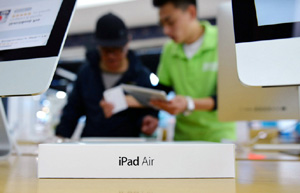
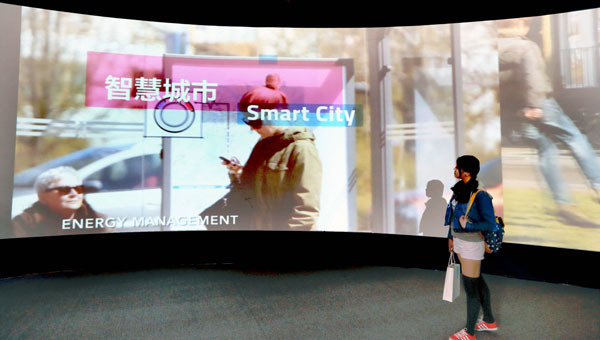
A visitor to the Smart City 2013 exhibition in Beijing in September looks at a display. Provided to China Daily |
Many factors can make visions become a reality — sometimes it's a traffic jam, other times it's a pleasant drive.
How well can China travel on its path to unprecedented urbanization — a process that will give some 200 million rural people urban jobs and homes and welfare coverage in about a decade?
How will the country be able to accommodate so many people in its already overpopulated cities?
How can it build new cities and new urban districts properly and guarantee their new residents a basic level of living?
How can the managers of everything, from roads to emergency aid and healthcare services, to various retirement plans, cope with such an increase in their daily workloads?
How can people generate less waste and less pollution?
Information technology specialists say there's a systematic solution. Only by collecting and analyzing large volumes of information from all public sources can a city have an integrated management system capable of responding to changes in a smart way, namely to constantly re-prioritize and readjust available services. Thus the name: smart city.
Right now, as all IT engineers will tell you, with its ambitious urbanization drive, China is going to be the world's largest smart city lab.
The country is facing too many dilemmas at the same time, said Peter Lacy, managing director of Accenture Sustainability Services Asia Pacific, who said he believes that China has no way to tackle them all without the aid of smart city technologies.
"The increasing population moving from rural areas to cities, the increasing consumption and expectations of citizens as they are getting wealthier, and the increasing difficulties to manage natural resources, energy, water and waste, are going to haunt China for the next 30 years," Lacy said.
China is going through a transformation that's not only turning it into the world's second-largest economy, but also attracting more than half of its population to cities.
The cities are where all the efforts will meet and all the things will be balanced out, such as the need to generate sustainable economic development and to provide human capital with increasing quality, Lacy said. Smart city technologies will be the most critical enabler for managers of all city-wide programs.
According to the report Smart 2020, which was published by Accenture Plc, deploying smart city technologies in areas such as electricity grids, transportation, logistics, building management and industrial areas could save up to 15 percent of global emissions in 2020, and about $900 billion a year by then in energy savings for the global industry.
That is doable, according to George Thomas, a senior executive of IBM Corp in charge of the company's smart city business in China, because "with the development of technology, it is cheaper and cheaper to put chips everywhere, and it is easier and easier to collect data from chips.
"Because we are able to collect the data, dig into the data and analyze the data, we are able to answer questions better than before," Thomas said.
IBM first started to champion the smart city concept around 2009, he added.
Not only will it be possible to predict traffic 60 minutes in advance by analyzing patterns from historical data, the "cool part" of the technology is that people can start asking the system questions they never thought they could get answers to, and they can keep asking more.
China's massive urbanization drive will result in cities that are larger than ever and more complicated to manage. International consulting company McKinsey & Co estimates China will have 10 to 12 mega-cities with populations of 15 to 20 million in 2025. And many city clusters will rise in due time.
A city cluster will comprise a mega city and 20 to 50 other smaller cities.
Also in 2025, most of the Chinese population will live in medium-sized cities with populations between 500,000 and 5 million, it added.
According to Liu Xu, a senior analyst on smart city projects with the Beijing-based CCID Consulting, there is a strategic aspect to the Chinese government's urbanization drive, apart from the social and environmental inevitabilities.
That is the national leaders' desire to find a new engine to provide additional growth to an economy that can no longer rely on exports for all its steam. To boost domestic consumption, China needs to accommodate more people in its cities. And to make sure they are willing to spend more on goods and services, China must have reliable city management technologies.
CCID, Liu's organization, is a research body affiliated with the Ministry of Industry and Information Technology.
Cecily Liu contributed to this story.
Copyright 1995 - . All rights reserved. The content (including but not limited to text, photo, multimedia information, etc) published in this site belongs to China Daily Information Co (CDIC). Without written authorization from CDIC, such content shall not be republished or used in any form. Note: Browsers with 1024*768 or higher resolution are suggested for this site.
License for publishing multimedia online 0108263 Registration Number: 20100000002731