 |
|
|
 |
|
|
|||||||||
Ranking reflects factors including innovation and social development
Singapore has the most competitive economy in Asia, according to a report released by the Boao Forum for Asia on Wednesday.
China and India, which along with Brazil, Russia and South Africa make up the BRICS economies, lagged behind in the ranking because of their low commercial and administrative efficiency.
China's competitiveness was ranked 10th highest among Asian economies in 2011, moving up from its spot in the previous year, according to the report.
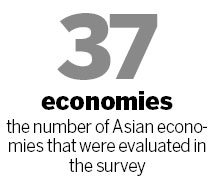
The forum assessed 37 Asian economies by looking at their economic strength, social development, infrastructure and human capital and innovation.
"China's overall competitiveness increased in 2011 because of the country's work to modify its structure," said Wang Jun, a researcher at the China Center for International Economic Exchanges.
"But it needs to streamline the approval procedure to improve commercial administrative efficiency."
The Boao Forum for Asia is a nonprofit organization that holds forums for government, business and academic leaders. Its next annual event will be held from April 1 to 3 in Boao, Hainan province, and Vice-Premier Li Keqiang plans to deliver a keynote speech during its opening ceremony.
Wang, one of the main contributors to the report, said the indicators were all calculated using official figures culled from governments or reliable international organizations.
Singapore has topped the list for two consecutive years, followed by the economies of Taiwan, Hong Kong, Japan and South Korea.
"China's ranking might decrease in the next year since the government has lowered its target for economic growth," Wang said. "Economic strength has great weight in the evaluation system."
Although India is a large market and enjoys rapid economic growth and a great potential for innovating, its ranking dropped to 32 from 28 last year.
Zhou Wenzhong, secretary-general of the Boao Forum for Asia, said it will be important for Asian economies to pursue their goals more strenuously.
"There is an increasing need to expand the region's internal demand to offset a continuous slowdown in the European and US markets," Zhou said.
Europe, the largest trading bloc in the world, saw its share of world trade decline to 38 percent in 2010, down from 41 percent in 2009. Asia's share, meanwhile, increased to 32 percent in 2010, up from 29 percent the year before.
"Further progress has been made in Asian economic integration and the production network has laid the foundation for the region's integration," said Pei Jiansuo, an economist at University of International Business and Economics.
About 54 percent of Asia's trade was conducted among Asian economies in 2010, up from 51 percent in 2009.
He said Asian economies are at a crossroads and must decide if they will further work toward regional integration.
Besides the free-trade cooperation now going on among the Association of Southeast Asian Nations and other Asian economies, the United States is promoting the US-led Trans-Pacific Partnership.
Pei said the Trans-Pacific Partnership is faced with great difficulties and uncertainties.
"The nine members' trade among merely makes up a small portion of their total trade and they tend to trade more outside of (the partnership)," he said. "The future of (the partnership) depends on the attitudes of Japan and South Korea."
Meanwhile, the Boao Forum also released its annual report on the development of emerging economies.
The biggest 11 emerging economies, including Argentina, Brazil, China, India and South Korea, also saw their growth weaken in 2011 as the global economic downturn lingered.
Huang Wei, an economist at the Chinese Academy of Social Sciences, said trade among emerging countries remains strong and their dependence on developed economies will continue to decline.
In 2012, the emerging countries are expected to see their economies grow by about 6.7 percent on average.
In 2012, China's economy is expected to grow by 8.8 percent, which is higher than the country's target of 7.5 percent. Meanwhile, India's economy is expected to grow by 7.5 percent, Brazil's by 4 percent and Russia's by 3.8 percent, the report said.
"Developed economies have yet to show signs that they are fundamentally improving, which could lead to a further weakening of global demand and affect emerging economies' growth."
Meanwhile, the leadership in many large emerging economies will be reshuffled in 2012, changes that could both directly and indirectly affect the economic and social development of those economies, she added.
lanlan@chinadaily.com.cn
(China Daily 03/22/2012 page17)