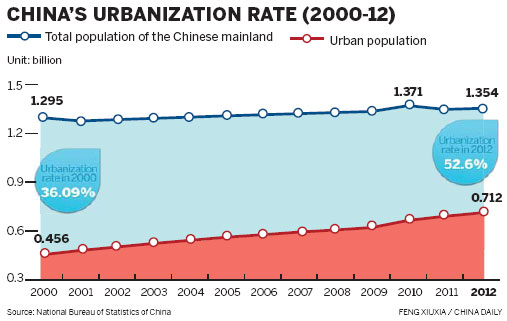
The years 2000 to 2012 signaled one of urbanization's fastest development periods. The country had an urban population of 711.82 million by the end of 2012, rising from 455.94 million in 2000, according to the NBS. The urbanization rate - the proportion of people living in urban areas - increased to 52.6 percent from 36.09 percent during the period.
However, many government officials and experts said the rate was an overestimation, because the NBS considers migrant workers who have lived in a city for more than six months as part of the urban population. Although the method of calculation conforms to common international practice, the migrant workers - unlike urban residents - have no access to public services, including social security and health insurance.
Because at least a quarter of the urban population nationwide does not have access to these services, the actual urbanization rate is only 35 percent, said Chen Xiwen, deputy director of the Party's leading group on rural work. There is still a long way to go before China can achieve the 60 percent target rate by 2020, he added.
This is not simply a problem of statistical analysis, according to Chen. It means the government must provide restitution for a task it has not finished - that of making public administration and social security available to migrant workers - while it promotes urbanization during the next 10 years.
"The key for the successful reform of urbanization is the transformation of large-scale city expansion into people-oriented urbanization and making the term 'migrant worker' a part of history as soon as possible," said Chi of the China Institute for Reform and Development.
He suggested the government should gradually remove the restrictions on household registration, starting with small- and medium-sized towns before moving onto the big cities and eventually allowing the free movement of people, and centralized administration within eight years.
Evaluation system
On April 1, 2012, the Shenzhen municipal government issued an interim regulation that allowed migrant workers to obtain hukou via an evaluation system. Those who meet the basic requirements and have accumulated 100 points can apply through their employers or human resources agencies.
But the requirements and standards of evaluation are too demanding, said Zhang Xiaoshan, a senior researcher at the rural development institute of the Chinese Academy of Social Sciences.
For example, to be eligible to apply, a migrant worker must be 18 to 48 years old and hold a diploma from a high school or secondary technical school. They must also have a city residence permit, as distinct from hukou, and be entitled to social security. The workers will receive three points for each annual payment of endowment insurance, but the total number of points each person can accumulate through insurance payments is limited to 30.
Zhang suggested that local governments could set their own thresholds for migrant workers to apply for hukou, and he also called on the central government to clarify the application standards and link the urban pensions and health insurance systems with those in rural areas.
Land ownership
"During the latest round of urbanization, the government should start with confirmation of land ownership," said Zhang.
Local governments, especially those at city and county level, had been eyeing rural land collectively owned by farmers' groups for many years. The governments took over a large amount of collectively owned agricultural land in the name of public interest, but later sold it to real estate developers at market rates. However, the farmers received only minimal compensation.
According to the current Land Administration Law, compensation for farmland requisition, plus resettlement subsidies, should not exceed 30 times the land's average annual output value during the three years before expropriation. That results in farmers receiving less than 100 yuan for each square meter of farmland, said Jiang Ming'an, professor at the Peking University Law School during an interview with Beijing Times in November. It's little wonder they have cause for complaint, he added.
Zhang from CASS, said: "Land-based financing is unsustainable, especially since people's awareness of land protection has risen. At this point, the government should think of a lasting, sustainable, win-win mechanism that will allow cooperation between the farmers and the government, rather than playing a one-shot game."
"In the future, the country should standardize the procedures for land expropriation and guarantee the farmers' bargaining rights during the transfer of the rights to collectively owned rural land," said Chi of the China Institute for Reform and Development.
"Farmers whose land has been expropriated should be compensated in accordance with the market value of their land," he said.
jiangxueqing@chinadaily.com.cn
Yang Wanli and Peng Yining contributed to this story.


Copyright 1995 - . All rights reserved. The content (including but not limited to text, photo, multimedia information, etc) published in this site belongs to China Daily Information Co (CDIC). Without written authorization from CDIC, such content shall not be republished or used in any form. Note: Browsers with 1024*768 or higher resolution are suggested for this site.
License for publishing multimedia online 0108263 Registration Number: 130349