IPHOFEN, Germany - Following the call for a "greener" community in the country's 12th Five-Year Plan (2011-2015), "sustainable architecture" has become the latest fashion.
|
 |
|
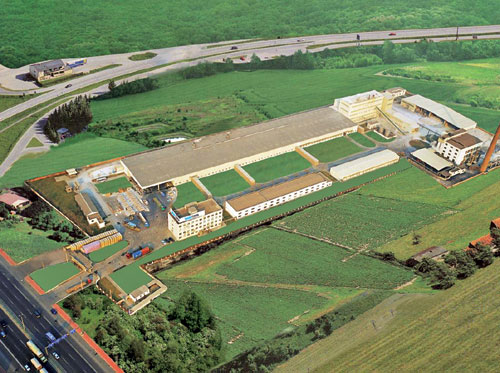
A bird's-eye view of Knauf's plaster boards plant in Tianjin. This year Knauf will open its fourth China-based plant in Taicang of East China's Jiangsu province.[Photo/China Daily] |
Architects and designers in China are on the lookout for information about sustainable design strategies and materials, while some far-sighted companies have seen ways of turning many of the current environmental problems to their commercial advantage.
Germany-based Knauf Gips KG, a leading producer of gypsum boards, is developing its operations in China to ride the urbanization boom and meet the green demand of the world's fastest-growing economy.
With its fourth plant in China to be fully operational in Taicang, East China's Jiangsu province this year, Knauf is poised to make a stronger presence in the architecture sector and introduce its green concepts and products to Chinese customers, said Manfred Grundke, chief executive officer of the company.
The company contributed to 75 percent of the projects in the 2008 Olympic Games in Beijing, supplied plasterboard products to 15 pavilions at the 2010 Shanghai Expo and actively engaged in the Asian Games in Guangzhou.
"As China becomes more and more urbanized, people are ready to consume power and energy and have a really high standard of living. That's where our opportunities lie," said Mark Norris, general manager of Knauf China.
A private company, Knauf was established in 1932 in Germany by brothers Alfons and Karl Knauf and began producing gypsum boards in 1958.
The use of plasterboard in housing is increasing as construction companies move away from brick-framed buildings to timber- and steel-framed buildings. Its raw material, gypsum, is a type of rock more than 200 million years old that weighs little and is flexible.
Its unique characteristics make an interior wall thinner than traditional brick and block, saving up to 50 percent of the energy required in conventional construction methods. It is an ideal surface for walls because it has the same pH value and the same thermal conductivity as human skin.
Its eco-friendliness also lies in the production process. According to Grundke, Knauf utilizes flue-gas-desulfurization (FGD) gypsum in making plasterboard from coal-fired power stations. It recycles consumer waste in the production process.
The plant in Taicang will become the most advanced factory in the Asia-Pacific region, striving to stay carbon-neutral. The production process will be completely traceable, said Jan Kreibaum, president and CEO of Knauf Asia-Pacific. He added: "The plant will be making a range of high-end products rather than ordinary plasterboards."
Currently Knauf holds a leading position in China's dry-wall market, wielding the largest share of the premium segment. After two factories complete expansion plans, the combined production space will amount to 150 million square meters within the next three years.
The four plants will meet demands from different regions of China. Norris said the localization strategy can help Knauf save up to 25 percent of freight costs.
Apart from conventional gypsum, Knauf's product portfolio includes spray plaster, boards that retain heat, fit into cooling systems or shield X-rays.
It also mass-produces spray plaster machinery, a method that is up to three times faster than manual plastering, enabling a three-man team to complete up to 150 square meters of high quality plasterwork every day. This will bring a radical change to construction work.
Norris expects the Cleaneoperforated plasterboard, a special ceiling that purifies the air, to be produced in China soon. "Air pollution is a concern for many people. The office may be a good place to escape from the outside," he said.
Norris said the Chinese government has taken the lead in pushing material suppliers to go green. Knauf is actively engaged in supporting green architecture standards alongside the government and industry.
"Our aim is to educate the market that an apartment doesn't need to be four walls painted white. Our biggest competitor is the limitation of people's imagination," Norris said.


Copyright 1995 - . All rights reserved. The content (including but not limited to text, photo, multimedia information, etc) published in this site belongs to China Daily Information Co (CDIC). Without written authorization from CDIC, such content shall not be republished or used in any form. Note: Browsers with 1024*768 or higher resolution are suggested for this site.
License for publishing multimedia online 0108263 Registration Number: 130349