Filling in the gaps
Except for the flocks of sheep, the only things moving in the yellowing, autumnal fields near Borxil town in Chen Barag Banner were several bulldozers, busily leveling the landscape.
The small town of less than 20,000 residents, in the middle of the Inner Mongolia autonomous region's northeastern region of Hulunbuir, remained tranquil until September 2012, when its name spread like a virus on websites and social networks in China and even overseas.
The sites focused on photos showing hundreds of collapsed mining pits on the vast grassland, with descriptions such as, "The Hulunbuir grassland has changed into a lunar surface."
Although a number of small collapsed pits remain, awaiting reclamation work, the land newly covered by grass is easily distinguishable, and generally, the area looks much better than the online depictions.
"I didn't even know we had become globally famous until journalists gathered here to see the lunar landscape," said Hu Zhiwen, deputy head of the banner's land and resources bureau, with an embarrassed smile. "The pictures were taken many years ago. But you know what people want to see on the Internet today."
According to Hu, the ecological rehabilitation project for these pits began in 2003. Aided by an investment of 63.2 million yuan ($10.3 million) from central and regional governments, the project initially reclaimed around 12.1 square kilometers in five phases. The sixth phase, which covered 3.85 sq km, began in July and finished at the end of October, meaning that this decade-long project is being wound up.
"I'm glad those pits have become part of history," said Hu.
Nevertheless, at this moment in time, "history" still looks ugly.
Liu Xi, head of the Borxil branch of the banner's land and resources bureau, said coal mining mushroomed overnight in the late 1970s when strict restrictions on individual businesses were lifted.
"Not only individuals, but public institutions swarmed in to dig coal," said Liu. "Most of the mines had to go through the approval processes, and were legal. They were encouraged to make a contribution to economic development, but their efficiency was poor."
Lacking advanced mining machinery, people simply dug shallow, open pits to extract the coal.
"They usually excavated tunnels in different directions for 10 meters and later abandoned them for reasons of safety," Liu explained. "The people left and took away the props, so the land collapsed in just a few years."
"That rough method of mining is hugely wasteful," added Hu. "It only uncovered around 10 percent of the available coal, leaving the remainder unreachable once the land collapsed.
"Dust pollution, tainted underground water, land desertification... you can imagine what will happen if the situation continues."
Dramatic change in the landscape caused by human activity is a recent, bitter memory for the people of Chen Barag Banner.
A pine forest covering an area of 13,000 hectares was wiped out by Russian contractors building the Chinese Eastern Railway around 1900 and later by Japanese troops during World War II. The barren land turned to desert in the following decades, and still takes a huge amount of money and energy to control.
Ecological concerns forced the closure of all the small mines near Borxil in the early 2000s, causing thousands of miners to lose their jobs. But Hu said the government had no alternative because approximately 2,000 pits were formed by the operation of 400 mines.
"It was impossible to drive into this area because the pits left little room for roads," he said.
"There's no need to judge whether the policy to encourage mining was right or wrong. What is more important is to solve the problems left by history. The exploiters have taken the treasures, but the country has to pay their bills."
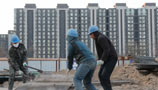
The rehabilitation process is complicated: Each different layer and type of soil must be separated and categorized. After the pits are leveled, the soil is replaced in the correct order and grass is planted to restore the natural environment.
"Within two years, the reclaimed grassland will look the same as the neighboring areas," Hu said. "The landscape will feature rolling hills and meadows, just like before. We are not building a soccer field, or anything that needs to be perfectly flat."
Hu said the deep pits could be turned into fishponds, citing several successful examples.
Nevertheless, the fear of accidents means no one involved will feel safe until the last day of reclamation work is over.
"I go to the rehabilitation site at least three times a week to keep a close eye on the progress," said Liu. "We have no comparable examples to learn from, and so we can only experiment."
According to Wang Chunqiu, the supervisor of the rehabilitation work, there are many undetected pits in the area.
"Some parts didn't collapse but the land above is too fragile to bear much weight," he explained. "If our heavy bulldozers drive on that area, terrible accidents could occur and they could fall into the pits.
"Consequently, we often question the miners, even the former illegal extractors who once worked here, about the location of pits. At least they are familiar with the landscape and are more experienced in some fields than we are."
- Wang Kaihao and Yang Fang in Hulunbuir, Inner Mongolia


Copyright 1995 - . All rights reserved. The content (including but not limited to text, photo, multimedia information, etc) published in this site belongs to China Daily Information Co (CDIC). Without written authorization from CDIC, such content shall not be republished or used in any form. Note: Browsers with 1024*768 or higher resolution are suggested for this site.
License for publishing multimedia online 0108263 Registration Number: 130349