

Green and clean car promotions begin to pay dividends
Updated: 2012-03-13 09:25 Comments()
  Print
Print  Mail
Mail  Large Medium Small
|
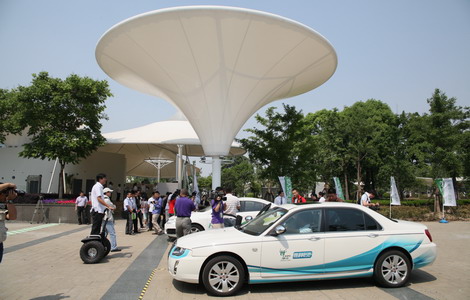 New electric cars on display at Jiading Auto City, Shanghai. [Photo / Provided to China Daily] |
Despite lingering consumer doubts about the technology and practicality of electric vehicles, the Chinese government and automakers are pushing ahead with the development of green cars.
Buyers of hybrid cars, which run on a combination of batteries and conventional engines, are entitled to a direct central government subsidy of 5,000 yuan ($790) per vehicle, while a rebate of up to 60,000 yuan on the purchase price is offered to buyers of battery-driven cars.
Other than government incentives, auto manufacturers are luring buyers of their alternative cars with free maintenance and a range of personalized services.
Their combined effort to promote greener cars on Chinese roads is beginning to pay off. A survey by the China Association of Automobile Manufacturers showed that 8,159 hybrid and electric cars were sold nationwide in 2011. All together, there are more than 10,000 green cars on China's roads.
The energy conversion rate of electric vehicles in general is 46 percent higher than in internal combustion engine cars, and they have the potential to reduce carbon dioxide emissions by up to 68 percent, said Raymond Tsang, partner at Bain and Company.
The majority of early converts to green cars are college-educated young professionals in major cities. For instance, Zhao Yu, a 30-year-old office worker at Shanghai International Automobile City, in Jiading, a district of the Shanghai municipality, bought a hybrid car domestically produced by BYD "to show support for my district's reputation as the country's showroom for energy-efficient cars".
Jiading, home to Shanghai Automotive Industry Corporation (Group), one of China's largest car manufacturers, considers itself a suitable testing ground for popularizing the use of clean cars.
All the promotions were making Zhao feel embarrassed every time she drove her gas-guzzling, pollution-belching, sinister-looking lump of a sedan to work every day. To repent, she spent 160,000 yuan in April last year to buy BYD's new hybrid model, the F3DM, to drive to work and show her eco-friendly credentials.
To her surprise, buying the car has brought benefits that make her feel like a pampered child. For a start, she received close to a 40 percent, or 60,000 yuan, rebate from the central and local governments on the purchase price of her hybrid car. What's more, she was told she could enjoy free battery recharge at stations sprouting in the city, compliments of the Jiading district government.
"I am still getting the hang of owning and driving a hybrid car," she said. But the many incentives have removed any earlier doubts she had about the economic sense of buying one. "I feel like I am one of the chosen few," she said. That feeling, she added, "makes me feel immensely proud of my decision".
Zhao's F3DM can go as far as 150 kilometers in hybrid mode, a range long enough to make the daily round trip from her home to the office and back. "I never need to worry about running out of juice in the middle of nowhere," she said.
In electric power mode, the batteries can sustain up to 90 minutes' driving, or 80 kilometers, before the gas engine takes over. "I only need to recharge the batteries once every day, after I get to work," Zhao said.
The good thing, Zhou added, is that her car is smooth and quiet. What's more, it saves her quite a bit on fuel costs, compared to her other car, which she drives only on weekends.
"But the shortage of recharging stations outside Jiading has made it impractical to take my hybrid anywhere other than the office," she said, sighing. Otherwise, she said, "I would have sold my old car in a jiffy."
China's strategy to develop new energy cars has gained sufficient ground on many fronts. When coal imports began to exceed exports in 2009, the government saw the urgent need to reduce the country's dependence on fossil fuels and launched a campaign to widen the use of alternative energy sources.
The country also faces the challenge of reducing greenhouse gas emissions in every sector of the economy. An area that has raised great concern is emissions caused by the explosive growth of the car population in the many sprawling urban districts. As a result, great emphasis has been placed on the development of green cars that can be widely accepted by consumers.
On the policy front, the development of the electric vehicle industry has been set as a priority of the Ministry of Science and Technology since 2001. The resulting "863 Electric-Drive Fuel Cell Vehicle Project", a State-level, high-tech development plan, received an initial investment of 800 million yuan, said Wang Tianwei, policy director of the policy coordination department of Jiading Auto City.
On the regulatory front, the Ministry of Industry and Information Technology and the National Development and Reform Commission passed at least 20 new regulations in the past decade to regulate and promote wider use of hybrid and electric cars.
These combined efforts centered on a multiple of tax incentives to manufacturers as well as price subsidies to customers. The original target was to make the country a world leader in electric vehicles by putting 500,000 units on the road by 2011. But held back by technology constraints and policy coordination, the deadline has been extended to 2015.
Electric car pioneers, including SAIC, Chery and BYD Motors have indicated their commitment to the development of electric vehicle technologies. SAIC, for instance, is planning to introduce Roewe E50, an all-battery-powered vehicle with the latest technology, by late 2012.
The car, which produces zero emissions, has a range of 120 kilometers on a full charge, compared to about 80 km for the existing models.
According to Hu Maoyuan, SAIC chairman, the E50 is "a result of the company's efforts", which he described as an example of "indigenous innovation". The company holds the patent and rights to all the key technologies it developed for this project.
To be sure, there are snags to overcome before hybrids and battery cars become a common sight on Chinese roads.
Battery performance remains the challenge to the practicality of electric vehicles. Wang said Chinese companies still lag far behind their competitors in the West and Japan in battery technology.
A study conducted by the United Nations Department of Economic and Social Affairs said China holds just 1 percent of the total patent registrations for lithium ion batteries, while Japan owns 52 percent and the US owns 22 percent.
Tsang said he believed China has many advantages for developing electric vehicles, including availability and integration of resources, and strong government support.
Contact the writers at quyingpu@chinadaily.com.cn and hewei@chinadaily.com.cn?

 IDEO
IDEO
|
|
|
|
 HOTO
HOTO
 EWS BY BRAND