|
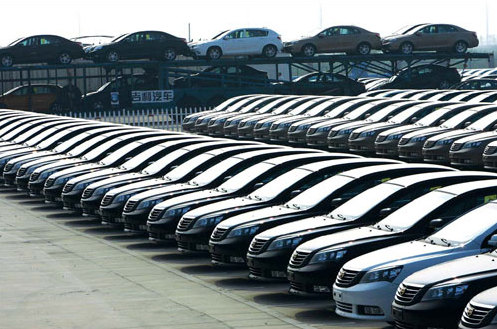
An inventory glut often means mounting losses. Carmakers that respond with lower quality materials and services might only fuel their downward spiral. Cui Xinyu / Xinhua |
China now has 72 brands, 65 percent factory use rate
Last month, the China Association of Automotive Manufacturers predicted that more than half of Chinese domestic passenger vehicle brands would cease to exist in the next three to five years.
Excessive market competition - especially from foreign brands - was cited as the main reason behind the prediction.
If we combine the current deceleration of the Chinese economy with the negative effect the slowdown has had on vehicle sales - sales are growing, but slower than expected - then CAAM's forecast seems reasonable. If we then mix in the toxic level of vehicle production capacity that exists in China today, then CAAM's forecast morphs from mere possibility to high probability.

While rapid extinction of brands would likely produce a measure of turmoil in the short term, such a shakeout would likely have a positive effect on China's automotive industry and the consumers in the long-term.
Slower sales are not the biggest challenge facing China's automotive industry. In fact, new light vehicle sales are expected to reach 19.4 million units in 2012, an increase of 8 percent - or 1.5 million units - compared to 2011. While this is not the double-digit growth that China regularly experienced in years past, 8 percent annual growth is still healthy and especially vigorous for what is already the world's largest market for new vehicle sales.
Real challenge
Instead, the real challenge facing China's industry is its massive production overcapacity.
There are 72 light vehicle brands being built in China today, and the automakers behind those brands have capacity to produce an astounding 28.5 million vehicles annually, according to LMC Automotive. To put that figure in perspective, it is nearly as much world's next largest automotive producers - Japan, the United States, and Germany - combined.
The general business formula for any manufacturer - regardless of industry - is to invest in new products and manufacturing capacity, produce their new wares, and sell them to consumers, bringing in revenue to pay off their initial investment, while realizing a reasonable profit. That's pretty straightforward.
In the automotive space, however, this formula is much more complex and risky.
That's because the mass manufacture of a single vehicle regularly requires years of planning, the coordination of hundreds of suppliers and thousands of workers, and the investment of hundreds of millions or billions of dollars in product development, regulatory certifications, manufacturing facilities, capital equipment and distribution operations. What is more, all this effort and investment must be made before a single vehicle is produced or sold.
With so much time and money invested in vehicle production - with no promise of a return - automakers are under tremendous pressure to utilize as much production capacity as possible to recoup their initial capital outlays.
General rule
While the industry varies from nation to nation to some degree, the general rule of thumb is that a vehicle production plant needs to operate at 80 percent capacity to break even on operations, with every vehicle after that contributing to profit. In another way, this means automakers need to produce and sell vehicles for 9.5 months out of the year to cover costs in order to start to earn profits during the last 2.5 months.
In 2012, light vehicle makers in China are expected to produce about 18.5 million new vehicles, according to LMC. This translates to an industry-wide utilization rate of just 65 percent, far below the threshold needed to reach profitability.
Naturally, some automakers are producing and selling vehicles at near capacity, and are doing just fine. But it is the others, those producing far-below capacities, which pose the biggest risk to the industry.
In the automotive industry, the preferred rejoinder to slowing sales is not to cut production - after all, the major investments have already been made. Instead, the characteristic response is to cut retail prices in order to stimulate demand. This action, in turn, causes other automakers - both the competitive and non-competitive ones - to also cut their prices. The result is a trend of deflationary pricing and reduced revenue for all, driving the weakest competitors into even more desperate circumstances.
This is what we are witnessing in China today.
Cost-cutting impacts
When revenue and profits are slashed, automakers naturally tend to look for ways to reduce overhead. This might include using cheaper materials to manufacture products, de-contenting of vehicles to cut costs, hiring cheaper (and less capable) vendors to provide essential services, reducing employee headcounts to shrink payroll obligations and rescinding customer perks that were formerly considered indispensable to creating a loyal clientele.
The predictable result of these actions, of course, is that vehicle quality suffers and customer satisfaction declines.
The likely outcome of the current situation in China, as CAAM has indicated, is that the weakest automakers will not survive. Of the 72 light vehicle brands being produced in China today, roughly 66 percent are domestic Chinese brands.
However, this two-thirds majority in numbers does not translate into an advantage in sales. Instead, China's domestic brands account for only about one-third of sales in the country's largest and most profitable automotive segment, passenger vehicles. Quite simply, there are too many competitors pursuing too few sales opportunities in a slowing market.
Lagging behind
Besides the frenzied competition, there are other issues crowding in on many of China's domestic automakers.
These include lagging product performance in areas such as quality, technology, safety and refinement; relative inexperience in marketing, branding and distribution strategies; satisfaction gaps in sales and customer service; and competitors who are better positioned to withstand a market downturn due to profits earned in other markets.
Each of these issues present significant challenges that all Chinese domestic brands have to confront - and that only a few will be able to address successfully.
Unquestionably, a mass culling of China's domestic brands will have serious repercussions for the affected automakers, and the companies that support them.
However, for those brands that survive, such a thinning of the ranks should lead to a much healthier industry, where rather than fending off competitors in a fierce battle of attrition, automakers can focus on building better vehicles and providing superior value, while retaining current customers and winning over new ones.
The writer is the senior vice-president of JD Power and Associates
(China Daily 08/27/2012 page19)

Copyright 1995 - . All rights reserved. The content (including but not limited to text, photo, multimedia information, etc) published in this site belongs to China Daily Information Co (CDIC). Without written authorization from CDIC, such content shall not be republished or used in any form. Note: Browsers with 1024*768 or higher resolution are suggested for this site.
License for publishing multimedia online 0108263 Registration Number: 20100000002731