There are about 250,000 cars in the rental business in China, with the number expected to grow to 430,000 by 2014. Revenue from the industry is forecast to rise from 18.2 billion yuan ($2.91 billion) to 28 billion yuan, according to a report by Roland Berger Strategy Consultants in late 2012.
Earlier media reports said that by the end of 2011, the top five car rental businesses only occupied 9 percent of the market in China, compared to 95 percent in the US.
|
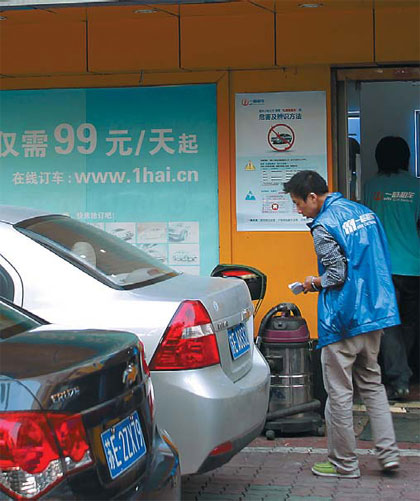
An employee checks cars at an eHi Car Service outlet in Shanghai in October 2010. [Photo/China Daily] |
"I am afraid the situation is still unchanged," Zhang said.
This contrast shows that China's car rental industry is still highly fragmented, whereas in the US the market is highly concentrated among a few large players, he added.
China's fragmented market has triggered fierce competition. Some companies have introduced rental charges of less than 50 yuan a day, while the lowest charge in the US is $30.
Meanwhile, there is a constant war of words between competitors, including allegations of price-cheating and operating problems.
More importantly, profit margin remains a thorny issue.
Insiders said all companies in the car rental industry are experiencing losses, and a daily rental fee of 100 yuan is unlikely to cover the cost of maintaining vehicles and hiring staff. But many firms are looking to claim a bigger market share by expanding to more locations and offering lower prices.
"This is a sector that emphasizes capital input. And vehicle depreciation represents a major cost in our industry," Zhang said.
His company received a capital injection of $50 million from US-based Enterprise Holdings in early 2012, through a 15 percent stake transfer. Before this, the company raised $95 million through three rounds of funding from venture capital.
"We plan to balance profitability and market expansion at the same time. Both are important for us," Zhang said.
His company will buy 6,000 new cars in the next four months, with an investment of 600 million to 700 million yuan.
On the other hand, eHi is also trying to explore a market niche featuring a green lifestyle. It will be the first company in China to include e-cars in its rental business.
Consumers remain hesitant about buying electric cars due to inconvenience during maintenance, and charging services.
"By taking care of these issues, we can give the public more opportunities to experience green mobility, and help them make the right decision," Zhang said.
From this month, customers in Shanghai will be able to rent an e-car for about 150 yuan a day, with eHi planning to equip recharging stations at its stores scattered across the city.
Buying an electric car may cost more than 100,000 yuan, including a government subsidy, and is a big decision for many. However, renting such a car for a weekend trip is less expensive than a decent dinner for two. So long as there are more people willing to try this, there may be more buyers, Zhang said.
As China's middle-class expanded dramatically over the past 20 years, cars became the new symbol of prosperity.
However, with more than 13 million sold in China last year, vehicle emissions have become the single biggest source of PM2.5 -particulate matter with a diameter less than 2.5 micrometers that forms in the air and is small enough to enter deep into the lungs. Thick smog has plagued large cities, including Beijing, periodically since late 2012.
The Chinese authorities started offering subsidies of 60,000 yuan to buyers of electric cars three years ago. Some city governments have also been handing out similar subsidies.
In Shanghai, buyers of electric vehicles can also receive a free local license, which costs about 80,000 yuan at an auction market. But despite these measures, sales of e-cars have not matched expectations.
"The major problem lies in an insufficient supply of recharging stations," Zhang said. Nationwide, there are about 10,000 stations, with around a fifth of them in Shanghai, mostly in the city's outskirts.
Zhang uses a BMW for business travel. He has bought a hybrid vehicle for his parents living in the US, and plans to change his own car to an e-vehicle.
"It is my dream that one day all the cars we provide for rental are electric cars," he said.
xieyu@chinadaily.com.cn

Copyright 1995 - . All rights reserved. The content (including but not limited to text, photo, multimedia information, etc) published in this site belongs to China Daily Information Co (CDIC). Without written authorization from CDIC, such content shall not be republished or used in any form. Note: Browsers with 1024*768 or higher resolution are suggested for this site.
License for publishing multimedia online 0108263 Registration Number: 20100000002731