"BMW is better to drive, Benz better to ride in," goes a saying in China, implying that the BMW handles well, while Mercedes-Benz should be a chauffeur-driven sedan for transporting passengers in style and comfort.
Even without the cost of a chauffeur, Mercedes-Benz owners in China need fat wallets to pay for maintenance and repairs. Replacing all the parts of a locally produced C-Class compact sedan costs 12 times the price of the same new model, according to a recent report by the Insurance Association of China and China Automotive Maintenance and Repair Trade Association.
"Big Mercedes-Benz sedans are undoubtedly for business tycoons. If I hadn't had a 25-percent discount on my little C260, my Benz dream wouldn't have come true. But when I need to repair it, I'm afraid the dealer will try to get back the money they helped me save," said Tony Tao, a 34-year-old architect in Beijing who traded his Volkswagen Sagitar for a C-Class last year.
For the time being, the German "Big Three" dominate the luxury car market in China. Among less expensive models, however, competition is fierce with Audi parent Volkswagen AG and General Motors Co. (GM) vying for the car-seller crown, while automakers such as Japan's Nissan, Republic of Korea's Hyundai and China's Great Wall also battle for a share.
The Chinese also have definite ideas about the status of lesser brands. GM's Buick brand, for example, is known by China's older generation for its limousines for dignitaries such as Dr. Sun Yat-sen and late Premier Zhou Enlai
Capitalizing on that history, GM started to produce the Buick Regal in Shanghai in 1999, and the model soon became popular with government officials. After exiting bankruptcy in 2009, GM tried to reinvent its "damaged" brands, introducing the new Buick Regal and Excelle as well as the Chevrolet Cruze in China to attract young customers.
"Buick is an old brand, but my friends all agree that the Excelle hatchback has a handsome, sporty look," said Zhu Beicong, a 25-year-old Buick Excelle owner, who works for China Unicom, a major state-owned telecom operator.
Following up on the success of Buick and Chevrolet, the Detroit-based auto giant also aims to breathe new life into Cadillac in China, where the brand was a big status symbol like Mercedes-Benz in the 1990s.
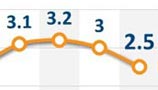
As the market grows, China's domestic automakers are losing ground to foreign-invested joint ventures and imports. In March, sales of Chinese-brand passenger cars shrank 2.3 percent from a year earlier while the overall market grew 7.9 percent, according to the China Association of Automobile Manufacturers. Their market share shrank by 4.1 percentage points to 39.3 percent.
Why do Chinese car buyers overwhelmingly prefer foreign brands to homegrown ones? The answer can be summed up in one word: image. Most Chinese brands are seen as substandard, unsafe and copycat. Foreign rivals easily outgun them as status symbols.
To fight the trend, FAW, China's oldest automaker, plans to revive the Hongqi, or "Red Flag," the country's most famous homegrown car brand, which originally built official limousines for the Communist Party elite and state guests.
In 2013, when Foreign Minister Wang Yi abandoned his Audi A6 for the latest Hongqi H7 sedan, Chinese media trumpeted a possible new dawn for Chinese brands. But only 3,000 H7s were sold last year. In comparison, it took Audi just two or three days to sell the same number of cars in China.
Jia Xinguang, an independent auto analyst in Beijing, says the foreign minister's choice of the Hongqi H7 has more political than market significance.
"FAW builds political cars," he said, "while automakers like Volkswagen and Toyota manufacture people's cars -- good cars that ordinary people can afford."
Clearly, it is going to take more than a minister to change Chinese perceptions about auto brands.
|
 |
 |

Copyright 1995 - . All rights reserved. The content (including but not limited to text, photo, multimedia information, etc) published in this site belongs to China Daily Information Co (CDIC). Without written authorization from CDIC, such content shall not be republished or used in any form. Note: Browsers with 1024*768 or higher resolution are suggested for this site.
License for publishing multimedia online 0108263 Registration Number: 20100000002731