|
 |
|
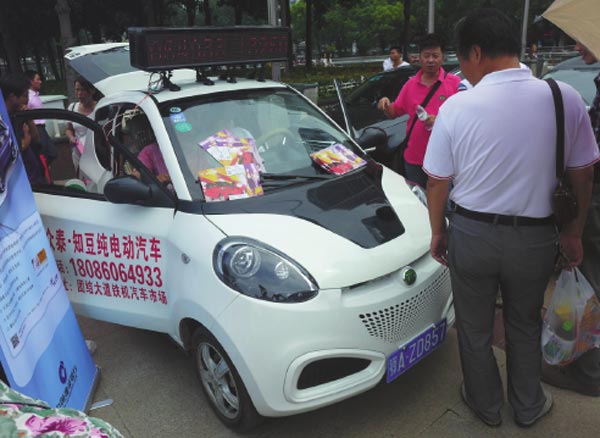
Local visitors are attracted by a Zotye Zhidou electric car at an auto show in Wuhan, Hubei province. With a price of about 40,000 yuan, the low-cost EV has a range of 120 kilometers on one charge, with a top speed of 80 km per hour. [Photo/China Daily] |
Low-cost, low-speed EVs have stimulated the growing popularity of new-energy vehicles in China
Apocryphal or not, the story of the Norwegian fishing boat captain who mysteriously succeeded in landing catch after catch of live fish gave rise to the term "the catfish effect".
When faced with the challenge of maximizing his revenue by selling live rather than frozen sardines, this legendary fisherman came up with an ingenious solution, which only came to light after his death.
In order to keep his valuable catch alive, he introduced a catfish to the tank containing his haul. The usurper incited the sardines to swim harder and faster, thus keeping them alive.
The term is now used to describe how existing players in a given market are prompted to improve their products and services when faced with a new and unexpected competitive element.
The appearance of low-cost electric vehicles-or EVs-in China in 2014 had much the same effect. Their market debut left existing players with no choice but to up their game in order to avoid losing market share.
The automotive industry in China has long been eager to explore the potential of EVs and three overriding factors underpin this objective.
The first is the hazardous air quality, for which vehicles, coal and industrial activities are the worst culprits. A number of cities in China have already implemented restrictions on car purchases in an attempt to address the problem, leaving buyers with a stark choice: either participate in an auction or lottery to acquire a car, or choose a new-energy vehicle.
The second factor is China's reliance on imported oil. Given that foreign oil imports accounted for 60 percent of the market in 2014, the use of alternative sources of energy to reduce oil consumption has become a major priority for the government.
The last factor is the government's ambitious goal for the new energy vehicle market: cumulative sales of 5 million units before 2020.
However, the gap between the government's target and the reality of the market cannot be ignored. In 2013, there were fewer than 8,000 electric cars on the road in China, while during the first three quarters of 2014, only 8,200 units were registered.
To clarify this disparity, we must look at the three principal obstacles that stand in the way of market expansion.
First, the retail price of EVs remains high in China and is beyond the reach of the wider public, in spite of the subsidies available. For example, the BYD E6 would cost a buyer anywhere from 210,000 yuan ($34,257) to 260,000 yuan inclusive of any discounts from subsidies. The same buyer could buy a BMW 3 Series or a Mercedes-Benz C class for roughly the same price.
Second, we cannot escape the lack of charging facilities for EVs in cities across the country.
And finally, the falling oil price now means that the payback period for an EV will exceed that for a traditional car.

Copyright 1995 - . All rights reserved. The content (including but not limited to text, photo, multimedia information, etc) published in this site belongs to China Daily Information Co (CDIC). Without written authorization from CDIC, such content shall not be republished or used in any form. Note: Browsers with 1024*768 or higher resolution are suggested for this site.
License for publishing multimedia online 0108263 Registration Number: 130349