 |
|
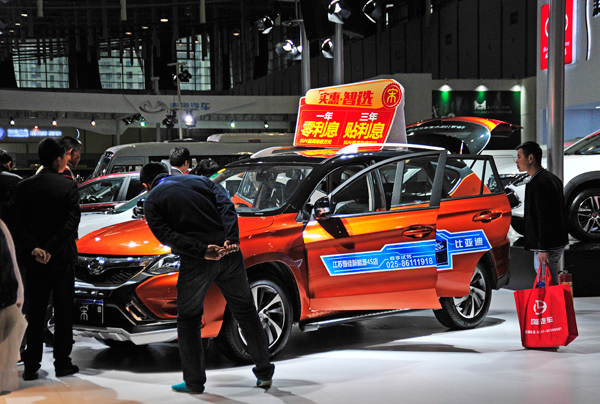
Visitors check out a new energy car at an energy conservation and new energy auto show in Nanjing in April. Xing Qu / For China Daily |
The central government is tightening regulations in a bid to cleanse the market and improve the industry's international competitiveness
China's Ministry of Industry and Information Technology is seeking public opinion on a new draft of regulations for the new energy vehicle sector, signaling its intention to bring order into the somewhat chaotic sector.
Compared with the 2009 version, the draft released on Aug 12 is much stricter about products and car manufacturers, and experts say it is intended to improve the sector's competitiveness and cleanse the market, which is plagued by shoddy products.
The new draft has streamlined the definition of new energy vehicles to cover purely electric vehicles, plug-in hybrids and fuel-cell cars, and demands that makers monitor the condition and reliability of cars during their whole lifespan.
Zhang Zhiyong, an independent auto analyst in Beijing, believes that as the quality of their vehicles would be monitored for life, carmakers would have to pay more attention to quality and gradually generate a virtuous cycle of building customer confidence in their products and promoting sales.
China has more than 200 manufacturers of new energy passenger vehicles, buses and special-use vehicles, but it lags behind global leaders in terms of quality, reliability and key technology, according to a report released in July by the National Development and Reform Commission.
Executive Vce-President of the China Association of Automobile Manufacturers Dong Yang, said that the ministry has a goal to reduce the number of such manufacturers to around 10 competitive ones.
According to the draft, carmakers would not be allowed to apply for a license unless they are capable of developing the control system and coordinating the power and drive systems. In the 2009 version, knowledge of one of the three systems was sufficient and both carmakers and car modifiers were allowed to apply for a lisense.
Huang Xili, an auto analyst at Changjiang Securities, said in a report that the revision would make it difficult for companies to enter the sector but would benefit companies that have been working hard in research and development, including BYD and JAC.
Some experts, including Zhang, believe that it would be better if there are clearer and more detailed definitions of "developing" a system.
Huang does not share concerns that removing car modifiers would affect sales. Citing statistics from his company, he said electric cars from car modifiers accounted for 30 percent of the total sold in 2015 but carmakers can compensate for those parts because they have sufficient capacity.
Industry insiders also believe the revised rules would prevent repetition of previous cases in which cottage-like companies falsely gained government subsidies.
China promulgated plans in 2009 to stimulate the sector and set a goal in 2012 to have 5 million new energy vehicles on its roads by the end of 2020.
To that end, China's central and regional governments started offering subsidies in 2010 to makers and buyers of new energy cars, and there were reports of some companies illegally claiming subsidies by producing sub-standard cars and selling them to their subsidiaries.
A report from the State Council, China's Cabinet, showed that the central government gave 28.4 billion yuan ($4.25 billion) in subsidies, with regional governments offering more than 20 billion yuan to the sector from 2013 to 2015.
Dong said once the black sheep are removed, the market will be cleaner and people will have easier access to well-developed and better-made products.
In addition to making it difficult for newcomers to enter the sector, the revised regulations also demand that those already on China's list of carmakers and auto products must reapply for lisenses within 24 months.
Despite the absence of detailed rules, it is clear that the ministry will introduce a mechanism of coming and going instead of staying permanently on the list once approved.
By the end of 2015, there were 277 new energy models on the list but only 43 had annual production of more than 1,000 units in the year, according to statistics from the ministry.


Copyright 1995 - . All rights reserved. The content (including but not limited to text, photo, multimedia information, etc) published in this site belongs to China Daily Information Co (CDIC). Without written authorization from CDIC, such content shall not be republished or used in any form. Note: Browsers with 1024*768 or higher resolution are suggested for this site.
License for publishing multimedia online 0108263 Registration Number: 130349