Lower-tier cities set to fuel auto market growth for decade


 |
|
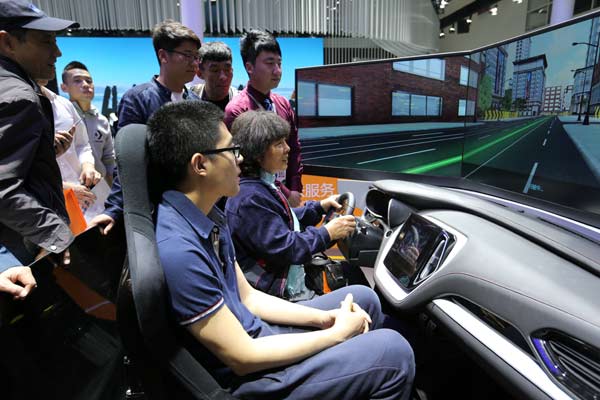
Visitors test a driving simulator during last year's Beijing auto show. With steady economic growth, experts say there is likely to be a sustained demand for automobiles in the years to come. [Photo by Wang Zhuangfei/China Daily] |
The world's largest automobile market could continue expanding for a further decade, fuelled by the increasing incomes and aspirations of residents in China's lower-tier cities.
The China Association of Automobile Manufacturers made its prediction that the new car market volume could touch 29.4 million units this year, at round 5 percent annual growth from 28.1 million units in 2016, at a news conference on Thursday in Beijing.
The association also anticipated the passenger car sales volume could climb around 5 percent to 25.7 million units this year from 24.4 million units last year.
The anticipated 5 percent growth rate is substantially lower than the 14.5 percent leap in the auto market in 2016, as CAAM took the deflating effects of the tax deduction policy into consideration, according to Xu Haidong, assistant to the association's secretary-general.
Tax cuts were revised to 25 percent on cars with 1.6-liter engines and smaller from 2017, from the 50 percent tax cut in 2016. Buyers of such vehicles this year will pay a tax rate of 7.5 percent of the purchase price, about 5,000 yuan ($710) more for models priced at around 200,000 yuan.
The association's research paints an optimistic picture for the market as more families will make their first purchases and more will replace their vehicles, as the country's overall economic development fuels consumption over the coming five to 10 years.
'Still huge potential'
Speaking of the anticipated growth in consumption, Xu said: "When people are wealthier as a result of economic growth, car purchases tend to grow simultaneously. There is still huge market potential in China."
He continued: "The Chinese auto market is far from mature. The average car ownership in 2017 might reach 119 units among 1,000 Chinese people, which is far less than that seen in the saturated markets in developed countries where ownership rates are many times higher".
As an example, the car ownership rate was more than 800 units among 1,000 people in the United States in 2015.
Zhang Zhenhua, vice-president of Nielsen China, echoed the sentiment that the positive Chinese economic trend will help the expansion of the middle-income group, and result in the sustained growth of the auto market for at least the next five years.
She told China Daily: "Besides the constantly growing middle-income group, China's ongoing urbanization will result in more of the country's rural residents relocating to urban areas. There will a greater demand for cars because of this shift.
Liu Shijin, former deputy director of the Development Research Center of the State Council, said in an earlier interview that consumers in Chinese cities ranked lower than third tier are becoming the main drivers of the growing sales volume of new cars, due to the fact that such cities do not place restrictions on new car license plates, as first-tier, and many second-tier, cities do.
SUVs preferred
Consumers in cities ranked below third-tier tend to prefer sport utility vehicle models, according to Nielsen China. According to Zhang, one reason for this is the poorer condition of road surfaces in such cities.
Shi Jianhua, deputy secretary general of CAAM, said: "SUVs meet several of their needs in one car. For example, the younger generation like SUVs because of their trendy shape; some choose them because of higher clearance and roomy trunk.
"Many Chinese customers now buy SUVs as their family's first vehicle, instead of the second car as previously tended to be the case."
Statistics from CAAM show that more than 9 million SUVs were sold in 2016, marking a 45.7 percent rise year-on-year, 11 times higher than the 3.9 percent increase in sedans and hatchbacks which registered 12.1 million units sales.
Shi anticipated a higher growth rate for SUV segments because the association found that as many as 85 percent of potential car buyers are looking at SUV models with a view to buying.
"The sales volume of SUVs might overtake that of the total of sedans and hatchbacks. It might not happen this year, but it is highly likely that it will happen in the next couple of years," he said.