


 Comments()
  Print
Print  Mail
Mail  Large Medium Small
Innovative
"I cannot imagine a more beautiful picture than a farmer using a mobile phone near his farm house, with the blue sky and green fields," Wang said.
China Mobile is very much a State-owned company. It shoulders the responsibilities of constructing telecommunication facilities, providing telecom services and hands over profits to the government.
However, unlike most State-owned enterprises, such as banks and oil companies, China Mobile demonstrates a noticeable characteristic - a willingness to embrace innovation. Analysts said this is because the telecom industry by its very nature has a close relationship with innovation. Moreover, Wang, the leader of China Mobile, was good at making long-term strategic moves.
He said the telecom industry changes fast and mobile Internet is perhaps the biggest ongoing change.
Mobile Internet is a convergence of the telecom industry and the Internet industry. Therefore, Internet companies and handset manufacturers compete for market share, which squeezes the profits of traditional telecom businesses, such as voice and text messaging, and pressured telecom operators to transform.
On many occasions Wang has said telecom operators are going to compete with outsiders, such as Google Inc and Apple Inc. "If we take no action, operators may gradually become a silent pipe," he warned.
As more people use mobile phones to surf the Internet, Wang estimated that in the future the volume of data will be more than that of voice alone, and telecom operators should prepare for that.
"The data business will become more and more important," he said.
As early as 2000, China Mobile introduced the "Monternet" platform, which enables customers to get access to various value-added services, such as short message services and Color Ring, a service that allows subscribers to customize ring tones.
After Wang took office, China Mobile took even bigger strides toward new business fields.
The company started to build up nine business bases in different Chinese cities from 2006, including a wireless music base in Chengdu and a mobile video base in Shanghai. The function of the nine bases is to produce content and find effective business models in the mobile Internet era.
Like some innovative companies in the Internet industry, China Mobile also developed its own mobile operating system, called Ophone, in 2009, and an instant messaging tool, Fetion, which has close to 100 million active users.
In China Mobile's mobile Internet strategy, its application store, the Mobile Market, is expected to play a core role. The Mobile Market is the world's first mobile phone application store set up by a telecom operator. After it was launched in August 2009, the number of applications grew to more than 95,000 by October 2011.
Every new business attempt reflects China Mobile's response to the crossroads of industry convergence. "However, we haven't seen significant progress in China Mobile's data businesses so far," said Huang Meng, a telecom analyst with Beijing-based research firm Analysys International.
The revenue contributed by data businesses accounted for less than one third of China Mobile's total turnover. In times when China Mobile can achieve rapid growth by increasing user numbers and strengthening its voice business, it is no hurry to find new revenue sources.
"But when the domestic mobile market nears saturation point, it will be extremely critical for the company to boost its data businesses," Huang added.
A fluent English speaker, Wang is a man with a global vision. His amiable nature and openness to partners, investors and the media has helped China Mobile to increase its brand recognition around the world.
Unrealized dreams
However, to truly lift the influence of China Mobile in the world, the company should expand its business overseas, Wang said. The global market will provide new revenue engines, especially when China Mobile faces domestic challenges arising from industry convergence, intensified competition and increasingly high mobile penetration.
The mobile giant has conducted only one overseas acquisition so far. It bought Paktel Ltd, a loss-making Pakistani carrier, in 2007 for $284 million from Millicom International Cellular SA. The company was renamed China Mobile Pakistan, or CMPak, and its services were rebranded as "Zong" in 2008.
"More than four years ago, when we bought Paktel, it was on the brink of bankruptcy. Now the company can generate enough cash flow to maintain its operations," Wang said.
The Zong brand has seen the largest net growth in cellphone users in Pakistan in the past three years, according to the Pakistan Telecommunications Authority. Zong had a user base of 13.2 million by October, rising from fewer than 1.5 million in 2007.
With Pakistan as an example, China Mobile intends to expand its operations to a greater number of emerging markets. The company is also seeking opportunities to become a minority shareholder in telecom carriers in the European or North American markets, said Wang.
Another aspect of China Mobile's globalization is to promote the homegrown Time Division Long-Term Evolution (TD-LTE) 4G technology to be adopted worldwide.
Compared with FDD-LTE, another 4G technology, the world has been slow to adopt TD-LTE technology. Five commercial TD-LTE networks have gone into operation in countries such as Saudi Arabia, Japan and Brazil - far fewer than the 33 FDD-LTE commercial networks that have been deployed around the world.
As a man who saw Chinese homegrown 3G technology failing to become truly international, Wang said China Mobile is going to support TD-LTE technology with all its strength. "If China Mobile finds opportunities that will help TD-LTE technology to go global, we will be interested in investing," Wang said.
The company is also actively promoting the convergence of TD-LTE and FDD-LTE technology. "I hope in the era of 4G nobody will have to talk about which wireless standard to choose because everyone will be able to access both TDD and FDD by using the same handset," Wang said.
The biggest challenge for China Mobile remains in the domestic market, as the "running elephant" starts to move at a much slower pace.
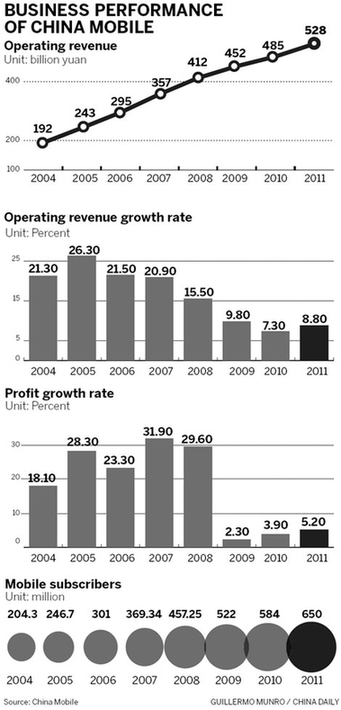
China Mobile posted a net profit rise of 5.2 percent to 125.9 billion yuan in 2011. Growth momentum in earnings picked up for the second straight year but at a much slower rate than it had in 2008 and in the years before that.
In the 3G market, China Unicom, the country's second-biggest telecom carrier, managed to outstrip China Mobile to have the biggest monthly net growth in its number of 3G users since last October. China Telecom Corp Ltd, the smallest carrier, is also growing quickly and became the second telecom carrier to introduce Apple Inc's iPhone series on contract on March 9.
In his farewell speech on March 22, Wang said his successor, Xi Guohua, a former vice-minister at the Ministry of Industry and Information Technology, has rich leadership experiences in the telecommunication industry. Xi values corporate strategy research and is good at viewing things from all angles, Wang said.
shenjingting@chinadaily.com.cn
Copyright 1995 - 2010 . All rights reserved. The content (including but not limited to text, photo, multimedia information, etc) published in this site belongs to China Daily Information Co (CDIC). Without written authorization from CDIC, such content shall not be republished or used in any form. Note: Browsers with 1024*768 or higher resolution are suggested for this site.
License for publishing multimedia online 0108263 Registration Number: 20100000002731