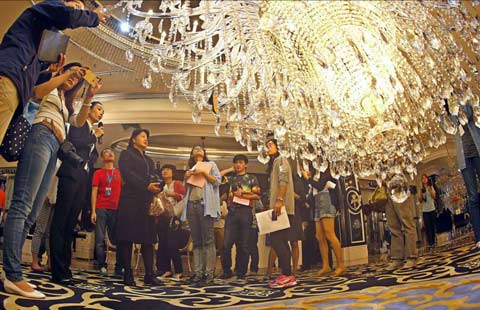
My cousin returned last month from a holiday in Canada carrying a new suitcase full of gifts for everyone in the family.
Luxury purses, cosmetics, electric toothbrushes, baby's toys, even milk powder, costing him nearly $10,000.
"I would have bought a house there, but for the foreign exchange controls," he laughed.
But it was actually no joke.
Chinese tourists splashed out more than $165 billion overseas last year to become the world's biggest spenders, a 28 percent rise year-on-year, according to data from the United Nation's World Tourism Organization.
But according to regulations set by the State Administration of Foreign Exchange, the foreign exchange regulator, every Chinese mainland citizen can exchange foreign currency worth no more than $50,000 each year, a level unchanged since 2007 when it was expanded from the previous $20,000.
And it's not just tourists who complain about the controls.
"The key issue is actually that our investment capital cannot freely flow out of the country," said Duan Wuqing, chairman of Shenzhen Zhongrong Insurance Ltd, who speaks for private companies that intend to make acquisitions overseas.
Under the government's tight controls of the capital account, it is hard for any privately owned mainland company to make overseas purchases directly through equity investment, unless it can raise money offshore using an overseas financing platform.
Recently Duan said he had considered becoming a major shareholder in a natural gas company in Estonia, for instance, but he had to look for partners from Hong Kong who could invest capital directly into the acquisition.
His ambition was sparked by the country's biggest ongoing economic initiative, to explore opportunities along the economic belt linking East Asia with Western Europe, the so-called New Silk Road.
This "Belt and Road Initiative" is expected to see huge amounts of Chinese capital invested in outbound infrastructure construction-and energy-related development projects.
As State-owned enterprises prepare to form a queue to make investments along the route, private companies are still confused about what controls they face on cross-border capital flows, and many are urging the country's top foreign exchange regulator to revise the rules to allow them to compete with SOEs.
Keeping control of the country's exchange rates has been one of China's most important macroeconomic measures since 1949, to safeguard financial stability against any global currency shocks.
Since China became more market-oriented as it deepened its economic reforms, particularly since joining the World Trade Organization in December 2001, SAFE has been willing to open the current account accordingly, allowing money to be freely exchanged in cross-border trade of goods and services.
As China became one of the world's largest exporters, foreign exchange controls have helped enlarge private sector deposits, and by the end of 2014 they had reached about $5 trillion, the world's highest.
Economic textbooks teach us that currency is the most powerful tool in allocating resources efficiently in a market-oriented economy.
But controls on the capital account have become too strict, meaning flows of cross-border capital investments are not as free as they should be as more Chinese seek to swap their resources for others, all over the world, in line with the government's economic policies of "going global", and of increased consumption.
The internationally acclaimed economist Stephen Roach wrote in his book Unbalanced: the Codependency of America and China that the restructuring progress of the world's two largest economies will determine the future of the global economic landscape.
With China being a country of excessive savers, and the United States a country of excessive consumption, however, we have created an imbalanced global economic structure, he said.
China's exchange rate controls have also created a significant imbalance between the country's own saving and spending, which is restraining consumption growth.
The country's central bank governor has reiterated on various occasions his plans to open the capital account by the end of December, based on a complete revision of the foreign exchange regulations.
At that time, the Chinese yuan will become a freely used global currency, which will mark a milestone for its internationalization.
Personal consumption helped build the "American Dream" a century ago.
This century, will the breaking of national currencies boundaries help realize the "Chinese Dream"?


Copyright 1995 - . All rights reserved. The content (including but not limited to text, photo, multimedia information, etc) published in this site belongs to China Daily Information Co (CDIC). Without written authorization from CDIC, such content shall not be republished or used in any form. Note: Browsers with 1024*768 or higher resolution are suggested for this site.
License for publishing multimedia online 0108263 Registration Number: 130349