 |
|
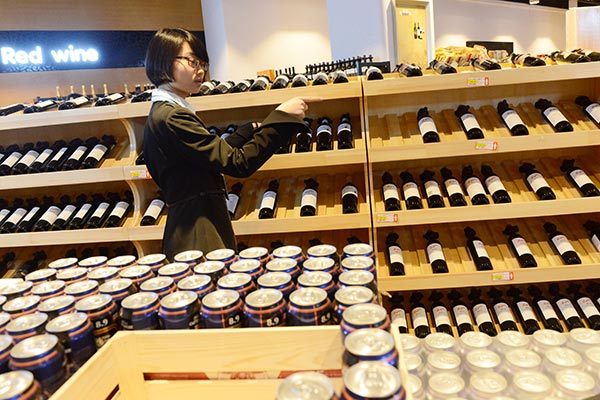
A customer chooses wine at a cross-border duty-free shop at the Zhengzhou airport, Henan province. ZHANG TAO / FOR CHINA DAILY |
But grapes could turn sweet for Anbang if it emulates other investors and invests in China's wines and spirits businesses. Alcohol appears capable of generating long-term returns on investment, a potential alternative to real estate that cash-flush, M&A-minded Chinese companies are snapping up worldwide.
Not just overseas vineyards and wineries, even alcohol startups launched in the past 10 years, are attracting big-ticket investments. In terms of funding globally, the top 10 alcohol startups received $686.4 million so far, according to Tracxn.com. Of them, five are from China that accounted for $533.3 million or 78 percent of the funding.
Beijing-based, NEEQ-listed Jiuxian.com, an AAA-rated B2C liquor e-tailer, alone received $310 million. Yijiupi, Jiubianli or Liquor Easy, Wine9.com (formerly Pinwine.cn) and YesMyWine.com are the other four.
Yijiupi's valuation zoomed to about 3 billion yuan ($463 million) in March after a fresh round of funding.
Online and online-to-offline B2B and B2C alcohol startups like these retail both imported and Chinese wines and spirits. Their colorful websites and apps offer cheap deals for shapely, bright porcelain or glass bottles, packed in leather cases, fancy wooden boxes or premium shopping bags.
In 2015, wine sales in China were worth 78 billion yuan, with imported wines accounting for 26 billion yuan. According to government data, online sales of tobacco and liquor products generated 196 billion yuan in 2015, up 13 percent.
An Analysys International report projects overall liquor sales in China at more than 1 trillion yuan this year. Alcohol e-commerce alone is expected to pull in nearly 60 billion yuan, or 5.6 percent of sales, next year.
Alcohol e-commerce has not only arrived in China but is set to rival other popular online shopping categories like cosmetics and fashion. This can be attributed to the growing number of young, knowledgeable, app-happy and lifestyle-conscious consumers in China, where focus has shifted to domestic consumption from exports.
Already, Shanghai-based YesMyWine.com claims it's the world's largest imported wine retail platform, with 1 million registered consumers and more than 5,000 wine products from 18 countries.
It sold 7 million bottles of wines in 2014 despite China's austerity drive that hurt import and sales of alcoholic beverages. Its Singles Day (Nov 11) sales via Tmall.com, a small part of its overall online and offline platforms, doubled to 40.5 million yuan from the 2014 festival.
Online marketplace JD.com expects to sell imported alcoholic beverages worth 10.5 billion yuan this year on its own, up from 400 million yuan last year. Sales of other alcohol merchants using its platform are expected to triple this year to 1.5 billion yuan.
Flush with funds, alcohol startups are expanding, setting up warehouses, offline stores and O2O tie-ups, and upgrading their IT systems, logistics and packaging. For example, Liquor Easy claims its express service reaches consumers in 20 minutes.
Competition could not only improve quality of both products and services but entail more ventures. China could see more startups focused on wine culture promotion, wine-related education, media and events, wine tourism, even innovative technology (like Kuwee's battery-operated, Wi-Fi smart-bottle that keeps wine fresh for 100 days).
Fruit wines may become popular. China Guangzhou Shunchangyuan Wine & Spirit Co Ltd will publicize its plum wine and litchi wine next week in Singapore at the inaugural ProWine Asia expo.
China has more vineyards than wine leader France, but grapes are mostly used as fruit. So, wine production in China may increase, potentially reducing the reliance on imports.
According to the International Wine & Spirit Research, by 2020, about 60 percent of the world's post-1990 generation will live in Asia with an expected $200 billion in disposable income. A significant part of it will likely be spent on alcoholic beverages.
Estimates suggest by the end of 2017, 4 billion bottles of wine, including 1.19 billion bottles of imported wine, will have been consumed in Asia, much of it in China, India and Southeast Asia. In volume terms, China tops country-wise consumption lists for both wines and spirits.
Chinese, it seems, will drink, no matter what-either to drown austerity- and slowdown-related sorrows, or to celebrate recovery and life itself. So, if a failed realty acquisition bid produces sour grapes, try to make wine and sweet profits.


Copyright 1995 - . All rights reserved. The content (including but not limited to text, photo, multimedia information, etc) published in this site belongs to China Daily Information Co (CDIC). Without written authorization from CDIC, such content shall not be republished or used in any form. Note: Browsers with 1024*768 or higher resolution are suggested for this site.
License for publishing multimedia online 0108263 Registration Number: 130349