Frugal billionaires good examples to follow in our Gilded Age


 |
|
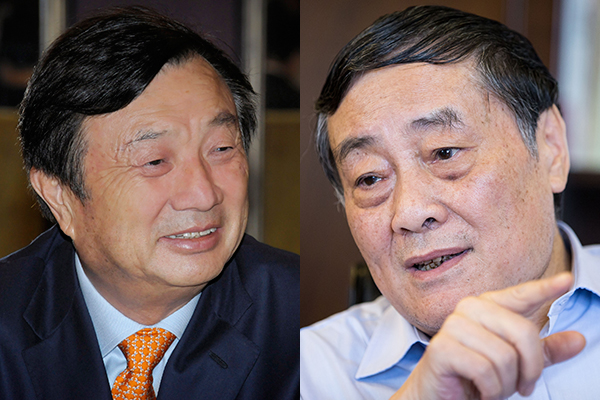
Ren Zhengfei (left), founder of the mighty Huawei empire, and Zong Qinghou, a beverage magnate. [Photo provided to China Daily] |
It's a traditional holiday season when many would pamper themselves with lavish spending. So indulge me while I wax lyrical about some penny-pinching Chinese billionaires.
One of them, Zong Qinghou, a beverage magnate with an estimated personal worth of $16 billion, recently caused a stir for traveling second class on a bullet train from Hangzhou, an eastern provincial capital where his company is based, to nearby boom town Yiwu.
It was a 50 yuan ($7.21), half-an-hour trip that the 72-year-old billionaire appeared to be enjoying as he chatted with his fellow passengers including a toddler. First and business classes costing 85 yuan and 158 yuan, respectively, were much more spacious and comfortable.
His staff said they had planned to travel first class. But after Zong realized there weren't enough tickets for everybody, he offered to downgrade. After posts of his ride later appeared on social media, people went gaga over the humility of one of the richest men in China, who could spend $10,000 every hour for the rest of his life or longer without going bankrupt.
Yet traveling second class was just one example of his stripped-down lifestyle including a cheap wardrobe, light meals, and total yearly living costs of about 50,000 yuan, according to people close to him.
Earlier, Ren Zhengfei, founder of the mighty Huawei empire, had also become an internet sensation, when he was photographed waiting alone at midnight in a line for taxi outside a Chinese airport, with an cellphone to his ear.
I've been thinking why people are so interested in their down-to-earth ways of living. Some probably have found them quirky, incarnating an oxymoron that contradicts their stereotypical images.
Chinese tend to believe that higher social status comes with greater purchasing power. So the successful should buy conspicuous or socially visible luxury products or services to indicate their higher social standing.
The roots of the Chinese conspicuous consumption could run deep in the tradition.
In a study of thousands of Chinese luxury consumers that was recently published in the journal Brand Research, Professor Zhang Mengxia from the University of International Business and Economics found that traditional cultural concepts play a part in their behavior.
While wealthy consumers with a high need for social status could be influenced by Confucian ideas of social hierarchy, Taoism motivates them in their pursuit of the finer things in life, the paper said.
It's true that more rich people now seek self-enjoyment rather than flaunting their wealth. However, the wealthy elite's extravagance remains standard fare in mass media that only reinforces perceptions of the Chinese rich associated with unabashed spending.
But isn't it their own business how the rich spend their money? How will all this impact ordinary people's lives?
Simply put, the spending patterns of the elites could have a cascading effect throughout society, as people tend to emulate behaviors of those in their own or higher social group. The rat race for status through conspicuous spending can reach down the social ladder to the very bottom.
While our living standards have improved, many of us are anxious about being less successful than our peers, which motivates us to buy bigger, better homes, drive more expensive cars and occasionally, have a taste of what it's like living the high life.
My wife and I always debate whether one has to spend money to make money. Billionaires like Zong and Ren who live a frugal life unexpected of them tell us that we shouldn't, at least for our lifestyle.