Related story: Red envelope fight flares among Internet giants by Meng Jing and Li Xiang
 |
|
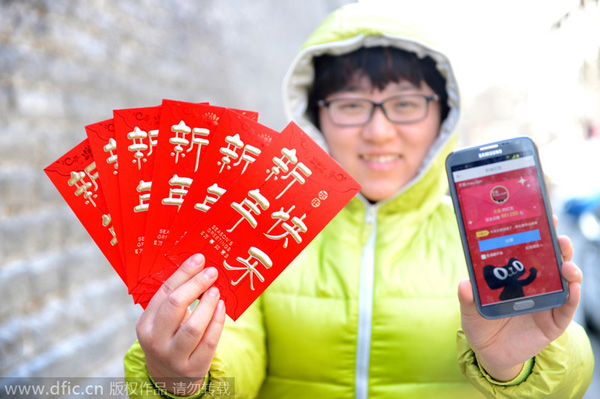
A girl holds the traditional red envelopes (left) and the electronic red envelopes (right) in Xi'an, Northwest China's Shaanxi province, Feb 2, 2015. [Photo/IC] |
Mobile services blocked amid fierce competition by rivals to prevent users being poached
Red envelopes-traditional monetary gifts sent at Spring Festival that are said to bring good luck-have gone viral amid hot competition to capture mobile payment users.
In subways, offices or restaurants, smartphone users are opening electronic red envelopes on social media platforms such as WeChat and Weibo or with e-payment tools such as Alipay Wallet.
"How much money have you got online?" has even become a new form of greeting in China.
More than 7 billion yuan ($1.12 billion) is expected to be spent by Internet firms during Spring Festival to lure new mobile payment users via cash-filled or coupon-filled red envelopes.
But brutal competition behind the red envelopes phenomenon has become a hot topic and has triggered mixed feelings.
WeChat, which is owned by Tencent and is China's most widely used mobile messaging app, fired the first salvo early this month by blocking red envelopes sent from Alipay Wallet, the mobile payment service owned by e-commerce giant Alibaba.
The move came within 12 hours of Alipay Wallet updating its service to allow users to share red envelopes on multiple channels, including Tencent's mobile chatting apps WeChat and QQ.
Tencent did not give any reason for blocking the Wallet service with its WeChat Web page, simply citing "security concerns" for rejecting requests to share Alipay's red envelopes on its platform.
The following day, WeChat blocked the music site Xiami, which is owned by Alibaba.
Wang Weidong, an analyst at iResearch Consulting Group, said given that mobile payments are a booming market in China, blocking competitors' services makes sense in order to prevent users from being poached.
"Red envelopes are a must-have feature to attract new mobile payment users during Spring Festival. This market is booming. Even if Alipay is the No 1 player, there is still a chance for other players to catch up or even reshape the market," Wang said.
According to the People's Bank of China, the central bank, mobile payments have grown strongly, with turnover soaring by 134 percent year-on-year to 22.59 trillion yuan last year.
Li Zhi, senior analyst at Analysys International, said the battle between Internet companies has seen the blocking of rivals' services become a common strategy.
"As Baidu, Alibaba and Tencent increase investment in various small companies, competition in China's Internet world can be compared to an ecosystem taking on an ecosystem, rather than product versus product," Li said.
Some legal experts said the action taken by Tencent and Alibaba in blocking each other's services could amount to unfair competition and jeopardizing consumers' rights.
You Yunting, a lawyer at DeBund Law Offices in Shanghai, said Tencent is not justified in blocking the services of Alipay on its WeChat platform. This has caused inconvenience for users and runs the risk of jeopardizing consumers' right to a free choice and fair trade, You said.
"Tencent initially cited 'security reasons' for blocking the services of its rival and then claimed it was viral marketing. These inconsistent statements have violated consumers' right to know," You was quoted as saying by Xinhua News Agency.
Francisco Martinez, a partner at international law firm Uria Menendez, said the Chinese Internet market is dominated by Baidu, Alibaba and Tencent.
"The aggressive practices they are using to conquer the market have not yet had a significant negative impact on consumer rights.
"At the end of the day, Chinese consumers still have many options to choose from. We can rest assured that if companies are breaching the law and having a negative impact on a great number of consumers, the State would likely intervene to safeguard the public interest," Martinez said.

Copyright 1995 - . All rights reserved. The content (including but not limited to text, photo, multimedia information, etc) published in this site belongs to China Daily Information Co (CDIC). Without written authorization from CDIC, such content shall not be republished or used in any form. Note: Browsers with 1024*768 or higher resolution are suggested for this site.
License for publishing multimedia online 0108263 Registration Number: 130349