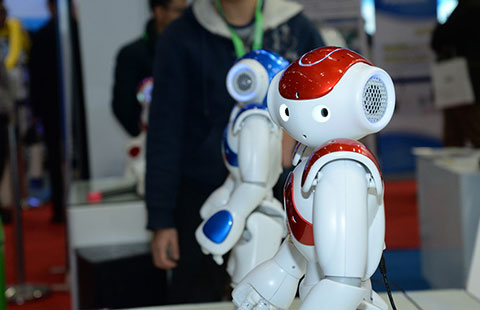
No business or government leader today would question that the Internet of Things drives growth, productivity and innovation. Like the industrial revolutions before it, the Internet of Things is becoming a new driving force in the global economy.
Globally, nations are scrambling to seize the opportunities this new digital age promises, but for China, the task is particularly urgent. The economy has slowed down, productivity growth has dwindled, while competition at home and abroad has intensified. Many of the country's industries are keen to move up in the value chain and build up their innovation capacity.
China's government has, in response, introduced the "Internet Plus" strategy and the "China Manufacturing 2025" initiative, aiming to boost the country's competitiveness through the extensive application of digital technologies led by the Internet of Things.
Accenture research shows that, with additional measures to improve its capacity to absorb technologies and increase investment in the Internet of Things, China could boost its annual GDP by 1.3 percent by 2030, cumulatively adding $1.8 trillion to the economy by that time.
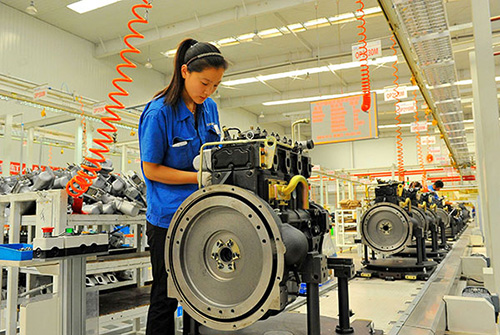
The research analyses the impact of the Internet of Things and reveals that manufacturing, public services and the resources sectors are most likely to gain from the use of the sector's niche technologies and business models. Together they account for over 60 percent of the Internet of Things' total cumulative impact on China's GDP by 2030, among which the top sector, manufacturing, can benefit by $736 billion with enhanced measures.
However, Chinese business leaders and policymakers cannot assume that the country will automatically enjoy strong economic growth thanks to the Internet of Things industry. To make such an expansion possible, China will need to significantly improve its capacity to diffuse the technologies used for the Internet of Things throughout its economy. In an international ranking of the strength of enabling conditions for the widespread use of the Internet of Things, China ranks 14 out of 20 leading economies.
By taking into account more than 50 factors that determine the Internet of Things' potential for economic diffusion in a given country, Accenture's analysis concludes that a number of factors are holding back adoption of the Internet of Things in China. A shortage of specialized talent is seen not only through a lack of core technology skills, but in the expertise required to transform traditional product offerings into more intelligent data-based services. A lack of integrated communications and IT systems and unclear data sharing policies prevent companies exchanging data to jointly deliver these intelligent solutions.
The advent of the Internet of Things could be a game changer for China and its industries. But without the right enabling conditions, that opportunity could be lost. The Internet of Things could ignite China's productivity growth and usher in a new era of global competitiveness for its industries. But this opportunity could be lost without the right enabling conditions. To ensure progress, China needs to close the gap in critical skills and infrastructure, promote cross-industry collaboration, and accelerate investment in the Internet of Things.
The author is managing director of Accenture Digital, Greater China.

Copyright 1995 - . All rights reserved. The content (including but not limited to text, photo, multimedia information, etc) published in this site belongs to China Daily Information Co (CDIC). Without written authorization from CDIC, such content shall not be republished or used in any form. Note: Browsers with 1024*768 or higher resolution are suggested for this site.
License for publishing multimedia online 0108263 Registration Number: 130349