 |
|
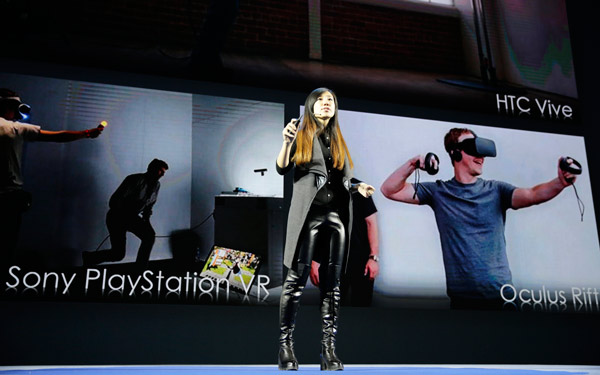
Tencent Holdings Ltd unveiled its virtual reality plans at its annual technology summit in Beijing in November. [Photo/Provided to China Daily] |
Technology companies are betting on clunky goggles or headsets, which symbolize the virtual reality or VR technology, to be the next big thing, as influential as the smartphones. And they may well be riding the right horse.
VR will likely gain impetus this year. Many top-tier vendors are expected to launch their first-generation products.

On Christmas Eve, LeTV Holdings Co Ltd released its first VR device Cool 1, a 149 yuan ($22) headset that requires a smartphone to be attached in front. It creates a three-dimensional or 3-D digital world through a pair of lenses.
Ablikim Ablimit, strategic vice-president of the Beijing-based company, said LeTV is heavily invested in development of VR devices and will try to include more partners to make hardware as well as video content.
"LeTV aims to build a platform for all companies involved in VR technology. We will focus on integrating the industry's resources so our partners can make profits," Ablimit said. He did not disclose the size of LeTV's investment in VR.
The VR headset provides users with a stereoscopic display, with two marginally different images rendered, one each for the left eye and the right eye. It allows users to experience depth. Armed with motion detection sensors, the user is able to look around in this panoramic digital environment.
A day before the LeTV announcement, Internet giant Tencent Holdings Ltd gave the world a peek into its VR strategy.
The Shenzhen, Guangdong-based Tencent, a top online games producer, said it will launch its first VR device in the July-September quarter this year. The owner of a long list of popular software products, including the instant messaging app WeChat, had never rolled out a hardware product.
Tencent said it will mainly provide software support. It will give out a free software development kit in March so startups can build their own products using Tencent's technology.
Taiwan-based mobile company HTC Corp is also betting on VR headsets after its smartphone sales slumped in 2015.
Global tech giants have also invested in VR. Facebook Inc bought VR firm Oculus for $2 billion, Google Inc invested $542 million in another startup Magic Leap, and Microsoft Corp is developing its own high-end device named HoloLens.
Huang Xiaojie, CEO of the Beijing-based VR products company Beijing Mojing Technologies Co Ltd, said the entry of big players will significantly boost the VR market. "The market remains in its infancy and needs big brands to lure customers."
He said tech giants are developing sophisticated VR equipment that can be connected to computers. Mojing is betting on inexpensive mobile devices in the hope that it will gain a wider user base.
Research firm Digi-Capital estimates the global VR industry will generate $30 billion in revenue by 2020, with VR games accounting for nearly half of it. Hardware, films and theme parks rooted in VR will generate the other half.
According to another research firm Tractica LLC, worldwide (excluding China) VR revenue this year will likely be close to $500 million, mainly driven by demand for VR headsets, content, and content creation tools such as cameras from the United States, West Europe and Asia.
In China, the VR market is on track to generate 5.7 billion yuan ($880 million) in revenue, a nearly threefold year-on-year increase, according to iResearch Consulting Group, a Beijing-based research company.
It further estimated revenue is set to exceed 55 billion yuan by 2020 because of foreseeable demand surge. By then, the sector's size will likely be comparable to the early days of the smartphone market.
But, to harness the multi-billion-dollar potential, VR companies need to address a few issues, experts said.
First, technology needs improvement for commercial use. Current VR goggles cause a sick feeling or dizziness to users because of image delay and distortion. Many manufacturers acknowledge the problem and are developing updates.
Second, VR customers are going to need a huge amount of content, which no company is in a position to offer at the moment. Lack of adequate content will become the biggest obstacle in 2016. The VR technology is set to be widely adopted by video games and 3-D movies, but producing such contents is time-consuming.
So, some companies are moving to create VR content in right earnest.
LeTV pledged to bring VR movies, video games, educational material and sports broadcasting services to its users. Tencent is also looking to introduce VR video games.
Craig Foster, principal analyst of Tractica, said once the VR technology matures and costs come down, more sectors, including marketing, advertising, tourism and retail, will adopt it.

Copyright 1995 - . All rights reserved. The content (including but not limited to text, photo, multimedia information, etc) published in this site belongs to China Daily Information Co (CDIC). Without written authorization from CDIC, such content shall not be republished or used in any form. Note: Browsers with 1024*768 or higher resolution are suggested for this site.
License for publishing multimedia online 0108263 Registration Number: 130349