 |
|
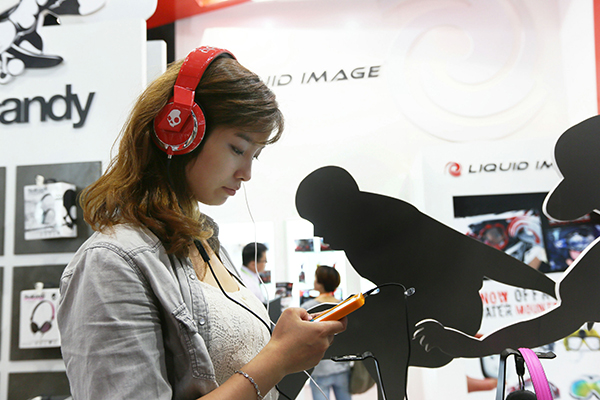
A woman views a wireless mobile charger video at a recent digital technology expo in Shanghai. [Photo/China Daily] |
Chinese firms are developing next generation wireless technologies to charge up mobile devices and electric vehicles
People who loathe carrying around messy smartphone charging cables can breathe easy. Soon, while driving, they will be able to use Chinese wireless charging technology.
Chinese firms are trying to commercialize their technology by applying it in automobiles. Their rationale is that people tend to spend a great deal of time in their cars and are always looking to charge their mobile devices.
"An in-cabin wireless charger for mobile devices is very likely to be a standard feature in cars in future," said Wang Zhe, 27, chief executive of Beijing InvisPower Technology Co Ltd, a developer of wireless charging solutions.
Wang first developed his interest in wireless charging when he did research at Massachusetts Institute of Technology as an engineering student of Tsinghua University. He later dropped out of the doctoral program at Columbia University to pursue his passion for providing wireless charging chips, solutions and "in-cabin" charging modules for automakers.
While the technology has the potential for diverse applications, experts said if in-cabin wireless charging proves to be successful, it will likely give the industry a lift and set a trend for wider commercial applications.
"This is a huge convenience feature for users. Customer feedback is strongly positive as the car is the third most common charging location after home and office," said David Green, a research manager for wireless power at IHS Inc, a US-based market consulting and information company.
"Clearly, this market is linked to the receiver market in mobile phones, meaning the technology chosen, and the adoption of in-cabin chargers, will increase along with the rise in adoption of wireless charging in mobile phone handsets," Green said.
IHS predicts that one in 10 handsets sold this year will integrate the wireless charging feature. The receiver shipments of wireless charging products had exceeded 140 million in 2015, which is increasing the number of automotive OEMs (original equipment manufacturers) that offer in-cabin charging solutions.
 |
|
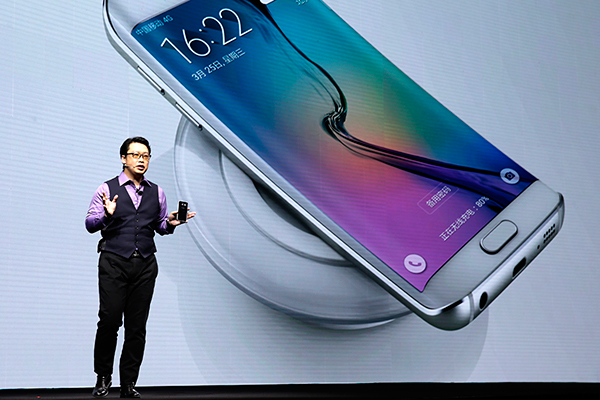
A Samsung Electronics Co Ltd representative speaks during the launch of its S6 Edge smartphone and its wireless charger device in the 798 art district in Beijing. [Photo/China Daily] |
"We're already close to shipments of in-cabin chargers exceeding 1 million per year and that will increase dramatically from 2017 onwards," Green said.
The convenience for vehicle drivers and market potential for in-cabin wireless chargers have allowed companies such as InvisPower to achieve initial commercial success in the automotive industry.
The company has successfully secured orders for in-cabin charging modules from Chinese automaker Brilliance Auto Group and JAC Motors Co Ltd.
Foreign auto brands such as Jaguar-Land Rover and Audi have also expressed interest in InvisPower's products.
"At present, foreign automakers tend to employ the products of our foreign rivals. But we are now challenging them with our reliability, quality as well as the cost advantage," Wang said.
Major car brands such as Cadillac, Jeep, Lexus, BMW and Audi have employed the in-cabin wireless charging feature for smartphones in some of their models.
There are more than 30 vehicle models worldwide that already have the technology, usually as an optional accessory, particularly in high-end vehicles, according to IHS.
"The automotive industry as a whole is incredibly competitive with a huge number of tier-1 suppliers able to design and produce in-cabin charging modules," Green of IHS said.
The wireless charging technology works on the principle of electromagnetic induction. Coils of wire create a magnetic field to transfer energy between two objects.
Despite the concept's appeal, the existing wireless charging technology has not become mainstream due to several technological obstacles such as distance restraint, relatively lower charging efficiency, interoperability of different technology standards and concerns about radiation.
Some industry experts said the existing wireless charging technology offers only a minor convenience for consumers as it allows users to avoid messy cables but still fails to really free up the devices.
Significant investments in research and development are being made by the major market participants that are focusing on improving the power transmission range to enable long-distance wireless charging and to expand its application base, industry experts said.
"If the technology manages to achieve a breakthrough first in the automotive industry, it will likely see faster growth and wider commercial application later," said Zhang Lu, a technology analyst at Huatai Securities Co Ltd.
Installation of wireless charging facilities at airports and railway stations has helped raise consumer awareness about the technology. So have built-in charging spots or mats for customers at shop floors of Starbucks, McDonald's and Ikea.
As the technology evolves, a more promising aspect of it could be that it may eventually be able to power up more demanding machines such as hybrid and electric vehicles.
Duan Yingsheng, an analyst at Founder Securities Co, said wireless charging for electric cars will be the next big commercial application of the technology.
German automaker Mercedes announced in May that its next-generation Mercedes S-Class plug-in hybrid electric vehicle will employ wireless charging technology. The company has partnered with BMW on the project and the vehicle is expected to be launched in the summer of 2017.
Other automakers such as Nissan, Toyota, Hyundai-Kia are also involved in developing wireless electric vehicle charging technologies. Companies such as Qualcomm Inc and WiTricity Corporation are the major players on the supplier side.
Going forward, technologies will seek to enable 'dynamic charging'-charging lanes that could power up electric vehicles in motion, industry experts said.


Copyright 1995 - . All rights reserved. The content (including but not limited to text, photo, multimedia information, etc) published in this site belongs to China Daily Information Co (CDIC). Without written authorization from CDIC, such content shall not be republished or used in any form. Note: Browsers with 1024*768 or higher resolution are suggested for this site.
License for publishing multimedia online 0108263 Registration Number: 130349