Innovation surges in Xiaomi evolution
 |
|
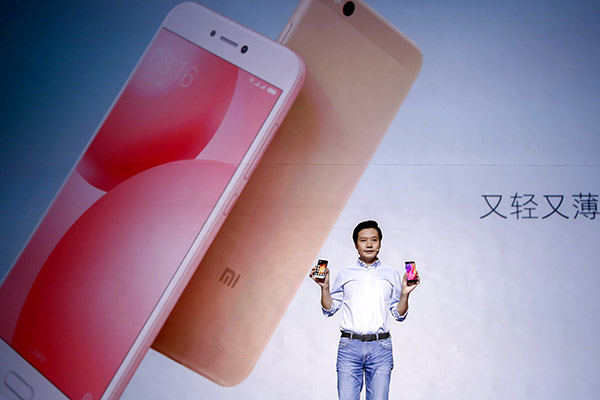
Xiaomi unveiled the handset Mi 5C in February, its first Surge S1-powered device. [Photo/China Daily] |
In 2014, Xiaomi Corp founder Lei Jun called the chip segment the "crown of the smartphone sector". Three years on, he has his own jewel in that crown - the Surge S1, Xiaomi's first in-house chip.
The technology tycoon has fond and vivid memories of a momentous instant that signifies Xiaomi's evolution from a smartphone major into a tech giant.
He recalls a night of September 2015 when, at 1:40 am, in a trial, the Surge S1 enabled the first call between a group of engineers and Lei. "My heart was surging with excitement at that moment. That's how the chipset got its name."
James Yan, research director at Counterpoint Technology Market Research, said though the Surge S1 is still at the entry level, Xiaomi's attempts to make inroads into the competitive industry highlight its determination to differentiate its products from a crowd of rivals and seek growth via innovation.
The pursuit of innovation was what drove the Beijing-based tech major back in 2014. It coasted on the stupendous success of its online-only sales model to establish a chip unit, Beijing Songguo Electronics.
It had figured out that reliable access to chips was going to be the key to success in the fiercely competitive smartphone market.
Today, Xiaomi is only the second Chinese smartphone major after Huawei Technologies Co Ltd to master chip-design technology.
 |
|
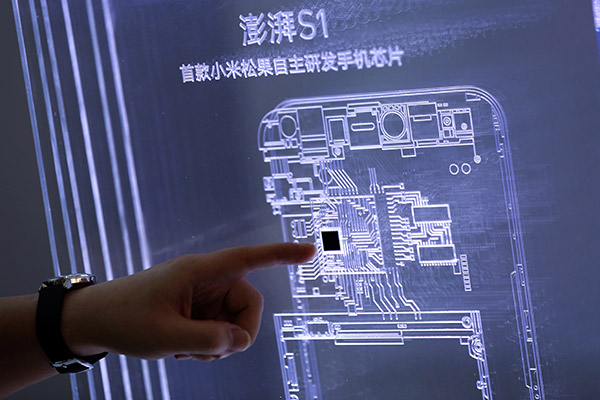
Xiaomi unveiled its first in-house chip Surge S1 in February in Beijing. [Photo/Xinhua] |
"Rapid technological advances in the past years shortened the research and development process and gave us a late-mover advantage,"Lei said in a recent interview.
When Xiaomi was mulling the chip unit, several experts had told Lei that it is a high-tech, cash-intensive business. R&D of chips alone would require 1 billion yuan ($147 million), and making a success of it would require at least $1 billion.
"If we want to challenge the world's top three players, we must devote long-time efforts to it," Lei had said then.
Xiaomi did just that.
After setting up Songguo in 2014, Xiaomi inked a technology transfer contract with Leadcore Technologies, a 100 percent subsidiary of Datang Telecom, a State-owned telecom company.
That partnership helped accelerate the R&D process."We have the smartphone shipment scale that can afford a bet on the chip business.We also have lured a number of experienced experts.That's our biggest advantage," Lei said.
Xiaomi's efforts paid off. It was able to launch its first Surge S1-powered smartphone Mi 5C in February. The 1,499 yuan ($218) handset put Xiaomi among global majors such as Samsung Electronics Corp, Apple Inc and Huawei that use in-house chips in their handsets.
At the March product launch, Lei said Xiaomi's nail-size chipset's sophisticated design allows more than one billion transistors to amplify and switch electronic signals.
So far, the company has poured more than 1 billion yuan into its chip business, partly supported by the Beijing municipal government.
The Surge S1 started as a middle-end chip and is positioned to compete with similar products of MediaTek Inc and Spreadtrum Communications Inc, all of which seek to balance devices' power and performance.
Yan of Counterpoint said Xiaomi needs to be on its toes. "It must delicately handle the relationships with third-party chip suppliers and be wary of any problems that may arise during the mass production stage, for Huawei's 10-year experience told us that the path to self-developed chips is by no means a smooth one."
The intensified push into the chip sector also coincides with Xiaomi's efforts to grow its technology patents. The company said it has so far obtained more than 3,600 patents.
Last year alone, it filed over 7,000 more patent applications, most of which will likely be approved in two to three years.