Opinion
What if you do raise yuan's value
By Wang Yiqing (China Daily)
Updated: 2010-05-13 07:53
 |
Large Medium Small |
After the US Treasury Secretary Timothy F. Geithner said the April 15 report on whether China manipulates its currency had been deferred, a section of the media began saying it was a sign of warming up of Sino-American ties and that the dispute over the yuan's exchange rate might be resolved peacefully.
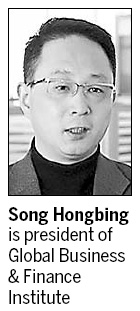
But for Song Hongbing, president of newly set up think tank Global Business & Finance Institute, there is no easy answer to the Sino-US dispute over the yuan.
As a grassroots economic observer who is active in the media now, Song became famous in 2007 for his popular book, Currency War. He says in the book that "bloodless currency wars" will replace military confrontations among the big powers. The dispute over the yuan is a typical currency war which, he says, proves his claim.
Song says the yuan's exchange rate is no longer an economic issue; it has become a political issue. But he doesn't agree with the simple explanation that the US is pressuring China to revalue the yuan merely because it is looking for a scapegoat for its huge trade deficit and high rate of unemployment. From 2005 to 2008, the yuan's exchange rate against US dollar has increased by 21 percent. But despite that America's trade deficit has increased. So a revalued yuan alone cannot solve America's domestic problems.
In the US, many low-end industries, such as textiles, have been outsourced to overseas destinations. And even if China reduces its exports to the US in these sectors, American companies will not produce these goods at home simply because the labor cost would be too high. "So it's obvious that China is not responsible for America's domestic problems," Song says.
The US has been saying that the "yuan is undervalued" because it has an ulterior motive. Or else, why has it ignored the analyses of a large number of economists that the yuan is not undervalued? What the US has done is selectively chosen some "theories" to support its stance. More interestingly, even in US' own analysis the yuan is not the world's most undervalued currency. "But the US has singled out China," Song says. "That's why I say the revaluation of the yuan is not merely an economic issue."
For the US, the yuan's exchange rate is only a tactical - or official - excuse that hides its real intention. "The currency war is a strategic game among big powers It's crucial and thus unavoidable."
The so-called "undervalued yuan" is only a virtual bargaining chip for the US in its game against China. It is actually aimed at forcing China to help the US overcome its Treasury bond crisis. Because of the huge financial deficit, matured bonds (including Fannie Mae and Freddie Mac's mortgage bonds) and interests that the US has to account for, its government's financing scale is up to $3.5 trillion this year. But it still has a financing gap of at least $1.5 trillion, which could hurt its economic recovery seriously. "That is the reason why the US has created a series of disputes across the world, including the one over the yuan." Song says that what the US "wants is to find someone to cover its huge financing gap".
In an earlier interview, Song has accused the US of being "the biggest currency manipulator". He argues that as a country which issues a global settlement currency, the US hasn't performed well and should take full responsibility for its failure. "It's akin to the US opening the sluice gates in the upper reaches of a river to resolve its financial crisis and leaving the countries downstream, including China, to fight the floods." To its advantage, "the countries downstream have always been passive and defensive on the issue".
Song says that forced or improper revaluation of the yuan could make China fall into the trap that Japan was once a victim of. A drastic revaluation may seriously reduce the existing yuan's domestic purchasing power and cause prices of domestic asset to skyrocket. The sectors to be worst hit by the price rise would be those doing business on credits and loans, such as the real estate industry. Song fears that could lead to economic as well as social chaos. Sky-high housing prices are already a top public concern in China. If the prices were to rise higher because of the yuan's revaluation they might spread public discontentment further and aggravate the social contradictions.
A revalued yuan may be able to check inflation, but the benefits can only be realized over a long time. In contrast, the yuan's revaluation would be equal to giving great momentum to speculators to cash out hot money which in turn would pose an immediate danger to the Chinese economy.
Song criticizes people who only talk about the advantages of the yuan's revaluation. He says their view is one-sided and they fail to see the whole for the part. The benefits to be gained from the yuan's revaluation can hardly offset the great damage it could cause to China. But he doesn't agree with the blind patriots, either, who compulsively disagree with whatever our adversaries say. They have to know that the game among big powers is complicated. He suggests instead that China consider adjusting the yuan's exchange rate as part of its overall national strategy.
To cope with US's pressure on the yuan's revaluation, China has to devise an optimal strategy at the bargaining table. "As the biggest creditor of the US, China deserves a meaningful negotiation." And the most important thing is to find out the real strategic intents and needs of each other.
On the currency policy, Song agrees the yuan's exchange rate should be basically stable on an adaptive and equilibrium basis. It would be a safe strategy for China at present, especially because the global economy hasn't yet recovered fully.
Once the world economy breaks out of crisis completely, China could consider raising its currency's value steadily but in a way that doesn't hurt its economy, because the yuan's revaluation is a precondition for the internationalization of the currency.
Though Song wants the yuan to become an international currency, he says its revaluation should be slow and unpredictable to preempt any serious harm that it could cause to the Chinese economy.