 |
|
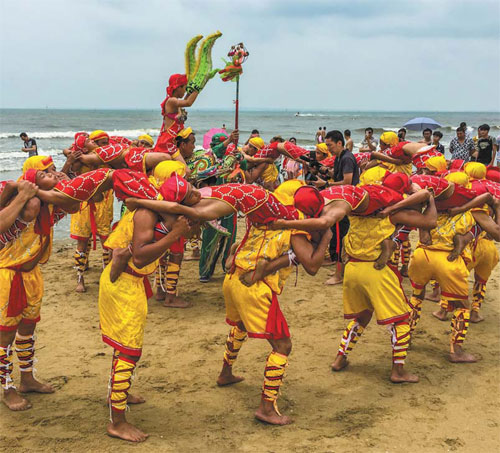
A ritualistic dragon dance is held at one of the beaches in Zhanjiang, reflecting the local tradition that has been passed down through many centuries. [Zhang Xiao / China Daily] |
In a year, 90 to 100 days are marked with thunder and lightning. Hence the place was named Leizhou, as lei means thunder.
Thunder's ability to also bring disasters, when it strikes people, animals, or buildings, was said to enhance its mystic power in the minds of Leizhou's ancestors.
Unlike Thor in Nordic mythology, there are many gods of thunder on the peninsula of thunder, each in charge of a different function. There is the division of yin and yang. The yang god dispenses cool rain and welfare to the public and the land, while the yin - or female - god is known for her unlimited power and precision in punishing evil deeds. Her way of penalty is said to be quiet and invisible, not thunderous.
Despite the myriad personifications of thunder, one person gained the reputation as the "ancestor of thunder".
Chen Wenyu was born in 570 AD in an age when China proper was embroiled in war and rapid change of dynasties. According to the original myth, a hunter with a nine-eared dog and a dozen villagers went on a hunting trip. The dog dug up a giant egg, which his owner brought home. The next day, lightning hit the egg and broke it in two. Out crawled a baby boy, each of his palms imprinted with the words lei and zhou, the name that has been associated with Zhanjiang for most of recorded history.
Chen grew up with both intelligence and physical prowess. In his adult years, he resisted the temptation to go into officialdom. Only after his father died and the Tang Dynasty (AD 618-907) stabilized did he agree to be the prefectural governor. The year was 631 AD and he was 61 years old.
Chen turned out to a great leader, caring for the people and giving his utmost to raise their living standards. When he died eight years later, there was such an outpouring of public grief that he was immortalized as a personification of thunder. He was also the first political leader of eminence who came from a local tribe.
In ancient China, the axis of power and culture was along the Yellow River. The further south one went, the more it would be regarded as a place of "southern barbarianism". The royal court would relegate officials who had fallen from grace to a remote place like Leizhou, where not only the inhabitants were viewed as less sophisticated, but even the wind and water were supposed to be poisonous.
Among these disgraced officials were some of China's greatest men of letters and words, such as Su Shi (1037-1101) and Tang Xianzu (1550-1616). It was a blessing in disguise, at least for Leizhou, which showered them with hospitality and is now home to a wealth of anecdotes and verses left by these literary icons.
In the past century, visiting dignitaries have also left their imprint. Some of them came up with descriptions of Zhanjiang that not only captured their own impressions but also distilled the essence of the place. When Deng Xiaoping visited in 1960, the then vice-premier was so impressed by its charms that he compared it to Qingdao, another coastal city that is a better-known tourist destination. Hence came the phrase "Qingdao in the north and Zhanjiang in the south".
In the same year, Premier Zhou Enlai flew down to Zhanjiang. The statesman, who had lived in France for five years in the early 1920s, noticed traces of French influence and so dubbed the city "Little Paris".
Down the centuries, Zhanjiang, or Leizhou Peninsula, has been a place of cultural confluence, with a mix of many indigenous tribes and their customs cross-pollinated with those of settlers from northern China and later from Fujian province. The major difference from modern mobility is, the early settlers might have moved there against their will, but nowadays people go there because they are attracted by the city's many charms, both natural and cultural.

Copyright 1995 - . All rights reserved. The content (including but not limited to text, photo, multimedia information, etc) published in this site belongs to China Daily Information Co (CDIC). Without written authorization from CDIC, such content shall not be republished or used in any form. Note: Browsers with 1024*768 or higher resolution are suggested for this site.
License for publishing multimedia online 0108263 Registration Number: 130349