The socks king of Yiwu
Updated: 2011-11-11 07:41
By Yan Yiqi (China Daily European Edition)
|
|||||||||||


|
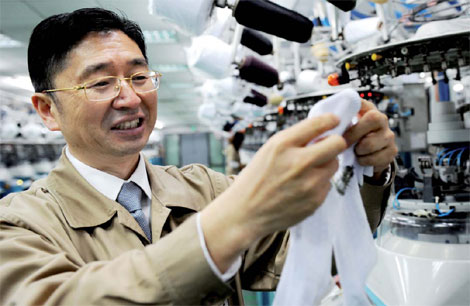
Weng Rongjin, president of Langsha Group, says that shortage of talent is the biggest problem for the Yiwu-based company. [Zhang Jiancheng / China Daily] |
Quality, perseverance helps Langsha stand tall among peers
With just a few days to go for Langsha's purchase meeting for the next spring and summer seasons, Weng Rongjin has his hands full as he sifts through the latest designs for socks to decide what should be included in the selection process.
As the president of Langsha, a multi-billion-yuan company, Weng has dozens of other important chores to perform, but choosing socks for the market still remains his top priority.
"We can be successful only if we are always in the first place. No matter how busy the work is, how hard the challenges are, one needs to be fully devoted to the job," he says.
It is that quest of being the best in the business that has and still spurs Weng and his company to be the best in the socks business.
"To me Langsha has no competition, except from ourselves," Weng says.
Langsha Group is currently the world's largest socks company in terms of production capability, with 8,000 socks machines imported from Europe and more than 10,000 workers. The company can produce more than 4 million pairs of socks every day.
Langsha was the first socks company in China to develop its own brand, and the first socks brand to advertise its products on television. It was also the first socks company to build a complete franchising system within China.
"The high-end socks market is dominated by European or Japanese brands, and most of the Chinese brands lack innovation. If we have to succeed, we need to work really hard on coming up with original designs and techniques," Weng says.
The company now owns more than 500 patents in the socks and underwear industries, and spends more than 3 percent of its annual sales revenue on research and development.
Currently, Langsha socks are sold in Western markets such as Belgium, France, Germany, Hungary and Italy, through more than 100,000 sales outlets.
"Weng and his brothers started the business by selling our products, but now we are far behind them," says Zhou Jiaxi, general manager of Guangzhou Dayong Thread.
"We have been working together for more than 10 years, and I really appreciate Weng for his brave approach," says Zhou.
Weng's brother Weng Rongdi says the key attribute to Langsha's success has been its uncompromising and unflinching attitude on quality.
"In 1996, during a brisk sales season, we discovered that several hundred thousand pairs of socks, worth more than 700,000 yuan ($110,000, 79,900 euros), had slight manufacturing defects. By saying slight, I mean, most factories would not even consider them as defects. But my brother burned all these socks in front of every employee," he says.
Langsha was essentially a family business set up by Weng and his two brothers in 1995. Among the three brothers, Weng Rongjin is the one who is often the most visible face of the company.
"He is a typical Libran, meaning he is good at dealing with internal and external relationships," says Fang Yi, executive assistant of Yiwu Socks Industry Association.
Weng is also the president of the socks industry association, and the two have worked together for several years.
"Though he is an extremely busy person, he always takes the time out to help me whenever I approach him with a problem," Fang says.
Weng is also a good boss to his employees. With the company currently in the process of moving out to a new building, he is currently working out of a temporary office space that affords him no privacy.
During most of his office time, he is not in his chair, but constantly talking to managers and signing the papers they hand to him.
"Langsha has been through so many ups and downs. But I want to assure my employees that their devotion to the company is rewarding," he says.
Regarded as a king in the socks industry, Weng says he is not satisfied with just making socks.
"No matter how high-end we position ourselves, the added value of socks is still very low. That is why I want Langsha to expand the industrial chain to other sectors, like the seamless underwear industry," says Weng.
The company, together with Itochu of Japan and Tefu Lan Company from Israel, has invested 240 million yuan to build a "China Underwear Industrial Park".
The park's annual output value has reached more than 640 million yuan.
But selling socks was not the first business that Weng was engaged in. As a native resident of Yiwu, where small commodities are sold everywhere, Weng and his brothers started doing business as early as in 1986.
They tried to sell Yiwu's artificial jewelry to consumers in the Xinjiang Uygur autonomous region. However, inadequate knowledge of the market saw them in the red to the tune of over 10,000 yuan. At that time, the annual salary of an average worker in China was no more than 400 yuan.
The setback, however, did not deter Weng. Instead it kindled in him the spirit to succeed.
"The biggest problem for Langsha, however, is shortage of talent," says Weng, especially as the company is entering a fast-growth phase and needs talent in all sectors.
"Yiwu is a small city, although we have a big market here. Most college graduates are not willing to come to such a small city, because they think Yiwu cannot offer them a prosperous future," he says.
As a Yiwu native, Weng has strong emotions toward the city, and he says he would never move his headquarters to bigger cities like Beijing and Shanghai.
"The Yiwu market is responsible for Langsha's success, and we will stay here for the foreseeable future," Weng says.