Leaders call for open trade in region
Updated: 2011-11-15 09:06
By Zhang Yuwei and Tan Yingzi (China Daily)
|
|||||||||||


 |
|
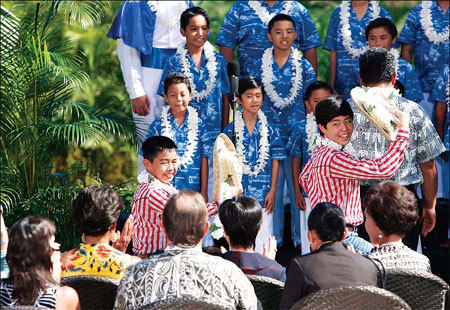
The Honolulu Boys Choir gives a performance to the spouses of Asia-Pacific Economic Cooperation leaders following a luncheon held at Kualoa Ranch, in Hawaii on Nov 13. [Photo/Reuters] |
HONOLULU - As the Asia-Pacific Economic Cooperation summit drew to a close on Sunday in Hawaii, leaders from the region pledged to promote "trade liberalization" and support clean energy.
Those policy goals, they said, will make it easier to provide for a stable world economy.
"In (Asia-Pacific Economic Cooperation) this year, we have committed to taking concrete steps toward a seamless regional economy, in order to link our economies and markets ever closer together, to the benefit of all," said The Honolulu Declaration - Toward a Seamless Regional Economy, a document posted on the summit's website.
Leaders at the event said, "Growth and job creation have weakened in many economies, and significant downside risks remain, including those arising from the financial challenges in Europe and a succession of natural disasters" in the region.
Even so, they pledged to fight protectionism and to hasten "the transition toward a global low-carbon economy in a way that enhances energy security and creates new sources of economic growth and employment".
The leaders said they will strive in the next year to develop a list of goods whose tariff rates will be reduced to 5 percent or less by the end of 2015. The goods are to be of the type that contributes to green economic growth and sustainable development.
The 21 members of Asia-Pacific Economic Cooperation also expressed concerns about an impasse faced by those who are trying to carry out the Doha Development Agenda, the semi-official name given to the latest round of trade negotiations being carried out by the World Trade Organization (WTO).
The group called on WTO members to take time at the organization's Eighth Ministerial Conference next month to throw their support behind an anti-protectionist pledge made by Asia-Pacific Economic Cooperation.
Talking about the declaration, Don Tapscott, CEO of The Tapscott Group and a participant in the CEO summit this week, said "it's a positive step that leaders recognize that there are significant risks ahead".
Both Chinese President Hu Jintao and US President Barack Obama spoke at the same event, which drew more than 600 CEOs from the Asia-Pacific region.
"The pledge against protectionism and in favor of a green economy echoed Chinese President Hu's five-year plan," Tapscott said. "I was also impressed by President Hu's commitment to an innovation economy, rebalancing trade, transparency and for China to play a stronger role in global economic governance."
He Weiwen, director at the China Association of International Trade's study center for China-US/EU, said Asia-Pacific countries' resolve to pursue green growth "will not only benefit the development of green industries that provide products that can protect the environment but also foster exchanges of green technology among members within the bloc."
By 2015, China plans to cut its use of energy for every 10,000 yuan ($1,574) of its gross domestic product (GDP) by 16 percent. That is expected to prevent the consumption of energy sources that are equivalent to 670 million metric tons of coal.
"Since the 11th Five-Year Plan period (2006-2010), China has taken effective measures to attain its goal of green growth, although the country is still in the middle and later stages of industrialization and of urbanization," Zhang Yansheng, a professor at the National Development and Reform Commission's institute for international economic research.
TPP on China's radar
Another topic of interest to members of Asia-Pacific Economic Cooperation has been the Trans-Pacific Partnership (TPP), a regional trade agreement that is still under negotiation. Among the countries that are studying it carefully is China, said Pang Sen, deputy director-general of the Chinese Foreign Ministry's department of international organizations and conferences.
China has no preference for any regional agreement and is open to any policy that will help speed up the Asia-Pacific's economic integration, Pang said.
The Trans-Pacific Partnership now concerns nine countries: Australia, Brunei, Chile, Malaysia, New Zealand, Peru, Singapore, the United States and Vietnam.
Meanwhile, leaders in the region are discussing two other trade agreements that have essentially the same purpose: the Association of Southeast Asian Nations plus China, Japan and South Korea (known as 10 plus 3); and the same association plus China, Japan, South Korea, Australia, New Zealand and India (10 plus 6).
At the 2010 Asia-Pacific Economic Cooperation meeting in Yokohama, Japan, leaders agreed that 10 plus 3, 10 plus 6 and the Trans-Pacific Partnership are all ways to move toward regional trade integration.
"This declaration shows a consensus among the members," Pang said. "There is no priority here."
"China holds an open attitude toward any initiative that will help lead to regional economic integration and has no preference for any agreement."
He said China merely wants whatever trade agreement that is reached to be "transparent and inclusive".
"The more countries that participate in the agreement, the more it can make a contribution to the region."
Xinhua and Bao Chang contributed to this story.