Rural credit bodies to seek foreign funds
Updated: 2011-11-23 09:55
By Wang Xiaotian (China Daily)
|
|||||||||||


HEZE, Shandong - As China continues the reform of rural credit cooperatives (RCCs), investment opportunities for foreign capital will increase, officials and analysts said.
|
 |
|
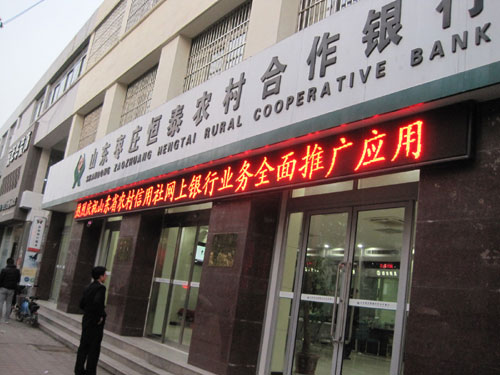
A passer-by stops at Shandong Zaozhuang Hengtai Rural Cooperative Bank, a transitional entity between a rural credit cooperative and rural commericial bank.[Photo/China Daily] |
"We expect more RCCs will be transformed into rural commercial banks after equity reform, and foreign investors are welcome to become strategic partners and make long-term investments," said Yin Youxiang, head of the rural financial service regulatory division of the cooperative finance supervision department of the China Banking Regulatory Commission (CBRC).
RCCs are local institutions that generally provide small loans to farmers, individual business owners and small local companies.
Calls for further reform of RCCs have increased as the rapid growth of emerging rural financial institutions - such as independent rural banks and lending companies - poses an increasing threat to RCCs' dominance of the rural market.
"RCCs acted like a catfish and stirred up the previous market structure. We must survive amid rising competition," said Song Wenxuan, deputy director of the China Banking Association and the head of the Shandong RCC Union.
In towns across Shandong province, where emerging institutions have their largest presence, RCCs only have about 20 percent of the market, compared with 50 to 60 percent in remote villages, said Song.
The Postal Savings Bank of China Co Ltd, which counts 24,000 rural outlets among its total of 37,000 outlets nationwide, could become a major rival for RCCs as it explores local business opportunities more vigorously, he said.
"It's time for RCCs to accelerate their development and deepen reform," said Yin Qing-min, head of the Juye RCC Union in Heze, Shandong province.
According to the Juye RCC Union's Yin, deposits, loans and profits of the credit union have more than doubled from the levels three years earlier.
"Maybe this is a phase in which RCCs dominate rural markets. But as farmers get richer and richer (and turn to bigger banking institutions), our market share will gradually decline," said Wang Chenxi, head of the Jiangsu RCC Union.
Zhuang Jian, senior economist at the Asian Development Bank, said there was great growth potential for foreign investors in rural banking and RCCs, but the ceiling of 20 percent on foreign holdings in Chinese commercial banks will limit their enthusiasm.
Before 1998, due to a high volume of non-performing loans (NPLs), many of the RCCs were technically insolvent. Since 1998, the authorities have injected about $4 billion into the recapitalization of the RCCs.
Many of these recapitalized institutions gradually became independent rural cooperative banks and rural commercial banks, which later opened to foreign investment and private capital.
At present, there are 183 rural commercial banks and 214 rural cooperative banks, according to the CBRC.
The first foreign investment in the sector was allowed in 2006, when Rabobank Group and the International Finance Corp - the private-sector arm of the World Bank - acquired stakes in the United Rural Cooperative Bank of Hangzhou Co Ltd.
The CBRC's Yin said that regulators have drafted a document encouraging all cooperative banks to transform themselves into rural commercial banks.
CBRC figures show that as of the end of 2010, the number of RCC outlets across the country stood at 77,000, accounting for 59.7 percent of all banking outlets at or below the county level.
The total assets of RCCs reached 10.6 trillion yuan ($1.67 trillion) at the end of last year, or 1.7 times more than in 2006. Outstanding loans tripled to 5.7 trillion yuan over the same period, with 68.4 percent related to agriculture.
The RCCs' NPL ratio declined by more than 30 percentage points to 7.4 percent from the 2006 level. The capital adequacy ratio, which was negative in 2006, stood at 8.7 percent at the end of last year.
Mao Hongjun, deputy director of the CBRC's cooperative finance supervision department, said: "Low returns, high costs and risks in the rural financial market have kept most RCCs in underdeveloped areas in the red for a long time."
- Chinese shares close lower after data release
- Passengers prepare for annual peak
- Home appliance sales in rural China up 66% in Nov
- Collective wage talks promoted
- Good things in store for Chinese life insurers
- Dotcom could fall into disuse
- Global supermarkets conquer China
- China's Nov CPI up 4.2%, PPI up 2.7%