Comments()
  Print
Print  Mail
Mail  Large Medium Small
le An artist has once again re-envisioned Hong Kong's iconic "red, white and blue" plastic fabric. His new line of merchandise helps people recover from mental illness to reintegrate into the mainstream of society.
On a recent rain-soaked morning, 42-year-old Stanley Wong sat in a backroom surrounded by mountains of bright red, white and blue fabric, preparing for a public crafts workshop. He wore thick black goggle-like spectacles. His salt-pepper hair was buzzed short with mustache and goatee neatly trimmed. He dressed in plain colors, grey shirt and black pants.
When Wong looks at Hong Kong, he sees a patchwork of red, white and blue plastic fabric. The woven polyethylene/polypropylene subtly pervades all strata of local society.
 |
|
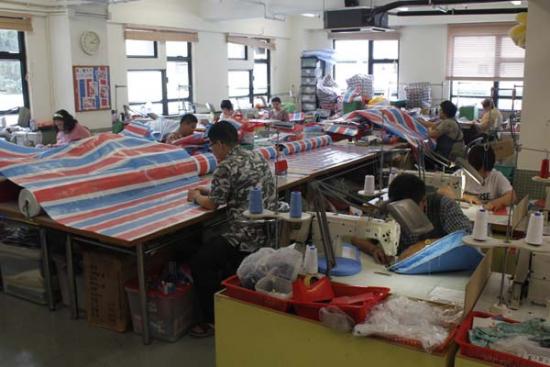
People recovering from mental illness are employed to create various items from the iconic fabric. They work in a multi-purpose facility Shek Kip Mei. [Doug Meigs / China Daily] |
For more than two decades, Wong has explored Hong Kong's relationship with the iconic woven plastic using his pseudonym "anothermountainman." He traveled the world taking documentary photographs and published a book reinterpreting the importance of the innocuous material.
"Everywhere (in Hong Kong) is red, white and blue," said Wong, a veteran advertising professional-turned-artist. "The character and personality of this material is part of the city. It's tough, durable, and possesses a 'never give up' attitude."
New Life Psychiatric Rehabilitation Association has embraced Wong's belief. The mental health organization opened a new boutique shop, known as RWB330 (short for red-white-blue 330), earlier this summer amid the bouquet-laden storefronts of the Prince Edward Flower Market.
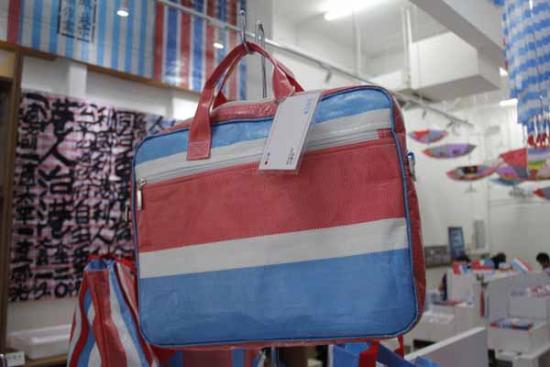
The store opening coincided with the launch of a RWB330 brand of merchandise. Wong designed the new product line for New Life. There are fashionable shoulder totes, t-shirts, tissue box covers and other items retrofitted from the quotidian tri-color fabric. People recovering from mental illness, under the association's supervision, have made each item by hand.
Wong's passion for the tri-color cloth began by chance. In 1988, he was visiting London for the first time, working on an advertising assignment. While exploring the shops of London's upscale Soho neighborhood, he discovered a mundane red, white and blue bag whose expensive price tag gave him a jolt.
"As a Hong Kong or Chinese person, I thought this belongs to us, but we never see it as something of value, then someone from overseas looks at it differently, appreciating it?" he mused. "We never care about what we have. I realized the importance of local relevancy from that moment."
The woven plastic fabric was first produced in Japan in only blue in the 1960s. The production technology later migrated to Taiwan, where the three-color mesh emerged, before factories on the Chinese mainland began producing it. Plastic sheets of the same type now come in a variety of colors and patterns.
Woven red, white and blue has become affectionately known as the Burberry of Hong Kong. The utilitarian bags hold special significance for many families. They would pack the bags with loads of gifts for relatives on the Chinese mainland. Even the bag was a treasured present in the decades preceding the nation's more recent economic good times.
Today, cheap plastic roller luggage has gradually replaced the woven bags crisscrossing the Shenzhen border stations. But the old bags are retained for daily use around the city, lugged around by elderly ladies, manual laborers and street sleepers.
Sheets of the raw material once covered the huge development projects that grew to become colonial Hong Kong's modern skyline. Such tarps still protect exposed beams, broken windows and idle machinery at scattered sites throughout the city (though green mesh netting has replaced the material on most large building projects), and throngs of tourists continue to haggle for knock-off handbags and trinkets beneath the all-weather protection of the plastic fabric at Mong Kok's Ladies Street Night Market hawker stalls.
Traditional red, white and blue bags sell at corner hardware stores for HK$10-20 dollars. Folding easily, they occupy storage space in most local homes. Wong said the sturdy fabric seems so commonplace that it's almost invisible to many residents.
During the past few decades, the all-purpose material has inspired major fashion labels (ranging from Comme des Gar?ons to Helmut Lang and Louis Vuitton), all of which created red, white and blue products that have sold for top dollar. Meanwhile, Canto-pop stars Anita Mui and Sam Hui both famously donned custom-made costumes of red, white and blue to embrace the fabric’s local identity.
Wong's work for New Life has helped to advance the fashion trend. Although his merchandise is moderately pricey — the most expensive item, an intricately stitched double-sided shoulder bag sells for HK $1,180 — his efforts were purely philanthropic, with all proceeds funneling back into funding for New Life's programs.
 |
|
New Life Psychiatric Rehabilitation Association has sold red, white and blue merchandise for five years. [Photo / China Daily] |
Copyright 1995 - 2010 . All rights reserved. The content (including but not limited to text, photo, multimedia information, etc) published in this site belongs to China Daily Information Co (CDIC). Without written authorization from CDIC, such content shall not be republished or used in any form. Note: Browsers with 1024*768 or higher resolution are suggested for this site.
License for publishing multimedia online 0108263 Registration Number: 20100000002731