|
Chip scandal hurts high-tech push
(chinadaily.com.cn/NYtimes)
Updated: 2006-05-15 09:27
Chen Jin became a national high-tech hero almost overnight, but his
easily-won fame fades quickly as his "breakthrough invention" -- computer chips
-- was proven to be a fraud.
|
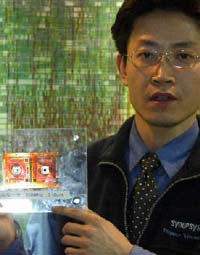
Chen
Jin, a leading scientist in the research of Hanxin computer chip series
for digital signal processing, was removed from his post as the dean
of Shanghai Jiaotong University.
| In 2003,
just three years after he returned to Shanghai from the United States with a PhD
in computer engineering, the then 35-year-old professor made a scientific
breakthrough: his team created one of China's first homegrown digital
signal computer chips.
The achievement was then hailed as a milestone for
China's rising technology industry. Chen was named one of the country's
brightest young scientists. He received a huge research grant from Beijing,
headed his own research institute and was named a dean at one of China's most
prestigious universities.
But on Friday, Jiaotong University, where
Chen and his team were based, announced that Chen faked his research.
He was fired from Jiaotong and stripped of his state honors and privileges.
University officials called his actions "despicable" and Beijing said he would
never again be allowed to do government research.
The disclosure has
turned into an embarrassment for Chen, Jiaotong University and the country,
which has been trying to lure talented scientists back from overseas in the
hopes of creating its own prestigious research and technology centers, according
to a New York Times report.
No longer content with being the world's
low-cost factory floor, China desperately wants to move up the economic ladder
and to show it can compete as a scientific and technological power.
The
country sent its first men into space three years ago; it is building its own
high-tech parks and 3G mobile technology. Internet companies are taking off
here.
In addition, Shanghai has been moving aggressively to develop into
a major center for microelectronic chips.
Few people symbolized the rise
of China's scientific elite like Chen, a charismatic young scientist who worked
for a multinational corporation and then returned home.
When he announced
the results of his research at a series of press conferences in 2003 and
2004, he smiled for the cameras and held up a glass-like plate bearing a new
family of Chinese born computer chips, dubbed "the Hanxin," or China chip.
Newspapers here called it a "breakthrough" that could help end foreign dominance
of the chip industry.
Then, last December, a former colleague - and, by
some accounts, a group of lab assistants - sent a letter or a series of letters
to the government. They said Chen's chips were fake. One of the so-called
whistleblowers even posted the allegations on the Internet. A few weeks later,
the government and Jiaotong University announced an the start of an
investigation, which ended with his dismissal Friday.
If Chen's team did
indeed create a fake chip, how they tricked a nation - and a large group of
scientific experts from the government and industry - is still unknown. Whether
Chen or members of his research team face criminal charges is also
unclear.
Reached Sunday by telephone, Chen declined to comment. He simply
said: "This is not the right moment to talk," the New York Times
reported.
People who know Chen, however, are perplexed.
"He was
really brilliant," says Yang Yunxia, a Microsoft employee here. "None of us can
understand this."
According to former colleagues, press accounts and his
own writings, Chen was born in coastal Fujian Province in 1968, along with a
twin brother. He earned a bachelor's degree at Tongji University in Shanghai and
then, in 1991, moved to the United States to study computer engineering at the
University of Texas at Austin. In 1998, he earned a master's degree and Ph.D. at
Texas while working at Motorola's Austin research center, he wrote in his
dissertation.
(For more biz stories, please visit Industry Updates)
|
| |
|
| |
|
|
|
| Most Popular Stories in 48 Hours |
|
|
|
|
