Forcing fast RMB rise will be lose-lose situation
By Wang Lijun and Zhou Shijian (China Daily )Updated: 2007-06-05 10:13
The authors Wang Lijun is associate professor at Capital University of Economics and Business and Zhou Shijian is an executive councillor at China Association of American Studies
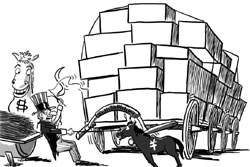
Clutching at yuan revaluation like a magic bullet, the US continues to press China for a major appreciation of the renminbi to narrow the US trade deficit with China.
The renminbi was a focus of the second round of the China-US Strategic Economic Dialogue (SED) in Washington last month.
The day after the meeting, President George W. Bush said at a news conference that whether the renminbi would be allowed to appreciate was of great concern to the US.
After the first SED round last December, US Treasury Secretary Henry Paulson made the point that the core issue of the China-US Strategic Economic Dialogue was the RMB exchange rate.
On February 7, Paulson told the Senate Banking Committee that, because of the growing US trade deficit, the Bush Administration had exerted all efforts to urge the Chinese government to quicken its renminbi appreciation.
It has been standard practice for several US administrations to press its trading partners to increase the value of their currency to reduce the US trade deficit.
During the 1970s, the US forced the Deutsche mark to appreciate. The result was appreciation from 4.2 marks to one dollar in the 1960s to 1.5 marks against the dollar in the 1990s, a 64 percent increase. Similarly, the US put pressure on the Japanese yen in the 1980s. The yen jumped from 263 against the dollar in February 1985 to 128 yen against the dollar in February 1988, up 51 percent.
Despite these major moves, the US trade deficits with Germany and Japan have continued to grow. In 2000, the US trade deficit reached $29.5 billion with Germany and $81.3 billion with Japan. In 2006, the U.S trade deficit increased to $47.8 billion with Germany and $88.5 billion with Japan.
The euro is another case in point. By the end of January 2002, one euro was equivalent to $0.86 and on January 1, 2006 it was equivalent to $1.29, an increase of 50 percent. Despite this, the US trade deficit with the euro zone rose sharply from $54.0 billion in 2001 to $91.5 billion in 2005, up 70 percent.
The competitiveness of a country's or region's trade is determined by many factors, not just currency exchange rates. It is a traditional and narrow-minded international trade philosophy to rely on the pressure of currency appreciation alone to reduce a nation's trade deficit.
As the world has developed and international trade has become increasingly complex, a traditional trade philosophy must be updated.
According to US statistics, by the end of 2006 the renminbi had appreciated
by 5.68 percent since the peg to US dollar was dropped in 2005. But the US trade
deficit in the first quarter of 2007 reached $56.9 billion, an increase of 35.8
percent over the $41.9 billion deficit in the first quarter of 2005. What this
means is that the appreciation of the renminbi has no effect on reducing the US
trade deficit with China.
| 1 | 2 | 3 |  |
(For more biz stories, please visit Industry Updates)