New homes, bluer skies
Updated: 2007-08-27 06:52
Isn't it a real bargain to renovate a decrepit building to make it seem like new at a comparatively lower price, especially in view of currently soaring housing prices? Furthermore, isn't it an even better bargain to retrofit old buildings for energy efficiency?
That is what the residents of the Tangshan pilot project of Energy Efficiency in Existing Building (EEEB), a Sino-German program, are rejoicing about.
The EEEB program is jointly operated by the Chinese Ministry of Construction (MOC) and German firm GTZ, with an overall budget of about 10 million euros ($13.55 million).
GTZ is an international cooperation enterprise for sustainable development with worldwide operations, commissioned by the German Federal Ministry for Economic Cooperation and Development.
The program, which began in 2005 and will run till 2010, may subsequently be extended.
"Unlike new construction in recent years, which can meet a higher energy-saving standard in accordance with the related laws and regulations, the buildings constructed in the past are generally energy inefficient and badly in need of repairs," said Xu Zhiyong, GTZ program director.
The project covers three buildings constructed just after the Big Earthquake in 1976.
Like many residential constructions in northern China, years of use and lack of repair had left the three buildings in the pilot project in the city in North China's Hebei Province in poor condition, with mold-mottled walls and heating facilities and loose doors and windows.
In winter, while temperatures outside averaged below 0 C, the average room temperature of the buildings in the pilot project could hardly reach 16 C due to inefficient housing techniques and ailing supply systems.
But the previously dilapidated buildings have undergone a dramatic transformation, thanks to the efforts of the EEEB work team.
"We are conducting a comprehensive housing renovation," Xu emphasized. The "comprehensive" renovation focuses on both exterior and interior conditions, seeking to ensure improved energy use and residents' comfort, he noted.
In this way, comprehensive retrofitting saves at least 20 percent of the costs that may otherwise be incurred through separate repair work on the buildings' exterior and indoor facilities.
Strengthened in structure and protected against further erosion with special construction materials, the buildings have become safer after the retrofitting project was completed in November 2006, according to Xu.
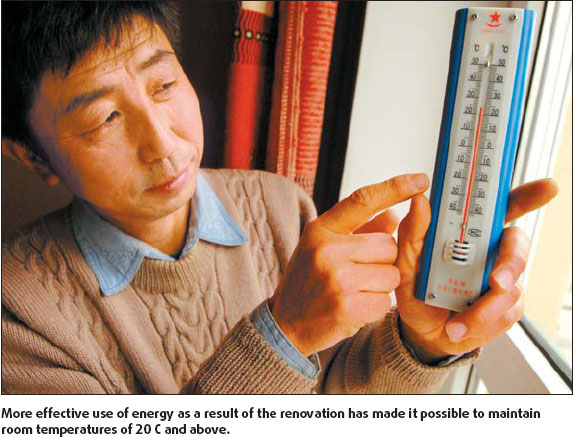
Meanwhile, redesigning heat and water supply pipes and the remaking of windows have helped raise room temperatures from under 12 C to over 20 C, Xu said.
Residents who were forced to wrap up in thick overcoats in their homes and suffered from the bitter cold can now relax in the warm and cozy atmosphere.
More heat reserved in the room ensures more efficient consumption of energy. EEEB has installed a temperature gauge and a control valve for every household heater, encouraging residents to make efficient use of energy.
Xu said that his team is conducting research on the effects of the project. Their findings show that energy consumption of the three buildings has dropped by more than 36 percent.
Xu is proud of his involvement in the EEEB program. "Our work is part of building a harmonious society," he says.
The success of the Tangshan project has triggered a wave of applications for similar energy-efficient renovations, and the city government has received several such requests from residential committees.
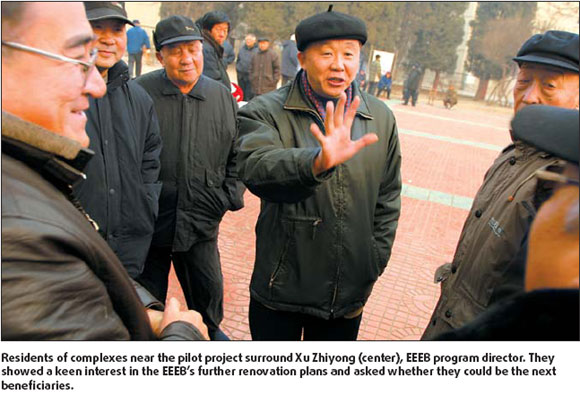
Xu said that residents of complexes near the pilot project surrounded him when he went on an inspection. They showed a keen interest in the EEEB's further renovation plans and asked whether they could be the next beneficiaries.
He particularly mentioned an old woman who wanted to have her home retrofitted so as to improve her conditions as soon as possible. "Every time I think of her longing expression, I feel motivated to work hard to expand the renovation projects."
Inspired by the success of the pilot project, the Tangshan city government is continuing its cooperation with EEEB, with 20 buildings listed in the renovation plan this year.
Another 100 buildings are expected to take on a new look both inside and out next year.
The Tangshan story has aroused the interest of other cities as well, including Beijing, Tianjin, Hebei, Harbin and Urumqi. Some of them have signed agreements with EEEB on renovation of existing buildings, Xu said, adding that the MOC is impressed with the Tangshan project and has called on the authorities of the 14 northern cities to visit the Tangshan buildings.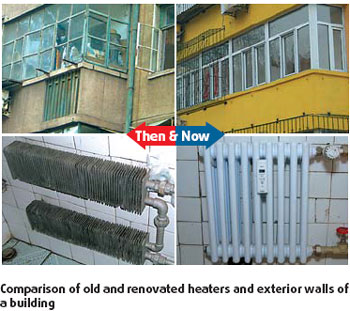
He noted that Germany has decades of experience, leading-edge technologies and rich managerial expertise in mass building renovation.
As an arm of the German firm GTZ, EEEB has an advantage in leveraging German experience in this field across its retrofitting projects in China.
Emulating a German real estate firm, EEEB made a thorough survey of information related to every family and asked for their specific requirements for the renovation.
Xu cited the baseline research as an example to illustrate how his team coordinated in the Tangshan project.
For instance, EEEB's staff produced different window models in advance and presented them to the residents to demonstrate what kind of window was best suitable for living comfort and energy efficiency.
Their tailored services were key to the smooth progress of the project, Xu said, noting that the residents' needs should be considered in future renovation projects as well.
Research shows that energy consumption in the building sector accounts for 27 percent of the total energy use in China, said Xu.
He noted that there is an estimated 6.5 billion sq m of urban residential construction area in the north of China, one third of which was built in and between the 1960s and the 1980s, and is in need of repair.
Integrated retrofit of domestic buildings in the northern of China is estimated to result in savings of 38 million tons of coal per year, equivalent to carbon dioxide savings of 105 million tons per year.
The Sino-German program EEEB has a significant impact on improving the air quality in China.
(China Daily 08/25/2007 page10)
|
|