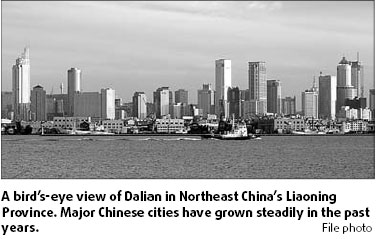
In the last five years China's cities have grown in size and economic power, driven by the accelerated industrialization process, a National Bureau of Statistics (NBS) report said yesterday.
The country had 661 cities in 2006, and 287 were at the prefecture level or above, an increase of 8 from 2002.
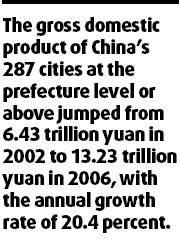 The gross domestic product (GDP) of the 287 cities jumped from 6.43 trillion yuan in 2002 to 13.23 trillion yuan in 2006, with the annual growth rate of 20.4 percent. The proportion of the country's overall GDP increased from 53.4 percent in 2002 to 63.2 percent in 2006.
China's "city belt" is becoming the power engine for the regional economy.
In 2006, cities near the Yangtze River Delta, Pearl River Delta and Bohai Bay area reported a GDP of 7830.5 billion yuan, accounting for 37.4 percent of the country's overall GDP. The Yangtze River Delta contributed 18.9 percent, the Pearl River Delta 10.3 percent and Bohai Bay area 8.2 percent. Per capita GDP in those regions was 37,819 yuan, 49,093 yuan and 32,036 yuan respectively, roughly 21,735 yuan, 33,009 yuan and 15,952 yuan higher than the national average.
Other city belts such as the Shandong peninsula cluster and the central China cluster also play an increasingly important role.
Due to the rapid industrialization process, economic power has gradually shifted from agriculture to industry and the services sector.
In 2006, the population of cities and counties totaled 577.06 million, accounting for 43.9 percent of China's overall population, 4.8 percentage points higher than 2002.

The urbanization figure for China's eastern, central and western regions last year was 54.6 percent, 40.4 percent and 35.7 percent respectively. Shanghai, Beijing and Tianjin have the highest score while Guizhou and Tibet have the lowest.
Meanwhile, economic structure has also improved since the 16th National Congress of the Communist Party of China. The added value of first, second and tertiary industries reached 458.2 billion yuan, 6.71 trillion yuan and 6.06 trillion yuan respectively, up 46.5 percent, 110 percent and 110 percent from 2002.
The proportion of the added value among these three industries was 3.5 percent, 50.7 percent and 45.8 percent in 2006. Compared to the structure of 2002, the proportion of first industry was down 1.4 percentage points, while the second and tertiary industries saw an increase of 1.1 percentage points and 0.3 percentage points.
Cities' rapid development was also demonstrated by improved traffic infrastructure, enhanced postal and telecommunication systems and better environment.
In 2006, city highways could carry 18.1 billion people and 14.4 billion tons of cargo, an increase of 21.6 percent and 37.7 percent respectively from 2002. Passenger transport capacity at railways reached 1.32 billion, and cargo capacity hit 3.12 billion, up 25.1 percent and 44 percent from 2002.
By the end of 2006, Chinese airliners could reach 140 domestic cities and 91 international cities in 42 countries. Airline passenger transport capacity hit 226.2 million, while cargo capacity reached 6.56 million tons, a jump of 120 percent and 110 percent compared with 2002.
Postal and telecommunication services have been among the most rapidly growing sectors of China's fundamental industries. In 2006, the telecommunication business in cities totaled 414.2 billion yuan, up 44.8 percent from 2002. Ownership of telephones and mobile phones among city residents jumped from 32.2 and 38.9 percent in 2002 to 49.2 and 80.5 percent in 2006. In 2006, urban mobile phone users reached 295.87 million and international Internet users topped 55.2 million, up 130 percent and 63 percent respectively from 2002.
Mobile networks covered most of China's cities and counties, and China Mobile has launched roaming business in over 200 countries and regions.
As China's economy roars ahead, environmental improvement has become the top priority for many cities.
By the end of 2006, cities at the prefecture level and above had parks and greenbelts of 250,000 hectares, or 6.8 sq m per person.
Local governments increased their investment into infrastructure facilities for environmental protection. By the end of last year, China had 814 sewage plants, with daily wastewater processing ability hitting 63.1 million cubic meters. Around 20 billion cubic meters of wastewater was processed by cities last year, up 6.6 billion cubic meters from 2002.
Among 559 cities monitored by the State Environmental Protection Administration, 24 cities (4.3 percent) were placed in the top rank in terms of air quality, 325 cities (58.1 percent) belonged to the second tier and 160 (28.6 percent) were listed as third level.