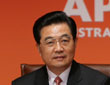
Yuan Guisheng is Party chief of Longmen Village of Hejing City. Over the past decade his leadership has brought sweeping changes to the village.
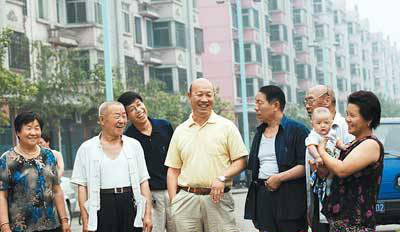
Yuan Guisheng, center, talks with residents in a community in this undated photo. [china.org.cn] |
Since Yang took over the role of Party Secretary in 1996 his business acumen coupled with good common sense has brought real economic progress to the village.
This is just a small village of some 3,500 residents. China's countryside may be lagging behind the booming city economies elsewhere but Longmen has become an economic legend with an output of 1.28 billion yuan (about US$0.17 billion). What's more, it raises 70 million yuan (about US$9.3 million) in annual tax revenues. Per capita taxes are some 20,000 yuan (about US$2,650) a year with net per capita income running about 18,000 yuan (about US$2,380).
For generations the people of Longmen (it means Dragon Gate) have struggled in a tough natural environment trying to lift themselves out of poverty. They must have wished for the magic of the dragon gate for themselves. In China's rich mythology that humble fish, the carp, could be magically transformed into an illustrious dragon if only it could manage to jump over the dragon gate.
Back in 1996, they had high expectations of their newly elected secretary. He was considered to be a man of experience who would bring the right mix of management capability and integrity to the post. They were not to be disappointed for he never let them down. Within his first year and a half in office the enterprises collectively owned by the village were already 500,000 yuan (about US$66,000) better off.
Yuan wants all of the villagers to benefit from the projects launched by the village. Instead of borrowing from the banks he urges the villagers to pool their money. Shares in the projects have become extremely popular.
In his approach to wealth creation, the emphasis is not just on making the cake bigger. For Yuan the emphasis has been to ensure that the poor get their fair share of the slices.
Under his auspices, the village committee decided to set a ceiling of 10 shares for each villager. As for those who couldn't afford even one share, the village committees distributed two shares each when the 700,000-ton coking factory project was launched in 2004. The necessary funds of some 21 million yuan (about US$2.8 million) came from the village's collective revenues from the year before.
These shares have been acclaimed by the villagers as a veritable fountain of wealth. Today the villagers are no longer peasants. They are shareholders entitled to bonuses each year. It is estimated that the total share value amounts to 120 million yuan (about US$16 million) and there are annual bonuses of up to 12 million yuan (about US$1.6 million).
Today Longmen is not just a workshop but one that is based on environmentally-friendly recycling practices. The old small inefficient and highly polluting factories have been culled. A new spectrum of industry has taken shape that encompasses finely washed coal, coking, electrolysis for aluminum production, electricity generation, construction materials, transportation and tourism. Assets have risen to 600 million yuan (about US$80 million). Annual outputs have reached 1.5 million tons of finely washed coal, 1 million tons of coke, and 60,000 tons of aluminum by electrolysis. Electricity generation capacity is now 2.7 megawatts.
"Our institutions are designed to encourage everyone to maximize their wealth while ensuring that no one is left behind," says Yuan.
The decision-making and administration of village affairs are subject to public scrutiny. Yuan believes that being able to earn the trust of the people is the ultimate productivity measure.
"Our administration is democratic, so that people are not only fed but can also be heard," said Yuan.
Yuan's catch phrase is, "People have the final say as to where their interests lie." People are consulted for each and every decision. Big issues are decided only after four steps have been worked through. First a plan is drafted. In the second step the drafts are gone through at both the Party Members' Meeting and the Village Meeting. Thirdly, the plan is publicized and the villagers' opinions are solicited. Then the final decision is made by the Party and Village Committees.
Professor Huo Guoqing speaks highly of this practice that has been followed and institutionalized over the past decade. He says, "For some other villages that have left poverty behind, it has been easier to feed people than to give them a say."
Over the past ten years, some 130 Party Members and aspirants have met on the eighth day of each month. The meetings are held to discuss the latest policies and village affairs generally. Experts are invited in to give lectures.
What's more, here there is an additional novel level of transparency and public accountability. Once a project is completed, the project supervisors and public representatives get to appear on the village TV show. There they have to account for every penny spent.
The Longmen of 10 years ago is now just a distant memory of simple mud brick buildings, barren land, and labor exodus. It is now a village with neat well-lit streets, school buildings with advanced facilities. There are awards for excellent teachers, and scholarships for students going on to higher institutions. About 42 percent of its territory is now green. Eighteen new apartment buildings now house 97 percent of the village residents together with some of the migrant employees. Ten types of fees and charges such as school fees, water bills and maintenance fees have been scraped.