|
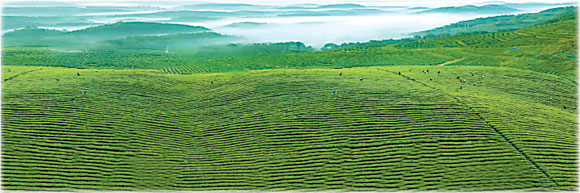
A magnificent tea garden in Guizhou. Climate, soil and low pollution combine to give Guizhou its unique edge.
|
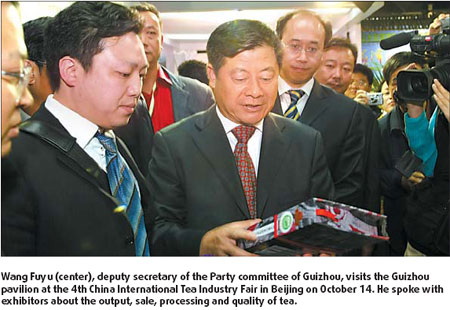
Guizhou in Southwest China is determined to cultivate its tea sector into a pillar industry by accelerating the development of the tea gardens, said Wang Fuyu, deputy secretary of the provincial committee of the Communist Party of China.
As part of its efforts, the province has issued a set of Suggestions on Accelerating the Development of the Tea Industry this year to help build the province into a high quality green tea raw material base, a processing center as well as an important production base for green food tea and organic tea, Wang said.

According to Wang, the province boasts great potential for the development of the tea industry.
A survey has shown that Guizhou has about 7.5 million mu (15 mu=1 hectare) of land suitable for growing tea. Currently, the province only has an accumulated tea garden area of 1.2 million mu. This indicates that 84 percent of the province's likely tea cultivation area is yet to be utilized.
"We have planned to develop an accumulated area of 5 million mu of tea gardens by the year 2020," said Wang.
To this end, Guizhou will build 400,000 mu of new tea gardens every year during the 11th Five-Year Plan period (2006-10). During the 12th Five-Year Plan period (2011-15), the province will add 200,000 mu of tea gardens every year, while between 2016 and 2020, another 200,000 mu of tea gardens will be created annually.
With these measures, Guizhou plans to forge itself into a leading tea industry province in China in terms of production scale, quality and brand image, Wang said.
"To meet the goal, the province will both mobilize rural households to set up new tea gardens and guide companies to develop tea farms."
To speed up the process of building tea gardens in Guizhou, it expects various enterprises to help carry out its ambitious plans by introducing their capital, talent and technologies.
Guizhou currently has 800,000 mu of tea gardens with normal production capability. These gardens mainly rely on plucking spring tea and processing it. Summer and autumn are slack seasons for tea farmers when the tea harvest rate is less than 60 percent.
In 2006, the province had 1.14 million mu under tea cultivation. Total output of tea leaf was 24,000 tons with an output value of 650 million yuan. The figure shows a production rate of only 600 yuan per mu, far less than the national average of 1,140 yuan.
These statistics indicate that if the province wants to reach the country's average level, its output should be doubled, whereas it will have to increase production even further if it wants to reach the level of other leading tea producing provinces.
Broader market
Guizhou also has great potential for in-depth tea leaf processing. In recent years, domestic and international companies such as Wahaha, Coca-Cola and Nestle have entered the tea market. The tea-related drinks market is growing at a speed of more than 10 percent annually, blazing a new path for medium and low-grade tea leaves.
Elements extracted from tea leaf such as tea pigment and polyphenol are widely affecting people's lives. Products themed on tea such as toothpaste, soap and shampoo have won favor from consumers. Medicines and healthcare products made from tea polyphenols are also gradually gaining recognition. A new consumption trend favoring oil, tea powder, tea cakes, tea candy and tea food products is taking shape.
Guizhou offers unlimited opportunities for business in the tea sector, as in-depth processing of tea is yet to be fully developed there.
Investing in the tea industry in Guizhou will mean reaping the benefits of a long tea picking season, low labor costs and low coal and power prices. Tea leaves can be plucked for seven months in the province, with 40 to 50 days suitable for such harvest during spring, compared with only 10 to 20 days in many other places.
Guizhou's tea gardens usually close in late September and early October, some even going on till late December. This means tea farm work can be carried out almost all year round.
The province's low labor costs are also a chief draw, as it accounts for between 40 and 50 percent of the production cost of tea in the province. The average price of rural labor force in Guizhou is about 40 percent lower than that in the central and eastern regions of the country.
The province boasts the most abundant coal and power generation resources among China's tea-producing provinces. The price of coal is between 300 to 400 yuan per ton and the price of electricity is 0.5 yuan per kilowatt-hour compared with 700 to 800 yuan per ton and 0.8 yuan per kilowatt-hour respectively in the coastal tea-producing provinces.
(China Daily 10/16/2007 page24)