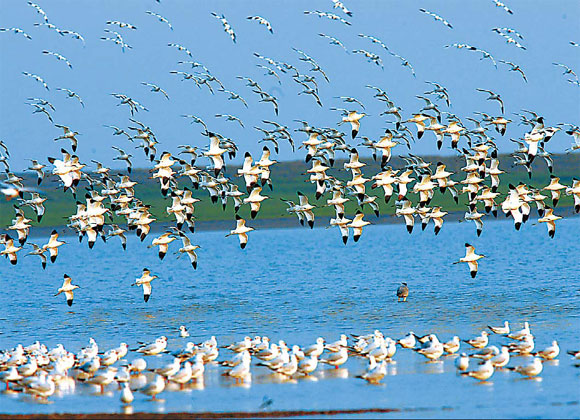
Fisher Mao Kequn had a fabulous time this summer watching jumping up and down in his pond. "Thanks to the government's efforts, my fish are no longer dying," he says.
Mao, who lives at the south bank of Dongting Lake in Hunan Province, could still remember the heartbreaking moment last June. All of his fish died within a couple of weeks due to polluted water from a nearby paper plant. He was so frustrated that he decided to drive a truck of dead fish to the local government and file a complaint.
"Now the water has been cleaned up, and I feel greatly relieved," he says.
Mao is only one of the 80,000 fish farmers at Dongting Lake, China's second-largest, located in the northern part of Central China's Hunan Province. In the past, pollution has had a huge impact on the local fishing sector, forcing many young people to pack their bags and seek work in other parts of the country. But his year, many of them came back when they saw that this vital sector was back on its feet.
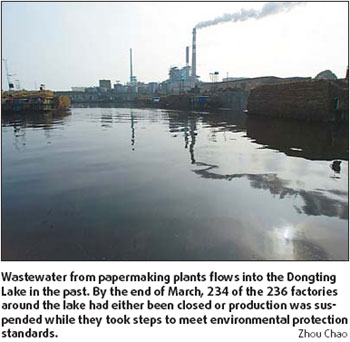
The change was a result of the efforts of the Hunan provincial government, which conducted a six-month campaign against the polluting paper plants. By the end of March, 234 of the 236 factories around the lake had either been closed or production was suspended while they took steps to meet environmental protection standards.
Since May, the water quality of Dongting Lake has improved by two grades, and pollution has been halved.
Changde Paper Making (Holdings) Co was one of the firms ordered to suspend its production as a result of the provincial government's campaign. The 40-year-old firm has spent over 62.5 million yuan on water treatment and alkali recycling. By the year's end, the firm, which has an annual production capacity of 50,000 tons of paper pulp, will be able to reach the local environmental protection standard.
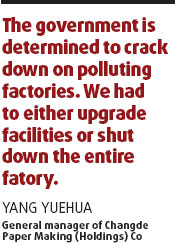
Company General Manager Yang Yuehua says: "The government is determined to crack down on polluting factories. We had to either upgrade our water treatment facilities or shut down the entire factory." Yang says the company could actually benefit from the environmental protection input. For example, the cost of the alkali recycling system can be recouped within three years.
Actually earlier in 1996 and 2000, Hunan provincial government took similar steps against polluting factories. However, the measures were not strict enough. Jiang Yimin, director of Hunan Environmental Protection Bureau, explains that local governments were afraid that cracking down on such factories would directly reduce the local tax income, therefore environmental protection officers did not implement the measures.
This time, the provincial government has named the mayors of the three riverside cities - Yueyang, Yiyang and Changde - as the first enforcers of this round of action.
Closing down or suspending production has resulted in 21,000 laid-off workers and has cut tax income by almost 400 million yuan. Provincial Governor Zhou Qiang held two high-level meetings discussing relevant issues, including offering credit and financial support to environmental protection projects, providing social security to laid-off workers, and allocating 50 million yuan to cities and towns hit by the loss in tax revenue.
The crackdown on polluting paper plants also had an impact on 150,000 reed farmers in the area. The provincial government has negotiated with Tiger Forest & Paper Group, a large State-owned firm, which will purchase reed from local farmers at a price no lower than that at the beginning of the year.
The province is currently assessing the papermaking industry in the vicinity of the lake district, in terms of raw material resources, environmental protection issues and market demand, and will later draw up a general development plan for the sector.
At the moment, less than 20 percent of the 234 closed or suspended factories have upgraded their facilities to reach the environmental standard. Most of the plants are shifting to other businesses, such as the construction materials business. In the meantime, laid-off workers are seeking other job opportunities. Li Xinyuan, who worked at Riyin Paper Making Co Ltd, subcontracted a 53,000-sq-m fishpond with some other partners. Fishing is also a promising business, he says.
Shutting down polluting paper plants has lifted Hunan's position in the nationwide environmental protection ranking. With regard to the gross discharge of chemical oxygen demand (COD), the province's position has improved from the 20th place last year to the eighth place in the first half of this year.
The province recently introduced new criteria on evaluating local government officials. Gross domestic product is no longer the main criteria, and instead saving energy and reducing pollutant discharges are the main factors when evaluating officials' achievements.
At the moment, the province has 29 cities, almost 60 percent of which do not have water-treatment plants. There are 72 counties in the province, and these have just two water-treatment plants among them. Municipal sewage will be the next issue to tackle.
There are so far five wastewater treatment projects in the province, which are due for completion by the end of the year. The province has called on every city to launch waste and sewage treatment facilities within the year.
Hunan provincial governmental is charting a new course in its economic development - promoting the modernization of industry, which means that all industries should make good use of modern technology to save energy and reduce pollutant discharges.
The government has set four bottom lines for industrial development: guarantee the total amount of farmland to stabilize food supplies; protect mountains and lakes, and further increase the forest coverage; save resources; and improve the welfare system in society.
The industry accounts for half of the province's economy, with the agriculture and service sectors accounting for one-third and one-sixth respectively. Hunan's industrial output stood at 266.78 billion yuan last year, up 16.8 percent year-on-year.
(China Daily 10/17/2007 page24)