BIZCHINA> Top Biz News

|
BIZCHINA> Top Biz News
|
|
Related
SMEs struggle to secure bank financing
By Wang Zhenghua (China Daily)
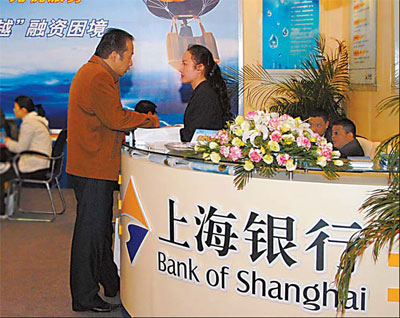
Updated: 2008-04-21 11:10 Standing in the pavilion of fancy booths at a recent banking fair in Shanghai that was promoting lending to small businesses, businessman Wu Puhua felt helpless. He had talked to 28 domestic and foreign banks there, but none showed any interest in lending Wu the 2 million yuan (about $285,714) he needed to expand the business of his small machine manufacturing company. Although many foreign banks have made lending to small and medium enterprises (SMEs) a centerpiece of their business strategy in China, companies like Wu's Shanghai Oucheng Balancing Machine still struggle to secure bank financing. "For small businesses like mine, nine requests out of 10 for funding will be turned down," says Wu. "All we can do is to tighten our budget and keep struggling. You just can't rely on bank financing to expand your business." A Bank of Shanghai booth at the 2008 Banking and Financial Services expo for small businesses in Shanghai. And this year, small businesses are facing even greater challenges as the government's tightened monetary policy put a stringent control on the loaning volume at banks, which frequently favor larger enterprises over their smaller counterparts. Small manufacturers relying on exports to United States are finding themselves in a particularly awkward position as the weakening US economy has slowed down the demand for China-made products - and banks are not there for help. According to the National Development and Reform Commission, China's macroeconomic policymaker and regulator, there are 42 million SMEs in the country, of which more than 95 percent are privately owned. Together they make up more than 99 percent of the nation's enterprises. They have contributed to 60 percent of the gross domestic product (GDP), about half of the country's total tax revenues, and provided more than three quarters of urban employment opportunities. Small company owners say banks are reluctant to make loans because they are often unable to provide valuable fixed asset guarantees, yet lenders stress small companies' information disclosure is insufficient. "Many banks stick to their old-fashioned principles and require property assets as mortgage," says Liu Fengzhi, deputy manager of a small-sized Shanghai grain and oil company. "They don't care how profitable your business is and the great potential there for the company's growth." The crunch has been particularly hard on smaller export players in the Yangtze River and Pearl River deltas. "Loans by commercial lenders will be scrutinized each month, compared with an overall check-up at the year end in the past," says Cai Xuefen, deputy head of SME lending business department at China Citic Bank's Shanghai branch. "You are not allowed to issue loans even though you suck in large deposits, because the loaning growth rate is tightly controlled by the government," she says. China's banking watchdog will seek to keep the number of new loans at the same level as last year and that means a smaller increase in percentage terms, says Liu Mingkang, chairman of the China Banking Regulatory Commission. The central bank made it clear once more on March 31 that it will maintain its tight monetary policy stance to keep inflation under control, despite a possible global slowdown that may drag down China's economy. The consumer price index (CPI) increased by 8.7 percent year-on-year in February, the biggest jump in nearly 12 years and well above the annual target of 4.8 percent set by the central government for 2008, driven mainly by an abrupt surge of food prices. Realizing that the tight monetary policy is likely to intensify SMEs' difficulties in getting loans from banks, the nation's banking watchdog has called for commercial banks to serve smaller companies, including by adjusting their loan structures. Dai Limin, an official with Bank of Communications' Shanghai branch, says her bank has recently separated its retail credit department, which focuses on personal and SME lending, from its corporate loan department to ensure better loan services for smaller businesses. "Traditionally, our mechanism led to a preference for large enterprises," she says. "When we have a tight credit quota, needs of large companies often have high priorities." But the bank has moved to show its support for SMEs by putting the retail credit department under the direct management of the bank's president, she adds, and by recruiting more staff. "The revamped department will be more conductive to business innovation and product designing, which will benefit SMEs a lot," she says. Lu Weijun, deputy general manager of SME credit department at Bank of Shanghai, underlines the necessity to abide by operating procedures, though he admits there is room for banks to improve. "If we could be flexible for whoever wants it, why do we need regulations?" the official says. As a city commercial lender expected to focus more on Shanghai's local businesses, he says his bank's share of SME lending is "not high". But he says the bank has taken measures to improve its SME lending. Beginning last year the bank has begun taking into considerations factors including SMEs record of tax payments, payments for public welfare projects and the personal credibility of SME owners. (For more biz stories, please visit Industries)
|
主站蜘蛛池模板: 柏乡县| 开鲁县| 黔西| 宜州市| 德兴市| 长兴县| 桂平市| 镶黄旗| 六盘水市| 沛县| 原阳县| 浦县| 萨嘎县| 泰兴市| 罗江县| 长葛市| 紫金县| 和静县| 岚皋县| 上蔡县| 台中县| 香格里拉县| 阿巴嘎旗| 南充市| 尚义县| 苍梧县| 石狮市| 宝鸡市| 白河县| 阳曲县| 乌什县| 河津市| 龙州县| 红原县| 乐清市| 峨边| 庆云县| 逊克县| 孝感市| 徐州市| 延安市| 玉龙| 巴林左旗| 巴林右旗| 安岳县| 迭部县| 武邑县| 屯昌县| 越西县| 闽清县| 肇州县| 疏勒县| 湖南省| 金塔县| 铜山县| 怀化市| 久治县| 兴和县| 静安区| 内黄县| 南陵县| 瑞安市| 广昌县| 潼南县| 浪卡子县| 都江堰市| 金湖县| 舟曲县| 宝丰县| 桑日县| 平原县| 哈密市| 易门县| 刚察县| 应用必备| 毕节市| 孝昌县| 疏勒县| 眉山市| 桐梓县| 依安县| 裕民县|