BIZCHINA> Center

|
BIZCHINA> Center
|
|
Shipbuilders grab more global market
(China Daily)
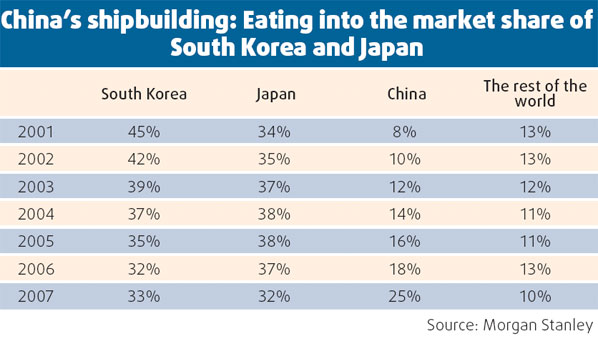
Updated: 2008-04-28 10:02 Success factors Researchers studying the Japanese and the South Korean shipbuilding industries suggest there are several factors that a growing market leader must have. The role of the government is very important with subsidies and general support and China's shipbuilding sector has enjoyed strong government support. In 2006, the State Council approved the long-term blueprint for the industry which set a target for the industry to comprise at least 25 percent of the world's total output by 2010 and 35 percent in 2015. But the development is better-than-expected. To power the goal, the Chinese government has already implemented several favorable policies to boost the sector's growth, including giving financial support by awarding special loans to shipbuilders and giving them preferential interest rates. In terms of technology, Chinese shipbuilders are also catching up with the South Korea and Japan. In 2005, the Hudong Zhonghua shipyard built the first LNG carrier in China. In 2007, China State Shipbuilding Corp delivered the first 8,530 TEU container ship, while Waigaoqiao shipyard delivered a 300,000 deadweight tonnage oil tanker. Industry observers expect a continuous upgrade of product mix with more high-end vessels being built. "We believe Chinese shipbuilders will become more competitive," says Hu. China will fully catch up in technology in a few years, he adds. China's shipbuilders also enjoy cheap labor costs, of course. The cost of shipbuilding in Japan and South Korea is 30-40 per cent higher than that of China, which makes China more competitive in the market. Challenges The key is to improve the industry's efficiency and productivity, say analysts. The efficiency of the country is about half of that of Japan and South Korea. Among the problems still plaguing the industry are: The ship design and supply chain are major bottlenecks and there is less cooperation among the country's shipbuilders which leads a slow diffusion of the technologies within the industry; Many older shipyards are not designed to follow the most-rational manufacturing process. The industry is slow to adapt new eco-friendly methods as manufacturers fear cost will rise. And the appreciation of the yuan is a potential threat due to weaker the industry's weaker earning capabilities. The situation also points to the industry's vulnerability to market and raw supply fluctuations. "The biggest challenge is how Chinese shipyards can improve their competitiveness," Hu says.
 (For more biz stories, please visit Industries)
|
主站蜘蛛池模板: 昌江| 大石桥市| 大兴区| 奉节县| 博客| 长治市| 长宁县| 吴旗县| 深水埗区| 建始县| 抚松县| 舞阳县| 桐城市| 岳阳县| 广昌县| 章丘市| 田林县| 哈巴河县| 临朐县| 合作市| 社会| 凤凰县| 余江县| 汶上县| 铜鼓县| 温宿县| 安吉县| 安康市| 宝应县| 三原县| 蛟河市| 兰西县| 集贤县| 甘孜| 襄垣县| 炉霍县| 东平县| 桦甸市| 门源| 桦川县| 哈巴河县| 星座| 法库县| 万年县| 宜春市| 且末县| 牙克石市| 济南市| 慈溪市| 启东市| 定兴县| 景宁| 福建省| 兴城市| 巴里| 隆德县| 涞源县| 县级市| 遂宁市| 浮山县| 永仁县| 定州市| 旌德县| 淳安县| 湖北省| 佛山市| 柳江县| 涡阳县| 嘉荫县| 华安县| 绥芬河市| 临夏县| 崇明县| 盐津县| 乐平市| 读书| 云和县| 抚顺市| 新疆| 文成县| 淄博市| 三明市|
