BIZCHINA> Wen's Lens

|
BIZCHINA> Wen's Lens
|
|
Related
Achin' to make bacon
By You Nuo (China Daily)
Updated: 2008-05-12 17:15
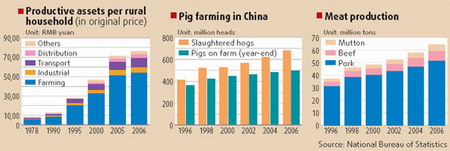
 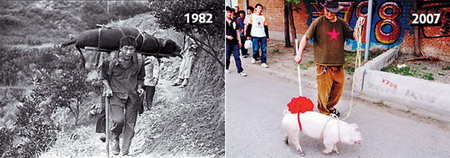 For more than 2,000 years, the China's heartland (south of the Great Wall) has not seen traveling herdsmen on horseback, as in the northern grasslands, where the land in the Yangtze and Yellow valleys have been entirely used for intensive farming. The predominant way to produce meat has been through household-based pig farming. But not just for family consumption. The most important use for raising one or two hogs used to be for their owners to sell them to the urban slaughter houses in order to finance the farming operations and to buy daily necessities. During the reform era, for many rural households the first pieces of farm machinery were earned by selling pigs. Indeed, the poorer a place was, the more its members had to depend on pig farming for any little change in their lives - even though selling a hog could be a great trouble, as our photographer has shown here from a picture he took on a reporting tour in the early 1980s of a farmer carrying his hog to a township fair from his mountainous village in Hubei province. It was commonplace in the Chinese countryside in those days. Except for a few urban pockets, most of China was still rural, and most of the residents were struggling hard just to feed themselves. Having a hog to sell might be just the one thing that could lift them from the subsistence level. Today, while the nation's demand for meat has been rising, at least a fair number of farmers have found other ways to make a cash income. Carrying hogs to the township fair is no longer the only way for rural households to generate cash, as funds from young men and women working in the cities has become a more convenient way help to their relatives in their home villages. From mid-1990s to 2006, their spending on productive assets, mainly farm machinery, had grew more than 170 percent, while the country's pork production, including that from large State-run farms, rose by 60 percent. At the same time, pig farming has become more dependent on feed supplies, and has been concentrated in just a few provinces, such as Shandong, Hunan, and Sichuan and bearing an increasing resemblance to an industry. In another 30 years, one can reasonably imagine pigs will disappear from most Chinese households - except, however, those being kept as pets. One of the nation's pioneering pet pigs was also caught by our photographer's lens, this time in Beijing's 798 Complex, a renovated industrial neighborhood for the city's modern artists and art dealers. How time flies, you may say. And so do pigs.
(For more biz stories, please visit Industries)
|
主站蜘蛛池模板: 罗江县| 芒康县| 西吉县| 综艺| 雷山县| 穆棱市| 杨浦区| 晋州市| 康定县| 库伦旗| 宁夏| 宾川县| 万源市| 武平县| 宽城| 如皋市| 达拉特旗| 西宁市| 宁德市| 察哈| 高邑县| 和田县| 台北县| 龙里县| 宝丰县| 内黄县| 七台河市| 孟津县| 永和县| 旬邑县| 阳高县| 长垣县| 白朗县| 连云港市| 博客| 东乌| 永年县| 天柱县| 富裕县| 昌宁县| 河池市| 青浦区| 宁强县| 贞丰县| 门源| 彭山县| 临澧县| 永胜县| 承德市| 沭阳县| 衢州市| 将乐县| 丹阳市| 龙海市| 彭阳县| 玉门市| 昭通市| 准格尔旗| 象山县| 星座| 曲麻莱县| 柯坪县| 滕州市| 清原| 靖州| 白沙| 于田县| 偏关县| 山阴县| 黔江区| 长武县| 宜章县| 临邑县| 壶关县| 肇庆市| 上虞市| 德钦县| 镇赉县| 珲春市| 横山县| 河北省| 凌源市|
