BIZCHINA> Top Biz News

|
BIZCHINA> Top Biz News
|
|
To raise oil prices or not, that is the question
(China Daily)
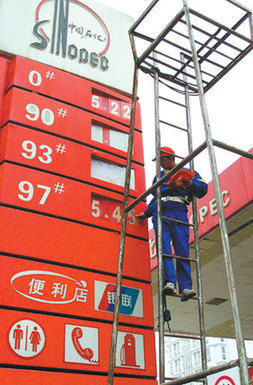
Updated: 2008-05-13 09:40 Diesel sold out. This notice can be seen at many gas stations in the country. Diesel has been in short supply again in a number of provinces and regions over the past few weeks, with Guangdong, Guizhou and Yunnan being the worst hit.
Han Xiao, who works for a private firm, drove from Beijing to Guangdong with his friends recently. He looked tired and upset after having had to wait for what seemed like ages at gas stations on his way to Guangdong. The experience made the journey in his Audi A6 TDI more like a burden, he says. "It seemed our journey could end anywhere on the way. We came across many gas stations that didn't have any gas." The government is in a dilemma because surging oil prices in the international market means it has to raise diesel and gas prices so that refineries continue to maintain their production levels. But any increase in prices is likely to jeopardize its efforts to curb the rising consumer price index (CPI), which was 8.5 percent in April. "China has been experiencing oil shortage recently with the price of crude hitting new highs," says Feng Fei, director of the Development Research Center's industry department in the State Council. The price of oil has risen at a rapid pace over the past few years, increasing fivefold from $25 a barrel in 2002 to $126 on Sunday. This means different results for oil-related upstream and downstream industries. The exploration sector has been making huge profits, while the refineries and some other industries suffer huge losses, says Chen Wei, an oil expert. Industries that depend on refined oil have been dealt a blow because of the rapid increase in prices. Among such companies is China's leading oil refiner Sinopec, and the country's textile, synthetic fiber, aviation and construction material production industries. "Domestic oil refiners have been losing money because they can't pass the high crude price to consumers," says Zhang Junsheng, a professor with the WTO research institute in the University of International Business and Economics in Beijing. The price of crude in China is linked to the world market, but refined oil prices are under government control. The government has adjusted oil prices nine times since 2005, with the last being in November, when prices of gas, diesel and jet fuel were raised by 500 yuan a ton. In late March, Sinopec got 27.3 billion yuan ($3.9 billion) in subsidies to tide over the losses it had incurred because of government price controls since 2005. But despite that, the sharp difference in the actual and market price of oil remains high. For example, the prices of gasoline and diesel in the international market are about 8,000-10,000 yuan and 7,000-8,000 yuan a ton, but in China they sell for about 5,980 yuan and 5,520 yuan a ton. "Low prices are dampening oil refiners' enthusiasm to produce more or to maintain their output levels", says Zhao Yumin, a researcher with the Ministry of Commerce. "Some enterprises, especially small private ones, have had to stop production to cut their losses because the more they produce, the more they stand to lose." Jiang Jiemin, chairman of China National Petroleum Corporation (CNPC), the country's largest oil producer, says the company's refining division could break even only if the international price falls to $66-67 a barrel. According to the CNPC, its refining and processing divisions lost 36.2 billion yuan last year, even though its exploration wing made a hefty profit. Sinopec's oil refining business, too, suffered "heavy losses" - up to 2,000 yuan for every ton of gasoline when the crude price was around $100 a barrel in the international market. So to what extent does international crude price make a difference in China? The country produced 186.66 million tons of oil last year (a growth of 1.6 percent over 2006), and according to Customs figures it imported 163 million tons of crude (up 12.4 percent). Since almost half of the country's oil is imported, we can gauge the impact that international crude price has on the economy. (For more biz stories, please visit Industries)
|
主站蜘蛛池模板: 密山市| 安龙县| 兴和县| 增城市| 汉中市| 长沙市| 沙雅县| 阿拉善右旗| 浦城县| 桃江县| 化州市| 游戏| 静乐县| 青海省| 富源县| 瑞昌市| 前郭尔| 南召县| 双峰县| 乌兰浩特市| 宕昌县| 鄂伦春自治旗| 西畴县| 海原县| 根河市| 德令哈市| 介休市| 鹤壁市| 大丰市| 松桃| 宁晋县| 社旗县| 晋宁县| 砚山县| 秦皇岛市| 巴彦淖尔市| 鄂伦春自治旗| 新郑市| 高唐县| 隆昌县| 永丰县| 肇源县| 文山县| 抚顺市| 钟祥市| 孟连| 万荣县| 大安市| 应城市| 彝良县| 伊宁县| 霍山县| 大埔县| 竹溪县| 内乡县| 根河市| 清镇市| 荃湾区| 永兴县| 雅江县| 乌兰浩特市| 麟游县| 百色市| 江城| 新和县| 怀来县| 荃湾区| 远安县| 满洲里市| 衢州市| 福州市| 台北市| 秦安县| 河间市| 谷城县| 桑植县| 资源县| 内黄县| 南岸区| 顺平县| 乡宁县| 虞城县|