BIZCHINA> Newsmakers

|
BIZCHINA> Newsmakers
|
|
Related
Boeing and China to compete and cooperate
(China Daily)
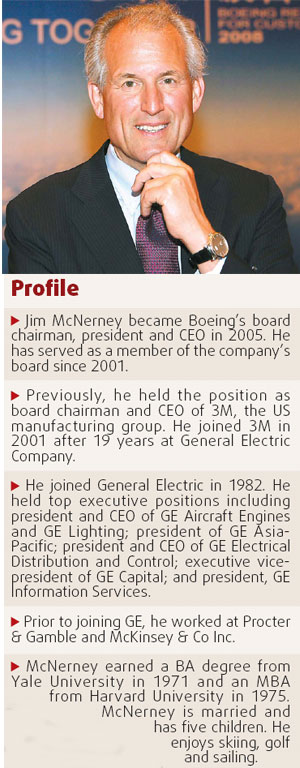
Updated: 2008-06-26 17:35 China ordered its first Boeing airplane in 1972, the same year that US president Richard Nixon made his historic visit to the People's Republic of China. More orders followed after 1979 when a strong relationship between the US and China was established. Today about 60 percent of China's fleet are made up of Boeing jets. Earlier this month Jim McNerney, board chairman, president and CEO of The Boeing Company, took a three-day visit to China. McNerney, 58, oversees the strategic direction of the Chicago-based, $66.4 billion aerospace company. He talked with China Daily reporter Lu Haoting about the development of the B787 project and Boeing's position in China's large airplane project.
Q: The first delivery of the B787 Dreamliner will be delayed until the third quarter of 2009. China ordered a total of 60 planes. When will Chinese airlines receive the first B787? How will they be compensated? And what is the impact of the delay on Boeing? A: The first delivery will be late next year. For Boeing the delay will have a financial impact - we will be making money later. We also have to work with the airlines to help them manage the delay of the B787, which will involve some costs. Every contract we have with airlines is different. But we usually find a mutually beneficial solution. We are working with the Chinese airlines right now to define that. It could mean a penalty, it could also mean helping with interim airplane capacity. Q: Boeing has outsourced an unprecedented large amount of work to its partners in the B787 program. So has Airbus in its A380 project. That has increased the risk in project management and both groups have encountered delivery delays. How do you see this problem? A: Global partnership is a good strategy. So we will keep implementing it. But looking back, we perhaps underestimated the difficulties in some of the partnerships we have and it took some our partners longer to get some things done. We will try to recover and learn from that. I think this represents start-up problems rather than fundamental problems with the cooperative model. Q: Boeing has a lot of industrial projects in China. Now China plans to build its own large airplanes. How will Boeing balance the role of being a partner and a competitor? A: First of all, China will have an entry in the large airplane market. China has experience in aerospace, both commercial and in the military. There is strong investment capability in China to build huge facilities that you need. There is a big aviation market here and a strong entrepreneurial capability in this country. If you put all these things together, China, more than any other country, except the United States and Europe, has the ability to get there first. Secondly, we feel confident of our ability to compete in a global market place. China is a huge market. So we might end up competing with China's airplanes for certain customers. But I think it is in China's and Boeing's best interest to have a fast growing aviation industry that will want more planes. I think it is synergistic. We can't be afraid of competition. China will be competing whether we help or not because they have the capability to build an airplane down the road. I would rather support the overall market and the overall capability of China. Both the Chinese airplanes and Boeing will benefit. And then, we will let the customers decide. Q: The last three years have been exceptional for Airbus and Boeing in terms of new orders. Last year, the two companies booked more than 2,800 orders. But Airbus has forecast a drop in new orders this year. What do you think about that? A: The credit crisis and soaring oil prices will probably have the greatest impact in the United States because the airline industry structure there is not strong. But outside the US we will see a smaller impact, but continued growth. So I think when it is added all together, we will see a moderate growth overall but not negative growth. We have a backlog of orders over the last five years that extend out for many years. I agree with the Airbus assessment that both of us will probably have fewer orders this year. But I still think we will get more orders than what we will be building.
(For more biz stories, please visit Industries)
|
主站蜘蛛池模板: 安达市| 铁岭县| 古丈县| 哈密市| 兴隆县| 牙克石市| 黎川县| 晋江市| 大洼县| 金秀| 玉环县| 辽阳市| 松阳县| 都兰县| 岳西县| 平利县| 涞源县| 大石桥市| 宁远县| 内乡县| 慈利县| 安义县| 定兴县| 乌鲁木齐市| 鹤岗市| 海南省| 元氏县| 巴林右旗| 青阳县| 长垣县| 襄樊市| 云南省| 甘洛县| 博兴县| 平湖市| 巍山| 宽城| 鸡西市| 洛扎县| 涟水县| 同德县| 潍坊市| 淮北市| 微山县| 浦东新区| 安丘市| 邹平县| 徐州市| 松溪县| 额尔古纳市| 遂川县| 乡城县| 桐庐县| 大石桥市| 古丈县| 东宁县| 四川省| 双城市| 南投县| 泰州市| 柳江县| 廊坊市| 丽水市| 陈巴尔虎旗| 阳山县| 前郭尔| 焉耆| 汤阴县| 高密市| 金乡县| 岳池县| 大埔县| 丹棱县| 武鸣县| 曲松县| 浮山县| 宁海县| 周口市| 宜春市| 大邑县| 天祝| 东港市|